









3 min read
Stop Writing to Your Audience’s Pain. Start Writing to Their Journey.
 Carly Ries
:
Feb 13, 2026, 6:00:00 AM
Carly Ries
:
Feb 13, 2026, 6:00:00 AM
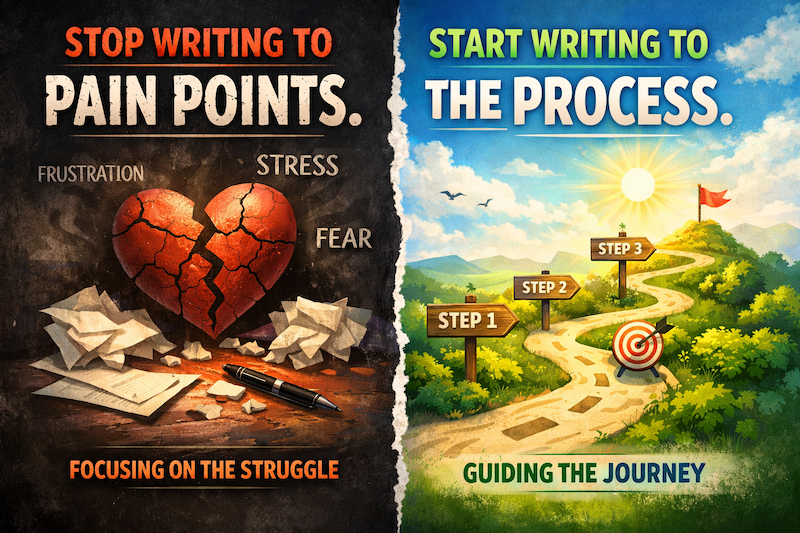
Let me guess. You’ve been told to “identify your ideal client’s pain points.” So you did.
You made a list. You highlighted the frustrations. You agitated the problem. You wrote the email.
And maybe it performed…fine.
But something about it felt flat. Or forced. Or overly dramatic.
Here’s why: Your audience is not walking around thinking, “Wow, I hope someone really pokes at my biggest insecurity today.”
And if you’re a solopreneur marketing to your specific niche, whether that’s busy parents, founders, executives, creatives, patients, couples, homeowners, or high-achievers, they don’t see themselves as “pain points.”
They see themselves as people in process.
And your writing should reflect that.
The Problem With Only Writing to Pain
Pain-based messaging assumes your audience is:
- Stuck
- Failing
- Desperate
- At rock bottom
But most people aren’t at rock bottom.
They’re:
- Trying
- Adjusting
- Researching
- Improving
- Iterating
- Balancing competing priorities
When you only write to pain, you accidentally flatten their experience. You reduce their whole journey to a single problem. And people don’t feel seen when they’re reduced. They feel marketed to.
The Shift: Speak to the Process They’re Already In
Instead of asking: “What hurts?”
Start asking: “What stage are they in right now?”
Because that’s where resonance lives. Your audience is somewhere between:
- Awareness → “Something isn’t working quite right.”
- Experimentation → “I’ve tried a few things.”
- Frustration → “Why isn’t this clicking?”
- Refinement → “I think I’m close, but something’s missing.”
- Momentum → “This is working. Now I want it sustainable.”
When you speak to that movement, your writing feels human. And human wins.
Example: Pain-Based vs. Journey-Based Messaging
Let’s say you’re a fitness coach.
Pain-Based: Sick of feeling overweight and out of shape? Tired of hating what you see in the mirror?
That works on paper.
But here’s the journey-based version: You’ve tried a few programs. You know what to do in theory. But life keeps getting in the way: work, kids, travel, exhaustion. You don’t need another extreme reset. You need something that fits your real life.
One shames. One understands.
Which builds trust faster?
Why This Matters for Solopreneurs Specifically
As a solopreneur, your business is relational. You’re not a giant brand with layers of distance. Your audience connects to you.
And when your writing feels overly dramatic, manipulative, or exaggerated, it creates subtle friction.
But when your writing says: “I see where you are.”
That’s powerful. Because most people don’t feel seen in the middle.
How to Tweak Your Writing to Speak to the Journey
Here’s a practical framework you can apply immediately.
1. Start With What They’ve Already Done
Instead of assuming incompetence, acknowledge effort. Instead of: “You don’t know how to manage your time.”
Try:
“You’ve tried planners. You’ve tried productivity apps. You’re still juggling more than feels sustainable.”
You’re not attacking. You’re recognizing.
2. Describe the “Messy Middle”
The most relatable place to write from is not rock bottom. It’s the middle.
The in-between. The:
- “I’m doing okay, but…”
- “This should be easier by now.”
- “I thought I’d be further.”
- “I’m close, but not consistent.”
That’s where real buying decisions happen.
Not in desperation. In desire for refinement.
3. Focus on Identity Shifts, Not Just Outcomes
People don’t just want solutions. They want to become someone. Your audience might want to become:
- A confident investor
- A present parent
- A consistent creator
- A respected leader
- A calm homeowner
- A disciplined athlete
When you speak to who they’re becoming, not just what they’re fixing, your writing carries weight.
4. Replace “Fix” Language With “Refine” Language
Watch for words like:
- Fix
- Finally solve
- Stop failing
- Avoid disaster
Replace them with:
- Strengthen
- Clarify
- Simplify
- Streamline
- Make sustainable
- Build consistently
The energy shifts from emergency to evolution. And evolution feels empowering.
What This Looks Like in Real Life
Let’s say you’re a financial advisor.
Pain-based copy: Worried you’ll never retire? Tired of financial stress?
Journey-based copy: You’re saving. You’re investing. You’re doing the responsible thing. But you’re not sure if it’s enough, or if it’s aligned with the life you actually want to live.
See the nuance?
You honor what they’ve already done. You meet them where they are. And you guide them forward.
How This Helps You Show Up Differently Online
When you write this way:
- Your emails feel less salesy.
- Your social posts feel more grounded.
- Your website copy feels more trustworthy.
- Your calls to action feel collaborative, not pushy.
And over time, that compounds. Because people start thinking:
“They get me.”
Not:
“They’re trying to sell me.”
FAQs
How do I write marketing copy that connects with my target audience?
Focus on your audience’s current stage, not just their biggest pain. Acknowledge what they’ve already tried, describe the messy middle, and position your offer as the next logical step in their journey.
Is it bad to use pain points in marketing?
Pain points are useful, but relying only on them can feel manipulative or exaggerated. Balancing pain with progress and identity shifts creates more trust and long-term connection.
How do I make my messaging feel more authentic?
Write as if you’re describing someone’s real life, not exaggerating their struggles. Use language that reflects growth, experimentation, and evolution instead of crisis and failure.