









19 min read
How She Went From Hollywood Writer to 7-Figure Solopreneur
 Carly Ries
:
Jan 20, 2026 3:17:34 PM
Carly Ries
:
Jan 20, 2026 3:17:34 PM
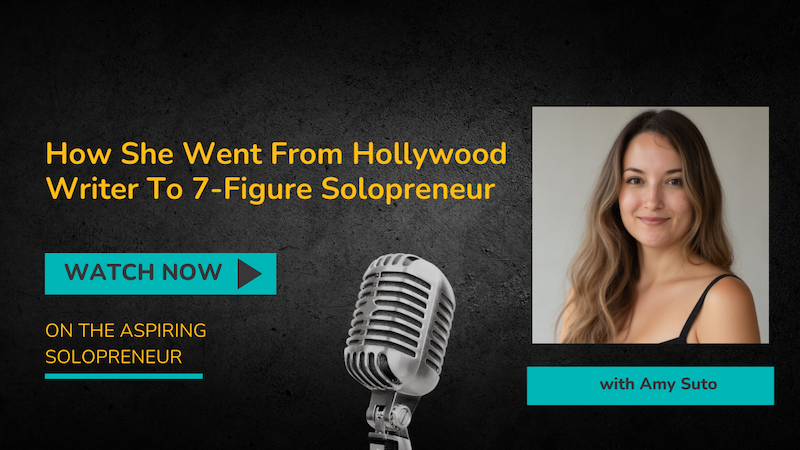
If you’re a solopreneur struggling with burnout, undercharging, or wondering how to build real income without sacrificing your energy, this episode is for you.
Carly Ries and Joe Rando sit down with seven-figure solopreneur and writer Amy Suto to talk about what actually drives sustainable success as a one-person business owner. Amy shares why energy management matters more than time management, how she transitioned from Hollywood screenwriting to building multiple income streams, and what finally allowed her to charge premium rates with confidence.
You’ll learn how to validate a side hustle before quitting your job, how positioning and portfolio matter more than credentials, why Substack is emerging as a powerful revenue stream for creators, and how to structure your content so clients can find you through Google and AI tools like ChatGPT. This conversation is packed with practical insights on pricing, identity shifts, inbound marketing, SEO, audience-building, and long-term business thinking for solopreneurs who want income and autonomy.
Like the show? We'd love it if you'd leave a 5-star review!
Connect with Amy Suto
- Visit makewritingyourjob.com
- Order Write for Money & Power
Favorite Quote About Success:
"Good writing is good thinking." - Paul Graham
Episode FAQs
How can solopreneurs avoid burnout when they’re responsible for everything?
Burnout often comes from mismanaging energy, not just time. Amy recommends doing regular energy audits to identify which clients, projects, and tasks energize you versus drain you. Solopreneurs who build their workload around high-energy activities tend to stay consistent longer, make better decisions, and grow more sustainably.
How can a solopreneur use Substack to build both community and income?
Substack is a platform for free and paid newsletters that allows solopreneurs to grow an audience and monetize their ideas without upfront costs. Amy shared that Substack works well because:
-
You can start for free and only pay a percentage once you earn
-
It supports organic discovery through Substack Notes
-
It allows creators to test ideas, build trust, and validate what people will pay for
-
It can become a long-term asset, not just another content channel
Her key advice: be clear on who you serve, what pain point you solve, and what content belongs free versus behind the paywall.
Why do so many solopreneurs undercharge, and how can they fix it?
Amy emphasized that undercharging usually stems from an identity issue, not a strategy issue. Solopreneurs often struggle to see their work as valuable because they’ve been conditioned to believe legitimacy only comes from corporations or credentials. Her advice:
-
Adopt the identity of a professional before you “feel ready”
-
Price for the value you deliver, not just time spent
-
Increase rates gradually as experience grows
-
Recognize that your energy, expertise, and problem-solving are premium assets
Being a solopreneur is awesome but it’s not easy. It's hard to get noticed. Most business advice is for bigger companies, and you're all alone...until now. LifeStarr Intro gives you free education, community, and tools to build a thriving one-person business.
So, if you are lacking direction, having a hard time generating leads, or are having trouble keeping up with everything you have to do, or even just lonely running a company of one, click here to check out LifeStarr Intro!
About Amy Suto
Amy Suto is a creative storyteller, published author, and produced TV writer who helps founders and inspiring individuals tell their stories with clarity and impact. As a specialist in nonfiction and memoir ghostwriting, she partners with clients to craft high-end books in their authentic voice and turn powerful ideas into lasting legacies.
Her work has been featured in outlets including Entrepreneur, Parade Magazine, U.S. News, Vulture, Forbes, Script Magazine, and publications from NYU and USC, among others. Clients praise her for her insight, professionalism, and ability to elevate both ideas and execution.
Amy also supports clients through the self-publishing process, including Amazon KDP, and collaborates with designers to deliver polished, beautifully finished books from concept to launch.
Episode Transcript
Carly Ries: What if burnout isn't a time problem, but an energy problem? In this episode, Joe and I talk with Amy Suto, former Hollywood screenwriter turned seven figure solopreneur, about how she rebuilt her career and built a thriving Substack. We cover why energy management matters more than time management, how positioning not credentials helps you land better clients, why Substack is an underrated platform for revenue and community, what you focus on in your first thirty days if you want to launch one, and the mindset shift required to stop undercharging. So if you're curious about newsletters, monetizing your expertise, or building income that doesn't rely on constant hustle, this episode is a must listen. You're listening to The Aspiring Solopreneur, the podcast for anyone on the solo business journey, whether you're just toying with the idea, taking your first bold step, or have been running your own show for years and want to keep growing, refining, and thriving.
I'm Carly Ries, and along with my cohost, Joe Rando, we're your guides through the crazy but awesome world of being a company of one. As part of LifeStarr, a digital hub dedicated to all things solopreneurship, we help people design businesses that align with their life's ambitions so they can work to live, not live to work. If you're looking for a get rich quick scheme, this is not the place for you. But if you want real world insights from industry experts, lessons from the successes and stumbles of fellow solopreneurs, and practical strategies for building and sustaining a business you love, you're in the right spot. Because flying solo in business doesn't mean you're alone.
No matter where you are in your journey, we've got your back. Amy, as I just mentioned offline, I'm very intrigued by your story and everything that we're gonna get into today. But before we kick that off, we always ask our guests an icebreaker question. So we have to ask you, what do you wish you would have known before becoming a solopreneur?
Amy Suto: This is a great question. I think that when you are a solopreneur, the thing that you don't realize is that as your own boss, you have to manage both your time and your energy. And time management seems very obvious, Oh, I need to make sure I'm not overbooking myself on my calendar or that my meetings and my deep work time have their own space. But what I think is really interesting and not talked about as much is when it happens when you're managing your energy improperly. And that's what leads to burnout. That's what leads to people being like, I can't do this anymore. just I'm not doing the right things. And so when it comes to energy management, what I really love to do and what I wish I would have done at the beginning of my time as a solopreneur is doing energy audits and understanding what types of clients and activities give me energy or drain energy.
Carly Ries: That's such a good point. And I feel like so few people do that. But it makes so much sense. Well, Amy, I want to start, you are a writer. So I figured let's start with a story, shall we?
You started in Hollywood, screenwriting. And then you pivoted into freelancing in this world of solopreneurship, entrepreneurship. What was the moment you kind of realized the traditional path wasn't sustainable for you? And what gave you the confidence to go solo? Because we have people that haven't jumped ship yet, and I want this to be the inspo story.
Amy Suto: Yeah. No. It's really scary. And when I started working as a freelance writer, it was actually in between writers rooms. I would be in a writers room, then either our show would wrap or it would get canceled.
And then I'd be like, okay, what next? And a lot of my peers would, you know, take bartending jobs, things like that. And for me, I'm just like, I'm gonna try this freelance writing thing. And it got to the point where my clients were beginning to fly me out to interview them to ghost write their memoirs. And I just was becoming so fulfilled for my work in my freelance side that my work in Hollywood was suddenly starting to lose its shine and I was starting to realize that I wasn't finding what I was looking for in Hollywood as a TV writer.
And so when the, twenty twenty shutdown started to happen and my writers room went to a Zoom room, I kind of had take a step back and be like, okay, what do I actually want for myself? And that was the year that I decided to just go all in on being a solopreneur and walking away from what I was doing in Hollywood and going all in on writing, freelancing, and that kicked off a five year journey of traveling the world as a digital nomad and building a new career for myself. But I think it's always scary to take the leap, so doing it on the side of a full time job is a great way to get started.
Carly Ries: That's such a great point. Well, I'm glad you said that because writers, for better or for worse, and it has changed over the years, but kinda have a connotation for inconsistent income. And there are a lot of jobs, especially if you're solo in business. People have the connotation that that means you don't have a steady paycheck, which isn't true. What did your first, this could actually work, milestone look like?
And how did you build stability from there so that you could replace that income?
Amy Suto: Yeah. It was just being in between writer's rooms and starting to see that I was out earning my primary day job and it was crazy because it's like I would be at a coffee shop before going into a writers room, working on a client deliverable, coordinating when they were gonna fly me out to interview them or or when I would go and see them for something else. And then I would walk out of that coffee shop and into my writer's room job and the pay that I was getting per hour would immediately drop. And I'm like, oh, wait. I think that the thing that's valuing me is the thing I'm doing in my free time.
Like, this is actually something that I can switch my focus on, and I'll actually be happier. And I'll actually be able to have time to then invest in my creative work and write my own books outside of my freelance work as well. And so, I think for me, it was just starting to see the freelance work start to grow. And I think for anybody who's trying to figure out, okay, when is the moment that I quit? It's when you start to realize that you're outearning your day job and that it feels like that the momentum is building.
Because up until that point when you're just trying to figure out what do I like to do as a solopreneur, then that's kind of the in between stage where you need to maybe do some searching and figure out what is that thing before you make the leap.
Joe Rando: So I'm curious. because I love the story, you know. Here you are, you're doing this job, and then all of sudden your side gig starts paying more per hour than your job. But, people were flying you out. That says to me that you had some real cred, you know.
It's one thing to engage somebody and see what happens, but when you start buying airline tickets to fly people, it's two things. You walked into this with some real cred. Can I ask where that came from? What it looked like? How you did it?
Amy Suto: Yeah. It's not as much credibility as you would think. It was just I went to USC for film school for my degree, so that was part of the cred of just being like, I went to USC for film school and here's my portfolio of pieces that I've written. but I've seen that a lot of writers that I've worked with in my community at Make Writing Your Job, which is the sub stack I run, start with very little to no cred. And the way that they change the perspective of the client to get them to say yes is by changing the positioning and their how they create their portfolio samples and present their portfolio samples.
We recently did a rate transparency report where we interviewed over a 100 writers about how much they earn and what were the things that allowed them to earn more. And in 2025, the biggest piece of advice that our writers gave for earning more that that worked for them was positioning and portfolio. And so positioning can mean a lot of different things, but you don't have to have the fanciest credentials to change the positioning of how clients and why clients should work with you.
Joe Rando: Can we say that means like niching onto something very specific that will resonate with a smaller group of people?
Amy Suto: Yeah. It could be, it could be niching. It also could be a variety of different ways of how you describe your experience, and so any copywriter knows that it's not just about what the thing is, but how you sell it. And so as somebody who, I started off doing copywriting as well, like that's something to really think about how you're positioning yourself to clients or to customers.
Carly Ries: Well, I like how you low key mentioned your substack. Make writing your job, because it's now one of the top business substacks. And correct me if I'm wrong on that. But one, can you first explain to listeners what a substack is if they're not super familiar with it?
And then what did you focus on first when building that community, whether it be content, consistency, or connection, or whatever?
Amy Suto: Yeah. I love Substack. I think it's kind of this really unique platform. And basically, it supports paid newsletters for creators who are writers, astrologists, people who are expats in other countries. There are so many lovely people who are making an income writing through this paid newsletter platform.
And what I did getting started with Make Writing Your Job is I just started to write articles about what it takes to be a freelancer. And one of the things that we added about a year ago is our writing job board. And so we share listings for different freelance writing jobs, pitch opportunities, grants, residencies, and contests, and help writers get connected. And I've also helped a lot of my freelance clients who are working on their memoirs get on Substack because Substack's a great place to also workshop different memoir content or things that you're working on. So if you're a solopreneur, if you're a creative person, it's kind of a great way to start a paid newsletter to workshop and see what your audience is really liking and what they will pay for.
Carly Ries: Yeah. I love that. And it's funny because this is episode 200 and something, and you are the first person to mention Substack. I don't think another guest talked about it?
Joe Rando: I can't think of anybody that's mentioned Substack. well, I know about it, but, yeah, I don't think it's come up on the podcast.
Carly Ries: Well, so for people who are listening and they're like, ugh, another platform. I got another platform. Why does Substack stand out to you as both a community builder and a revenue stream?
Amy Suto: Yeah. So it's kind of just started to really fire up and I think it is because of two things. One, it kind of has this interesting position in culture and legacy. So Charlie XCX and both Margaret Atwood are on the platform publishing. And there's such a diversity of opinions and types of people.
The New Yorker just joined. So it's kind of this interesting place where there's a lot of cool voices, but not just the people who are on, you know, the top of these pillars are the ones who are making a great living on Substack. Right now, we're kind of in the early days of Substack as a platform where it's kind of like the early days of TikTok or YouTube where new writers with no cloud can get more kind of organic exposure from the algorithm and from their social media platform Substack notes. I like it because it's they take 10% of your earnings, but they don't charge you a fee. So if you're a brand new writer and you pay for podcasting tools, if you can't pay for website hosting, then Substack will give that to you for free, and then they'll just take a percentage of your paid subscriptions when you turn those on. so it's kind of a cool model because they're incentivized where they don't get paid until you get paid, and they have a lot of good growth features that I've been loving.
Carly Ries: So people are intrigued and they're like, I wanna get in early like this. to launch a Substack, what should they be doing the next thirty days that you would say are non negotiables?
Amy Suto: Yeah. So the first thing that you need to understand is who are you writing for, and how are you creating content that solves a pain point for them. And this can be even through, you know, if you're writing a fiction substack because there are authors, doing serialized fiction. How do you end on a cliffhanger? How do you share the behind the scenes of the writing process and pique that curiosity?
And then if you're doing education, sub stacks, and teaching somebody how to do something, like what we do at Make Writing Your Job is thinking about what kind of content, classes, materials will people want, and then the balance of what is free and what's behind the paywall. So understanding who you're writing for, figuring out how to make content around a pain point, and then understanding how what gets put behind a paywall and what's free.
Carly Ries: Got it. Okay. Well, it's funny. We work with a contractor named George B Thomas, and he's kind of our sound tech guy too for some events where he has the cheers and everything because you've crossed the 7 figure mark at this point, and I feel like I wanna press that button that has the cheers and I just don't have it in front of me. So what business decisions matter more than writing talent per se?
Amy Suto: Yeah. It kind of comes back to this idea of positioning and how to position yourself not just as a writer, but as somebody who can uniquely solve a problem for a client in a way that will make their life better. And so, again, this kinda comes back down to copywriting fundamentals, how your also your visual branding too. And it doesn't have to be complicated or expensive to to think about how am I positioning myself to clients. And so that brand positioning is really important.
And then the other thing that I would say is trying to figure out how do you get that inbound traffic to find you. so for me, was a combination of SEO through my website amysuto.com where I learned what are the keywords that people are searching for and literally just wrote blog posts titled, how to hire a memoir ghost writer. And it worked because, when people are searching on Google or search engines or AI search, they're looking for a specific type of thing and they have this bias that if they pick you out of the ether rather than you going out and reaching out to them, they're more likely to hire you because people believe that their choice is better than a choice made for them.
Carly Ries: ChatGPT , AI . These are really hard words. How has that impacted people finding you? And have you like, do you recommend changes to your community based off of that?
Amy Suto: Yeah. So it's actually been really helpful if you're ranking well on Google and you're using keywords that helps AI find you. So thinking about what are people searching in ChatGPT and then having that be a keyword. So, how much does a memoir ghostwriter cost and trying to find different variations of how to say that, then you'll rank higher in ChatGPT. And I've had a few memoir clients who are like, I found you on Grok or ChatGPT.
I even had a Buddhist monk find me on AI. I'm like, wow, everyone really does use this tool.
It does help to have a combination of these AI tools or using Google ranking to help inform who they are recommending. Then also getting really specific about your niche and your positioning.
What types of things are your ideal clients searching in Google or AI that you could just put verbatim in your content.
Carly Ries: so let's circle back to the making money component. Like we just said, you hit the 7 figure mark. A lot of solopreneurs underprice their work because they're scared. So how did you learn to charge the rates you charge?
And what mindset shift kinda helped you stop tying pricing to hours of work? Especially for a writer.
Amy Suto: Yeah. It starts with this identity shift. And I really think that it's important that solopreneurs and freelancers of any type that we start with setting an identity even before we embody it. And being like, I am a professional writer. I charge luxury rates.
My time is worth it. My energy is expensive. And then when you have that identity, it becomes a lot easier to show up on a Zoom call and charge what you're worth. I think this is also the ability of when you're growing in your experience as a writer with every project increasing your rates, and trying to figure out how to build that confidence as you go. So you're not gonna be charging a thousand dollars an hour right out of the gate, but knowing that your energy is valuable will help you charge more than maybe you're comfortable with at every stage, which will help you grow faster.
Because I talk to a lot of writers and this has happened to me as well, where clients turn around and tell me at the end of a project, hey, you're undercharging. And that's something that we hear a lot in the writers in our community and I've heard from clients and that's like a big red flag that you're undercharging maybe way more than even that client has mentioned to you. I think that even in what we saw in our rate transparency report is like one of the biggest piece of advice expert writers give new writers, and I think this applies to a lot of solopreneurs too, is that they're just undercharging too much, too long, and need to really step into understanding how we're valuable and our time and energy and creation is valuable.
Carly Ries: I love that you factor in energy. And you said it at the beginning of the episode. You just said it briefly while you were talking about pricing. But an hour for something you enjoy and an hour for something you don't enjoy, those are completely different, hours. I really like that you factor that into your pricing as well.
Because I don't think people factor that in. They think an hour is an hour. But no, an hour you love versus an hour you hate. Very different. And I've never heard anybody talk like that from a pricing strategy.
But with this narrative and changing your frame of mind of your value and your worth, You wrote a book called Write for Money and Power, and you changed that starving artist story. So what do you think is the most damaging belief solopreneurs hold about making money creatively? It's kind of a piggyback question what we're just talking about.
Amy Suto: Yeah. So many writers and solopreneurs are told that, hey, you're not valuable outside of a corporation that is vetted outside of a big company. Like, you're not actually valuable. And this is a myth that is propagated because, you know, these big corporations, traditional gatekeepers don't want us to be able to know what we're worth because then we'll be able to charge that. And so, I think that on the creative side, the starving artist myth has been huge.
And a lot of people don't realize that William Shakespeare co owned a piece of the Globe Theater. So he was making royalties on productions there on top of what he was getting paid as a writer. And I think that when it comes to being a solopreneur and understanding how to step into confidence of what you're charging for a product or your raise, is understanding that you're you are valuable on a mindset shift. And then also understanding product market fit of the services that you're offering and the clients that you're serving. And understanding coming from a place of, I solve important problems for people and therefore, I should be able to charge more for that.
And then if you're struggling with charging more, going back to the drawing board of, okay, what problems am I solving, and are they valued enough by my ideal client or customer?
Carly Ries: You're like, wise beyond your years with all of this.
Joe Rando: Quick question on that though. Do you know Alex Hormozi
Amy Suto: I love Alex Hormozi. I take a lot of his business advice. Yeah.
Joe Rando: Do you think that that can help people think about ways of valuing themselves better with some of his thinking?
Amy Suto: Yeah. I love his book, $100,000,000 offers. Like, I think that this is kind of where I feel like solopreneurs can put themselves through business school by reading books like his and understanding how the fundamentals of how to create an offer, how to price yourself, the money models that support it. So I've used a lot of his tips and tricks and I think they work great. But yeah.
I think trying to understand what are the business tips that actually work for you because I've also taken advice from people online where I'm like, oh, this actually set me back six months by taking this person's advice. And so you kind of have to test out advice and being like, okay, does this actually work for me and what I want to accomplish? And if it does, listening to more of what that person has to say. And if it doesn't, being like, nope, this person led me down the wrong path.
Carly Ries: Yeah. Absolutely. Well, I mean, I was saying you're wise beyond your years, but even knowing what works and what doesn't is super helpful. But so looking back, what's one decision you made that you think compounded over time and made everything else a lot easier as a solopreneur?
And what would you encourage solopreneurs to do sooner rather than later?
Amy Suto: Yeah. The one thing that compounded the most was investing in my own projects. And I've had a lot of failed projects. I've had a lot of things that I've invested in for myself where I had a scripted podcast company totally shut down. It was we created good art, but it was not profitable.
There are so many things that I tried that didn't work, but I didn't give up on investing in the things that I was making. And I spent nearly two years writing on Substack to a very small audience of nobody before I figured out the types of content and the types of things my audience wanted to hear. And we just passed over a 186,000 in annual recurring revenue on Substack because I stuck with it for two years. And I even put out YouTube videos of me being like, hee's month one of me trying to grow on Substack. And so many of those months were me just failing and being like, I'm in the trough of sorrow this month but here's what I'm learning.
And so I think for me growing, really investing time, energy, and then sometimes also money in my own stuff ended up creating streams of income for myself that I'm so grateful to have now and be able to serve the communities that I serve, in the products that I've made for them, whether it's the books that I publish for myself or for my communities, whether it's the Substack that I've grown. So I think investing in your own projects outside of the work that you do for clients or customers is so important.
Carly Ries: How did you know to keep going? Like, at what point do you say, I'm in it because this will pay off, and I'm in it, and that this is gonna send me back even further. Because Yeah. Two years is a long time.
Amy Suto: Yes. And I think that I just knew. there's just something in me that knew that paid newsletters was going to be a model that was gonna work for not only myself, but for a lot of different writers and creatives because I was paying for other subscriptions of people that I loved. I was seeing them pave the road for me and for others, and I wanted to be part of that as well. And so it was kind of a belief that if you try if you really believe in something and you're also enjoying it, because I just love creating paid newsletters and online communities, that I knew if I just stick with it because I was also enjoying the process that it would work out.
And whereas some of my other endeavors like creating a scripted podcast company. Like, we created very beautiful scripted podcasts, but they were so expensive to make, so hard to make. We had to have a whole team to make them. I'm like, this is not profitable. This is not going to move the needle.
So it's understanding what is the profit margin? How much are you investing in? And what is something that you also genuinely love doing? And for me, managing a whole team of audio production, I'm like, yeah, I don't think I need to do this for the rest of my life. I think I'm done.
Carly Ries: Fair enough. Well, Amy, you have found success in the areas that you love on Substack and as a writer, and a combo of the two. So we have to ask you, what is your favorite quote about success?
Amy Suto: Yeah. One of my favorite quotes about success that is kind of more along the lines of success in the process is from Paul Graham. And even though he's a technologist who writes, I love his quote where he says, good writing is good thinking. And I love this because so many of us when we're thinking about our craft as writers or solopreneurs or business people, we can feel like the world doesn't value us. But I think understanding that at the heart of what we're doing in good writing, good communication is good thinking.
And we need to protect good thinking at all costs because that is the thing that's gonna move the needle for us as solopreneurs and creatives out there in the world trying to make something valuable.
Carly Ries: Love it. Love it. Love it. Amy, where can people find you if they wanna learn more?
Amy Suto: Yeah. So they can find me at makewritingyourjob.com. They can also pre order my book that I have coming out, Write for Money and Power at amysuto.com/power. my last name is spelled s u t o.
Carly Ries: Well, this has been so great. Like I said, we've had hundreds of interviews, and this is the first one to talk about this topic. So we really appreciate all of the knowledge you brought, and thanks so much for coming.
Amy Suto: Yeah. Thank you so much for having me.
Carly Ries: And listeners, thank you so much for tuning in. As always, please leave that five star review. It helps us spread the word to other solopreneurs who are also in your shoes. Show this episode with a friend, and subscribe on your favorite podcast platform, including YouTube, and we'll see you next time on The Aspiring Solopreneur. You may be going solo in business, but that doesn't mean you're alone.
In fact, millions of people are in your shoes, running a one person business and figuring it out as they go. So why not connect with them and learn from each other's successes and failures? At LifeStarr, we're creating a one person business community where you can go to meet and get advice from other solopreneurs. Be sure to join in on the conversations at community.lifestarr.com.
THE BUSINESS HELP YOU WANT TO BE DELIVERED TO YOUR INBOX.
Posts by Tag
- Featured (196)
- Expert Interviews (88)
- Business Operations (75)
- Marketing (52)
- Inspiration (36)
- * Solopreneur Success Cycle (SSC) (32)
- Sales & Marketing (25)
- Solopreneur Stories (25)
- Strategy (24)
- Woman-Owned Businesses (23)
- Productivity (22)
- Success (22)
- Finance (19)
- Setup, Legal & Financial (18)
- Aspiring Solopreneurs (17)
- 2 Plan (15)
- Experienced Solopreneurs (10)
- Market Position (10)
- 1 Envision (9)
- Health and Wellness (9)
- 0 Create Goals (8)
- Content Marketing (8)
- 5 Refine/Reimagine (7)
- Deep Dive (6)
- 7 Adjust (5)
- Community (5)
- Self-Care (5)
- Business Models (4)
- Life Skills (4)
- Relationship Building (4)
- Social Media (4)
- Focus (3)
- Websites (3)
- storytelling (3)
- 3 Setup (2)
- 4 Execute (2)
- 6 Decide (2)
- Affiliate Marketing (2)
- Collaborations (2)
- Digital Nomad (2)
- Email Marketing (2)
- Intellectual Property (2)
- Tax Planning (2)
- outsourcing (2)
- Technology (1)
- automation (1)
- eCommerce (1)
- networking (1)