









25 min read
The Business Advice Many Artists Wish They Heard Sooner
 Carly Ries
:
Mar 19, 2026, 11:34:46 PM
Carly Ries
:
Mar 19, 2026, 11:34:46 PM
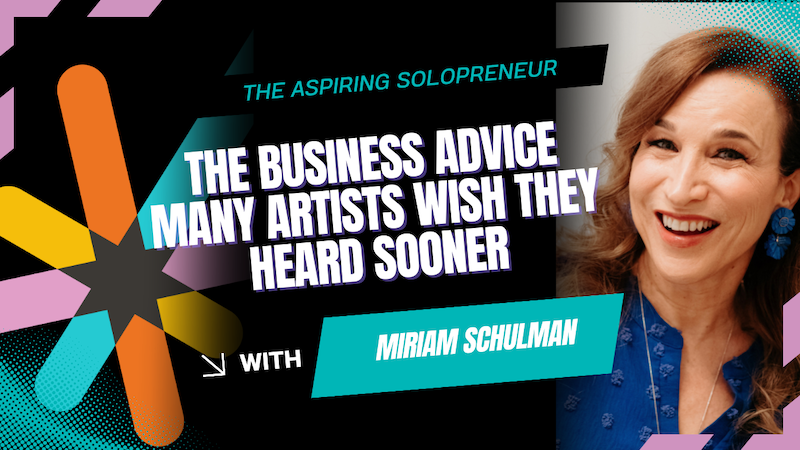
Can you really build a profitable art business, or is the “starving artist” stereotype still true?
In this episode of The Aspiring Solopreneur, Carly Ries and Joe Rando sit down with Miriam Schulman, artist, author of Artpreneur, and host of The Inspiration Place Podcast, to break down what actually works for creatives who want to turn their passion into sustainable income.
If you’re an artist, creative entrepreneur, or solopreneur struggling with pricing, inconsistent sales, or relying too heavily on social media, this episode delivers a clear, practical roadmap.
Miriam shares why cheaper is not easier to sell, how to shift from selling products to selling transformation, and why building an email list is far more powerful than chasing Instagram engagement. She also dives into mindset, marketing strategy, and the real reason talented artists often fail to make money.
This conversation is packed with actionable insights for anyone building a one-person business around their creative work.
What You’ll Learn
- Why underpricing your art can actually hurt your sales
- The difference between selling cheap products vs. selling transformation
- How to build an audience without relying on Instagram or social media
- Why email marketing outperforms social platforms for creatives
- The biggest mistakes artists make when trying to grow a business
- How introverted artists can market and sell effectively
- Why mindset and marketing matter more than talent alone
- What AI means for artists, and what it can’t replace
- The 5-part framework for building a profitable art business
Key Takeaways for Creative Solopreneurs
Most artists struggle not because of lack of talent, but because they focus on the wrong business levers.
Successful creatives:
- Price based on transformation, not time or effort
- Build direct relationships (like email lists) instead of relying on algorithms
- Focus on the right product, not just more output
- Develop business systems alongside their creative work
If you’re trying to grow a creative business, these shifts can dramatically change your results.
Who This Episode Is For
This episode is perfect for:
- Artists and painters
- Creative entrepreneurs and “artpreneurs”
- Content creators and designers
- Service-based solopreneurs with creative skills
- Anyone trying to turn passion into profit
About Miriam Schulman
Miriam Schulman is an artist, business coach, and author of Artpreneur. She helps creatives build profitable businesses by combining mindset, marketing, and strategy. She is also the host of The Inspiration Place Podcast, where she teaches artists how to sell their work and grow sustainable income streams.
Why This Episode Matters Right Now
In today’s “autonomy economy,” more professionals are leaving traditional careers to build businesses around their skills and passions. But many creatives fall into the trap of underpricing, over-posting on social media, and relying on outdated advice.
This episode provides a modern approach, focused on ownership, audience-building, and sustainable income, that aligns with how solopreneurs actually succeed today.
Listen + Share
If you found this helpful, share it with an artist or creative entrepreneur who’s ready to take their business seriously.
And don’t forget to follow The Aspiring Solopreneur on all major podcast platforms, including YouTube, for more strategies on building a life-first business.
FAQs
What is the best way for artists to make money?
The best way for artists to make money is to focus on selling transformation rather than low-priced products. Instead of offering cheap items to a large audience, successful artists often sell higher-value work or services to a smaller, more targeted group. Building direct relationships through email lists and personal networks is also more effective than relying solely on social media.
Should artists lower their prices to get more sales?
No, lowering prices often makes selling harder, not easier. Buyers associate higher prices with higher value and transformation. Underpricing can signal lower quality and attract less committed buyers. Artists typically see better results when they price based on the value and impact of their work rather than trying to compete on cost.
Do artists need social media to grow their business?
No, artists do not need to rely on social media to grow a successful business. While platforms like Instagram can help with visibility, they often have very low engagement rates. Building an email list, leveraging personal connections, and gaining publicity through podcasts or features are more reliable and sustainable growth strategies.
Why is email marketing important for artists?
Email marketing allows artists to directly reach their audience without depending on algorithms. Compared to social media, email typically has significantly higher engagement rates. This means artists can build stronger relationships, promote their work more effectively, and generate more consistent sales.
What are the biggest mistakes artists make when starting a business?
Common mistakes include underpricing their work, focusing on the wrong products, relying too heavily on social media, and lacking clear systems for sales and operations. Many artists also struggle with mindset issues, such as believing in the “starving artist” myth, which can limit their ability to grow a profitable business.
Can introverted artists succeed in sales and marketing?
Yes, introverted artists can be highly successful in sales and marketing. Introverts often excel at listening and building one-on-one relationships, which are critical skills for selling higher-value work. They can focus on personal connections, email communication, and smaller, more meaningful interactions rather than large-scale promotion.
What role does mindset play in an artist’s success?
Mindset plays a critical role in determining an artist’s success. Beliefs about money, value, and identity can directly impact pricing, marketing, and sales decisions. Artists who adopt a business mindset and believe in the value of their work are more likely to take actions that lead to sustainable income.
How is AI impacting artists and creative businesses?
AI can assist with idea generation and execution, but it cannot replace human creativity, taste, and original thinking. The most valuable part of creative work—the “last mile”—still requires human input. Artists who focus on originality, storytelling, and personal connection will continue to stand out.
What is the difference between selling products and selling transformation?
Selling products focuses on the item itself, often leading to lower prices and commoditization. Selling transformation focuses on the impact the product or service has on the buyer’s life. This shift allows artists to charge higher prices and attract more committed customers.
How can artists build a sustainable business long-term?
Artists can build a sustainable business by focusing on five key areas: creating the right product, pricing appropriately, building an audience (especially through email), actively selling their work, and developing systems to manage their business efficiently. Consistency in these areas leads to long-term growth and stability.
If you enjoyed this conversation, be sure to subscribe to The Aspiring Solopreneur and leave a review to help other solopreneurs discover the show.
Episode Transcript
Carly Ries: If you've ever wondered how creatives can actually make money without underpricing themselves, burning out on social media, or buying into the starving artist myth, well then listen up. In this episode, you'll hear practical advice on pricing for transformation, building an audience without relying on Instagram, and turning creative talent into a real business. Our guest, Miriam Shulman, shares hard won lessons on mindset, marketing, and what artists and other creative solopreneurs need to do differently if they want sustainable income. So whether you're an artist, a creator, or anyone building a one person business around your skills, this episode will give you a smarter way to think about selling what you do. You're listening to The Aspiring Solopreneur, the podcast for anyone on the solo business journey, whether you're just toying with the idea, taking your first bold step, or have been running your own show for years and want to keep growing, refining, and thriving.
I'm Carly Ries, and along with my cohost, Joe Rando, we're your guides through the crazy but awesome world of being a company of one. As part of LifeStarr, a digital hub dedicated to all things solopreneur ship, we help people design businesses that align with their life's ambitions so they can work to live, not live to work. If you're looking for a get rich quick scheme, this is not the place for you. But if you want real world insights from industry experts, lessons from the successes and stumbles of fellow solopreneurs, and practical strategies for building and sustaining a business you love, you're in the right spot. Because flying solo in business doesn't mean you're alone.
No matter where you are in your journey, we've got your back. Okay, Miriam. So this is actually a really timely episode for me personally. Joe, I haven't even told you this, but I went to a women's entrepreneur summit this weekend. And I would say 80% of the people there were creatives. In one way or another.
They were photographers. They were painters. And it wasn't for a creative audience per se, but that just happened to be a lot of the one person business owners that were in this room. And I was like, oh my gosh.
I wish you and I had talked on Friday. It'd have been such a good value add. But here we are today, and you can share your experience with our audience. So Miriam, welcome to the show.
Miriam Shulman: Thank you. And I'm not surprised to hear that because they do surveys on kids like what do they wanna be when they grow up and, I think the number one is YouTube influencer. I forget which number it is but I think in the top three is artist. So I'm gonna be employed for a long time.
Carly Ries: You are. You have so much to share. It's funny. I was trying to whittle down the questions to ask you because there are so many I wanna get into. But before we get into the ones that I did come up with, we always ask an icebreaker question.
So we're gonna ask you, what do you wish you had known before becoming a solopreneur?
Miriam Shulman: Yeah. That cheaper isn't easier to sell. And that's a lesson I still need to keep learning for myself. I teach that to my students. It's not easier to sell something cheaper. And then, like, I'll then create a product that's maybe half like, maybe a splinter of my coaching and it doesn't really sell. So the thing is people are looking for the biggest transformation. And you can see that across many industries, and I'm gonna use something like furniture.
If you were trying to furnish your apartment or house and you had nothing, what's the first purchase you might get? An end table or a couch?
Joe Rando: I was gonna say a bed
Miriam Shulman: Well, you can sleep on the couch. Right? So the couch. But how much do most couches cost?
Not the ones on Amazon. Like maybe West Elm or Pottery Barn, thousands of dollars. Right? But an End Table, it's only 400. But people much rather spend money on the couch or they'll spend money on a car even though a bicycle is cheaper or a guy will wait to save up for a diamond ring even though a bracelet is cheaper.
Because these are the purchases people are gonna make because they're gonna transform their lives much more than something that is less.
Carly Ries: That is such a good frame of mind. Well, let's dive into it.
it's funny that you're talking about pricing right now, that I joked that kids wanna be bankers. you actually transitioned to becoming a full time artist.
Miriam Shulman: That's right. I actually was a banker.
Carly Ries: So I didn't mean to tee up that transition, but good job for that. What was the pivotal moment that made you take that leap? And then what did you learn about courage, let's say in the process?
Miriam Shulman: So for me, the no turning back moment, like the burn the boats moment was when nine eleven happened. I was working in Wall Street and I was working down in World Trade Center, 7 World Trade Center. And I was actually working there in '93 when the first bomb went off. And during that time, we didn't have cell phones. I went up to my desk and everybody was still working. I was like, oh, there's a bomb going off? Really? Like I looked out the window, there were helicopters circling the building and people were just working. So when nine eleven happened and they didn't evacuate that second tower right away, I was like, oh yeah. I understand that culture. You keep working no matter what even if there's a terrorist attack happening.
So when nine eleven happened, I knew I could never go back to that world. And I didn't.
Carly Ries: Well, okay. So the courage component, I mean, that is scary to go from Wall Street to being an artist. I mean, that is a leap.
Miriam Shulman: Yeah. I didn't make a direct leap from this to that. at first, I still didn't believe I could make a living as an artist. So I did not become an artist initially because I didn't believe. I didn't believe.
And that's why in my book, Artpreneur, my first chapter is choose to believe.
Carly Ries: I love that.
Miriam Shulman: Because there are people who have different beliefs. They make different choices. My choice was I didn't believe.
That's what people told me. I said, okay. Well, where do you make money if that's what I have to do now? I had student loans to pay back. So that's why I ended up on Wall Street.
Carly Ries: So would you say that in your earlier days, that belief was the hardest lesson you had to learn about art and business or was there something else that's kind of a harder lesson?
Miriam Shulman: For sure. So when I first decided I wasn't gonna go back to Wall Street, I was painting on the side and I took a job as a personal trainer at a gym. And it was when I was selling personal training packages because that's what the gym's model really is, those trends like, were talking about those transformation, those bigger packages. They know that is where their real money comes from, not just the monthly fees.
So they gave me a lot of sales training. And when I had that sales training is when I had my moment because I was like, oh, this sales training, I'm gonna use that to sell portraits instead of pilates sessions because I understood that sales could be used to sell anything including art.
Joe Rando: I have a question the art thing because you might see the guitars in the background there. kind of had a spell right after high school of trying to make it in the music business. It didn't go as well as planned, but I remember reading a book about how to be a rock star. And kind of the first couple of lines was, learn how to play really well and write great songs. Which, makes complete sense, but it's kind of like a big piece of it. And I'm just wondering, how did you become somebody that could sell your art? Did you go to art school? Did you just have natural ability?
Miriam Shulman: I am not gonna dismiss the idea that talent plays some role. Obviously, it does. But it isn't the only thing. Because, Joe, I bet you can think of musicians that you're like, well, I don't understand why he's so great.
Joe Rando: Oh, yeah.
Miriam Shulman: Absolutely. I don't get it.
Joe Rando: Absolutely.
Miriam Shulman: Why are they so successful? They're not that great. So then you have to say, well, what is it that makes some people rise to the top and other people who are much more talented fail. So it's more than talent. I would say that the two things are marketing and mindset.
And if you don't have that mindset dialed in, the best marketing lessons in the world won't work for you because you will sabotage.
Carly Ries: Well, a mindset that so many people have around being an artist is that starving artist myth. And you challenge that pretty often. So how did you personally break free from that mindset? And then what advice would you give to artists that are struggling with that idea?
So many people would probably tell them.
Miriam Shulman: You know, I would say that the fact that I didn't go to art school probably helped me more get over that mindset because they drill that mindset into art students in art school. That if you're successful, it's actually bad like you're selling out. they is one of the reason and they don't teach business in art school. So the fact that I didn't have that preconditioning going into it, and then I was able to overcome it more quickly because I didn't have baggage around it.
Carly Ries: Well, how do you balance that creative side of being an artist with, like you're saying they don't teach business, but with that entrepreneurial side, is there ever tension between the two of which way you'd rather lean towards?
Miriam Shulman: Well, for me, I am more in the business world now. That is why I'm a full time business coach. I just really enjoy helping people. But in terms of both when my early years so I've been of doing this now for over twenty five years. So for the first fifteen to twenty years, most of my income came from my art.
Not coaching, not online classes. And for my students, one of the biggest things they have to overcome is not focusing. I mean, work very hard even on the business side, but they're focusing on the wrong things. And that's because they're following bad advice and outdated advice like, oh, if posting on Instagram isn't working for you, then you should post more. No.
If it's not working, doing more of what's not working isn't gonna help you. So it's focusing on the right things and not becoming content creators for the Zuckebergs.
Carly Ries: Yeah. I like that. Well, you wrote a book, Artpreneur. And you talk about it as art as business. What is one simple but powerful business habit that you think every artpreneur should start today?
Miriam Shulman: Yes. You should have a separate business checking account as your personal checking account. especially, you know, when you make decisions, you have to know what's all the money that came in from my business? What's all the money that went out of my business? And when you go to make those decisions, you shouldn't be asking your romantic partner for permission unless they're part of your business.
So being able to be very clean about decisions and understanding what money's coming in, what money's going out. I have a question. Do you recommend that people that are artists create corporate entities for their business? Like, LLCs or s corp,
That's a great question. I used to say you didn't have to because the first 10, I just was a sole proprietor, and that is how I filed my taxes. And twenty five years ago when I opened my business checking account, I didn't need an LLC. I have an LLC now. I'll tell you why.
Around two thousand and gosh. God, time goes so fast. whatever year it was that I had Instagram at the beginning of Instagram. So this is
Joe Rando: A long long time ago.
Miriam Shulman: My Instagram account got shut down, and I realized I had no way of proving to what is now Meta that Miriam Schulman was actually the owner of Schulman Art, my handle. So that was one main reason why I knew I needed some sort of proof around Schulman Art my handle at Schulman Art and making that an LLC. And the other thing is my niece, god bless her, she made her Instagram account j Schulman Art. So there was a little bit of brand confusion as well. She's changed it because she got married.
I don't know why she thought Schulman Art was good. I guess she figured my aunt's successful and she's Schulman Art and I'll be Jay Schulman Art. So, that's why I made my LLC. But my understanding is that some banks won't let you open a business checking account unless you have some of these documents in place. And that's what I'm learning from my students.
So that's why I think you probably should go ahead and do that.
Carly Ries: Yeah. I think that makes sense.
Miriam Shulman: You know, it's gonna depend on your state and the bank and that's why, it's hard for me to get that kind of advice. But I know for a very long time, I just was sole proprietorship. What do you tell your students as solopreneurs?
Joe Rando: Incorporate. just for the liability. You know, if any anybody can get sued, and just for that liability protection, that your house isn't on the line. I mean, I you know, even a piece of art, if you're a sculptor could fall over and hurt somebody and yep.
Who Knows? I mean Yeah. We Are a litigious society. So, yeah, we recommend it. And, also, obviously, getting some semblance of insurance around that too. So Yeah. Protect yourself.
Miriam Shulman: Good advice.
Carly Ries: Okay. So we're talking about the bank account, incorporating your business, all of that. Now, and tracking your bank account, which obviously, to see things coming in, you need to be selling things. But a lot of creatives struggle with pricing their work. And you were saying earlier, we were talking about the couch and everything.
What's your approach to pricing so that artists feel confident and can actually make a sustainable income?
Miriam Shulman: So we're gonna go back to the cheaper isn't easier to sell model. I already talked about why people are looking for the those bigger transformation things. I know some artists will say, well, the economy's not doing so well, which by the way, they seem to think it's not doing so well every single year I've been in business. they never seem to think it's doing well.
But they'll say, oh, we should be making smaller art. No. Because, when economy isn't doing well, people will not just buy little pieces of art for their bathroom, they will only focus on the big art that goes over the sofa. and that's just used from the painter world. But they're looking for the biggest transformation.
But also, it's what price are you putting on it? Because people are not making decisions in their life like I'm gonna choose the cheapest babysitter. I'm not going to choose the cheapest plastic surgeon. I'm not gonna choose the cheapest contractor. And then even if you're looking at loaves of bread.
So alright. If you're the class mom or you're going to your office picnic or whatever. Yeah. You might buy wonder bread because it's the cheapest thing. But if you're bringing a loaf of bread over to a client's house, you're going to the bakery and you're spending three times as much.
You're not gonna bring a loaf of wonder bread. So our collectors, people who are buying things from they they they want that's that thing that's reassuringly expensive. That communicates the value of it. So whether it is a bakery cake that is a higher price, a loaf of bread that's a higher price, people are not gonna be put off by these higher prices because it signals quality.
Carly Ries: so pricing aside, what are some big mistakes that artists make when they're first starting out?
Miriam Shulman: Okay. So five things, the first one is the pricing about cheaper being easier. So that's more like a pricing mistake. Another thing is sometimes it's not just the price but it is the product. to give an example that sounds ridiculous but this is a real example.
People email me. I get this email like once a year from somebody who says, well, Miriam, I paint on rocks and people don't consider that real art. Like, yep. Correct. So these are people who are trying to build a business around something that can't be priced higher.
It's just the wrong product. if you're trying to sell $4 stickers, you can't. you'd have to sell 10,000 of those to make $40,000 and so it's the wrong product. So wrong product, wrong price. The third mistake people make are trying to build their business on social media. So do you talk on this channel about the current social media stats or do want me to review that?
Joe Rando: We whine about it a lot.
Miriam Shulman: So when I first started writing my book, Artpreneur, the average engagement rate on Instagram was 1%. And that was two years ago, which still is terrible. I mean, that's 10 people out of a thousand is 11%. Right? Did I do that math right? It's one out of a 100 is 1% or 10 out of a thousand. Okay? Do you guys know what the average engagement rate is in 2026? I'm gonna tell you. The average is point three.
0.3. And what's pulling the average up are sports teams. Sports teams have 2% and colleges who have sports teams. Retail, home decor, all these creative industries we're talking about, point one. Point one.
That's one person out of a thousand will engage with you on Instagram. That means they will DM you or comment or like or watch the video, one out of a thousand. Now if you compare that to email where the average open rate is starts at 25%, so you would need 6,000 followers on Instagram to have the same number of people see what you're talking about in your business on email as only a 100 email subscribers.
Joe Rando: This is really interesting. So I totally agree with you, and we talk about this kind of thing all the time, relying on social media and building up email address lists of people that, opt in. But I don't know. How do you do that as an artist? We do it, in LifeStarr, we do it by engaging people in online events where we talk about, different things that are of interest to solopreneurs. But I'm really curious how that's done by an artist.
Miriam Shulman: Oh, artists, it's even easier. You just ask. So if Carly said to me, hey, Miriam, where can I see your art? Which is just to say for an example. And I would say, oh, Carly, would you like me to invite you to my next show?
And Carly says, sure. I'd love to. Okay. What's your email address? You just ask people.
Joe Rando: But how do you get that first interaction?
Miriam Shulman: Okay. So there are three ways to build your audience. Only three ways. Doesn't matter what business you're in. Doesn't matter if you're an artist, a website designer, a baker.
Three ways. One is your universe. That's anywhere you come into contact with people which could be online but it could be in person. I basically tell all of my clients you want everyone to know what it is that you do. So that's why chapter one in choose the belief, say tell everyone you're an artist. so Carly, what are few of the things in that woman entrepreneur event you went to? so we can give examples from different industries.
Carly Ries: Of what they were?
Miriam Shulman: Yeah.
Carly Ries: There were lots of photographers. There were people doing creative course creation that were there. There were content creators. It was a creator, so it wasn't just art. It was any any form of art. A lot of content creators. Some VAs that specialize in helping artists.
Miriam Shulman: Okay. Yeah. Alright.
Carly Ries: I was there kinda snooping.
Miriam Shulman: Okay.
Joe Rando: I will toss in. I've met some some people that do jewelry.
Miriam Shulman: Okay. So if you're a jeweler, every person you ever meet ever in your entire life while you're selling jewelry, you let them know. I mean, that's just part of something you slip into the conversation. Not in a weird way, but, just in a natural way. And people are gonna naturally say, do you have a card?
Do you have a website? When they say that, that is not your cue to hand them your business card or give them your website. That's when you ask for their email address. Okay. So I said there are three ways. So one is your universe, anywhere you come in contact with people. The second way is publicity, Free publicity. This is what I'm doing right now. So getting on podcast, articles, things like that. So publicity is the second way,
the third way which still works really well is paid advertising. For my clients, I tell them that's not for you. However, for someone who's wants to be VA, someone who wants to be a content creator, those work really well. Paid advertising is great. I'm sure you use paid advertising too in your business.
Carly Ries: Yeah. All great points. And it's funny because I feel like a lot of artists are jotting down notes right now. I think it'd be doing differently.
Miriam Shulman: Yeah. If you are a visual artist, you do not need to do paid advertising. Number one and number two is sufficient for you.
Carly Ries: Yeah. Are there any conflicts nowadays beginning artists with Canva or other platforms that can make, in theory, a person like me who has very little artistic talent an earnest? I guess, it harder to sell things now?
Miriam Shulman: I don't think so. Because, even Canva, I have one person on my team who studied art in college and somebody on my team who didn't. And I only let the person who studied art use the Canva because you can make Canva templates look really ugly.
Joe Rando: I can do that.
Miriam Shulman: Okay. So you know you cannot outsource taste . Like, yes, You can create things but is it any good?
What we have right now in terms of both visual art and I would say writing as well is a last mile problem. Do you want me to say more about that? Like why AI doesn't threaten creativity? So this is something that last mile problem, the shipping industry, it's not expensive to ship something from New York to Colorado.
The most expensive part of the shipping process is from, let's say, Boulder or Denver to where you live. And the closer you get to your house, that last bit, that's the hardest part. Now we have the same thing true in creative design as well as writing. Maybe getting a rough draft if you're using AI tools like ChatGPT or getting something visual. Maybe some of that can be done with these tools.
But that last bit, that last mile, that's the part that's gonna become more and more important. and you can't outsource taste and also the initial thing, the idea that has to initiate from a human because Chat GPT isn't gonna give you that either.
Joe Rando: I have to ask you, have you noticed like I have that people with anything AI generated, whether it's a video, art, or writing, if it's acknowledged and presented as AI generated, people are like, oh, okay, cool. I see these videos of these kind of futuristic societies, and it's like, oh, cool. But then if somebody puts out an AI video or an image or a writing that's being presented as not being AI, being human generated, but it's clearly AI generated, people just completely diss it and hate it. Have you seen that?
Miriam Shulman: Okay. I can say personally what really bothers me, like on LinkedIn, I don't mind when people use AI to polish their posts. Like you can kinda tell they have more em dashes than normal perhaps. I don't have a problem with that as long as it's giving me value when I'm reading it. But I have a huge problem with people who are outsourcing the comments to AI because it's just like, why did you even bother?
Either you are so aggressively beige Cause you know what I'm talking about? When you see the comments that look like AI generated. I was like, why do you think this is helping your brand? This is not helping you. So, to me that's why I said this is the last mile piece. it's not so much the big things. It's sometimes these other things that you're outsourcing the connection. Don't outsource the human connection piece.
Joe Rando: But even some some of the posts themselves, it's like you say, I will use AI to kind of help tweak a post that I write.
Carly Ries: Yeah.
Joe Rando: You know, what do you think? But I see some posts that came from AI. The entire concept came from AI. there was no human in the loop other than who might have posted
Miriam Shulman: Yeah. Usually, those are very generic and bland.
Joe Rando: Right. And yeah, it's terrible.
Miriam Shulman: It's bad.
Joe Rando: When I look and I go, you know, I'm moving on. I'm not really gonna follow this person because they're not really giving me anything from them.
Miriam Shulman: Right. when I use AI to write, there are usually two steps. One is I say, here's a picture. What are your 10 ideas of an angle? And sometimes I'll like none of them, by the way, but then I'll come up with my own idea.
And sometimes I will like an idea, and then I'll take the idea and I will shape it and post it. So you're not outsourcing the thinking. 100%. that is the part that you're not outsourcing. You're not outsourcing taste. It's execution pieces that you're outsourcing.
Carly Ries: Makes total sense. I wanna circle back really quick to help people find artists. And I want you to give advice to the introverts out there. Ones that are nervous about getting out of podcast, that don't wanna reach out to their network, that are just like, I paint because I don't wanna talk to anybody.
Miriam Shulman: So introverts actually have a great advantage, and that is because we're good listeners. And that makes us so much better at selling and these one on one types of connections. So you don't have to go on a podcast if you don't want to. But usually, comes down to selling, especially if you're selling something that's high ticket which is what I recommend people focus on. You know, there are two ways to build the business.
You sell something very cheap to everybody or sell very expensive things to a few. And as a solopreneur, I recommend you sell very few expensive things to a few because you're not Walmart, you're not Amazon. So there are fewer people you need to talk to and we're very good listeners. So shy artists, definitely it's not about dancing on TikTok. That's not what we're talking about here.
It's about listening to your customers and engaging with them however you meet them.
Carly Ries: Love it. Well, and we may have touched on some of this throughout our conversation, but you do have a passion to profit framework that is useful for artists. Can you kind of dive into what that entails?
Miriam Shulman: And we'll circle back You asked me the five biggest mistakes and we actually only hit on three. So the first one is production. What are you producing? Are you producing the right thing?
The second is pricing. Are you pricing it high enough relative to what it is? And so this is a math equation, you know, those two things have to be working together. The third thing is prospecting. We talked about moving people from wherever you're engaging with them to your email list.
Not follow me on Instagram where you'll never see them again, but an email list. The fourth thing is promotion. That's sales. I need a piece. I wedge that in there.
So by promotion, I really mean closing the deal. And the fifth thing is productivity. Not producing the art, but what are your systems that you have in place for getting everything else done. So those are the five p's.
Carly Ries: Right. Okay. Because I saw that and I was like, this seems just so intriguing to me. Well, we were talking about, Canva and AI and everything.
And things have changed. So looking ahead, how do you see the art world changing for independent artists? And what kind of new opportunities do you think aspiring artpreneurs should prepare for?
Miriam Shulman: Yeah. I did a whole podcast. Actually, I did two podcasts on this with AI. One is AI and copyright wars. It's like you have to document your process so people aren't ripping you off and make sure you're checking everything that you sign, that you're not signing away your rights to train your IP, letting AI train on your IP.
So I would say that's the one thing that artists need to be prepared for. The other thing is that it's no longer about being recommended by Google. It's being recommended by AI. So if you were to go on to Claude or ChatGPT right now and say, who are the top three artist business coaches? My name better come up.
And if you are looking for yourself, that is the goal now, to not just have Google recommend you, but AI recommend you.
Carly Ries: It's so funny. I muted myself because I was typing to see if you came up in my chatGPT .
Miriam Shulman: And do I?
Carly Ries: I stopped typing because you ended your sentence. I was like, oh, wanna keep asking questions. But the prompt is in there, so I will let you know ASAP.
Miriam Shulman: Yeah. We can do it now. We could do it live and if you embarrass me.
Carly Ries: Okay. Do it live. Okay. Let me see.
Miriam Shulman: I know mine does, but it may be just trying to kiss
Joe Rando: It learns from you who you are.
Miriam Shulman: Exactly.
Carly Ries: Maybe it saw that we had like a scheduling thing
Miriam Shulman: No. Don't know. okay. Listeners. This is for your listeners.
Carly Ries: Still thinking. You're number one. I'm not kidding. You are number one.
Miriam Shulman: Thank you. Okay. I want all the listeners to do it. And if somebody else I think it varies who the top three are. Allison Stanfield who I'm friendly with.
Corey Huff is another one. Being found on Google search by the way does help you be recommended by AI. So it's not what you've done in the past with SEO is a waste of time. It absolutely isn't because it's always crawling the internet. But if you wanna be the number one whatever it is, you wanna make sure those words, number one artist business coach or number one website designer. or if you don't wanna use number one because that feels weird to you, leading website designer. Something like that. You wanna use that kind of language so that it's always pulling from that.
Joe Rando: I hate to get in the weeds on this, but I just need to know, when you use that language, where does that go on like, is that your h one? Like, your top hero biggest stuff? Or can you put it a little further down?
Miriam Shulman: Joe, I'm so glad you're asking me this. This is why I'm on the podcast today. You know, what did I give you as my bio?
Carly Ries: That is in my inbox that I'm not looking at right now.
Miriam Shulman: Yeah. I don't do it for every single podcast I'm on, but I try to, like the number one business book for artists is our I'll try to put so it's not about your website and this is why publicity is so great is because you're getting it on a lot of websites. Oh, the aspiring solopreneur. Oh, this is who we should go to for help.
Joe Rando: So it's not on your website. It's other people putting it on their websites about you.
Carly Ries: Yes. Cool. Smart. Super smart.
Joe Rando: Glad I asked.
Carly Ries: Miriam, it's so funny. As we were talking, I was coming up with a list of friends that I wanna share this interview with and because they're artists.
I'm just like, oh, this would be so helpful. And I have no doubt you will help other people find success as artists. So I have to ask, so we ask all of our guests this question, what is your favorite quote about success?
Miriam Shulman: Yes. Okay. So I don't know who said this. It may not have an author, but this is something I've just been repeating for years that I don't think I made this up. The most successful people are just doing things that unsuccessful people won't do.
Carly Ries: Love it.
Joe Rando: You Know, it sounds a little bit like a Tony Robbins, but I'm not sure.
Miriam Shulman: I don't know if somebody out there figures out who's the original well, the thing is sometimes there are quotes that get attributed to multiple people. You know how that is.
Carly Ries: Mhmm. Oh, totally. Well, Miriam, this has been fantastic. You make me want to be an artist so that I can now put these, into practice. Where can artists or anybody find you if they wanna learn more about you?
Miriam Shulman: Yeah. So if you liked what we talked about today, come find the Inspiration Place. I'm on YouTube or wherever you're listening to The Aspiring Solopreneur. So you can come find me wherever you're watching or listening to this.
Carly Ries: Awesome. great. Well, thank you so so much for coming on the show today.
Miriam Shulman: Thank you. Thanks for having me.
Carly Ries: And listeners, as always, thank you so much tuning in. Please share this episode with an artist, creative friend of yours that you think would love this. Leave that five star review. It helps us spread the word to other solopreneurs and artpreneurs. And subscribe to our show on your favorite podcast platform, including YouTube.
And we'll see you next time on The Aspiring Solopreneur. You may be going solo in business, but that doesn't mean you're alone. In fact, millions of people are in your shoes, running a one person business and figuring it out as they go. So why not connect with them and learn from each other's successes and failures? At LifeStarr, we're creating a one person business community where you can go to meet and get advice from other solopreneurs.
Be sure to join in on the conversations at community.lifestarr.com.