









 Joe Rando
Is creating a course the only way a service-based solopreneur can move beyond trading time for money?
If you look at the internet, you might think the answer is "Yes." But, in fact, there are at least 10 other ways a solopreneur can leverage their expertise to move beyond pure time for money.
Here's an example. A few years ago, I was on a Zoom call with a LifeStarr Member, we’ll call her Maya, when she said something that struck me.
“If I want to make more, I have to work more.”
Maya runs a solopreneur life coaching business. She’s sharp, in demand, making about $90K a year. Her clients respect her. She enjoys the work. She bills hourly, delivers real value, and sleeps well at night knowing she does good work.
But she realizes, like many service-based solopreneurs, that her income is capped by the number of hours she works.
Trading Time for Money Isn’t the Problem
Before we go any further, let’s remove the villain from the story.
There is nothing inherently wrong with trading time for money!
Client work sharpens your thinking. It keeps you close to real problems. It forces clarity because someone is paying you to solve something concrete. For many people, that close proximity is the point. They love it.
The issue isn’t that hourly work is bad. The issue is when it’s the only lever in the business, it limits your income.
When all income flows through one channel, growth becomes linear. More money requires more hours (or a price increase, which isn’t always feasible). That doesn’t make you trapped; it simply means the system has a visible ceiling. And the ceilings are simply constraints based on how you’ve designed your business.
The shift isn’t about escaping client work. It’s about expanding how your expertise shows up economically.
Think architecture, not reinvention.
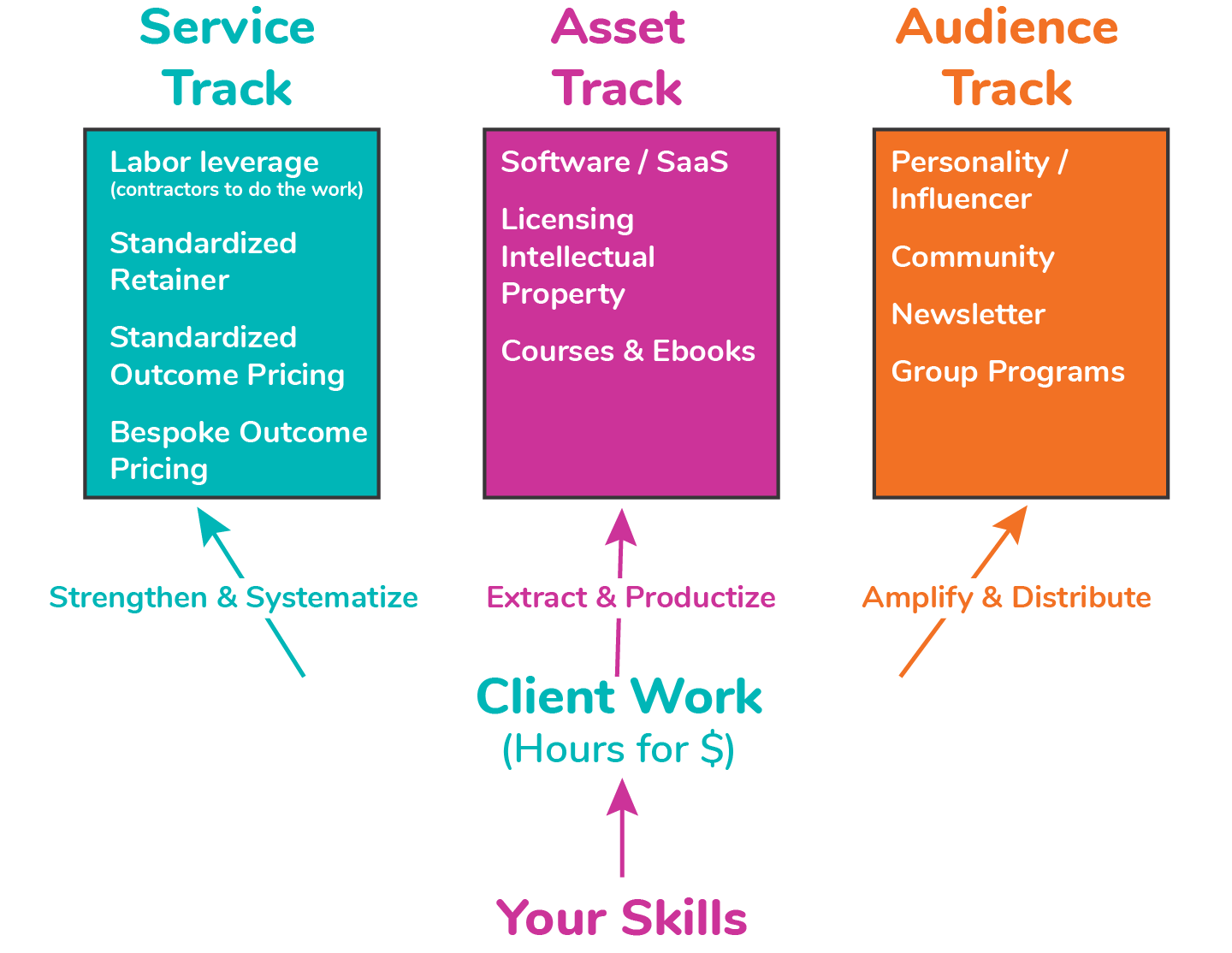
Three Stackable Tracks for Reducing the Ceiling
There isn’t a sequence here. You don’t graduate from service into products. You don’t earn the right to build an audience after you “prove yourself.” These tracks are stackable, and you can combine them in whatever proportion fits your goals and temperament.
You can keep what works and layer what adds flexibility.
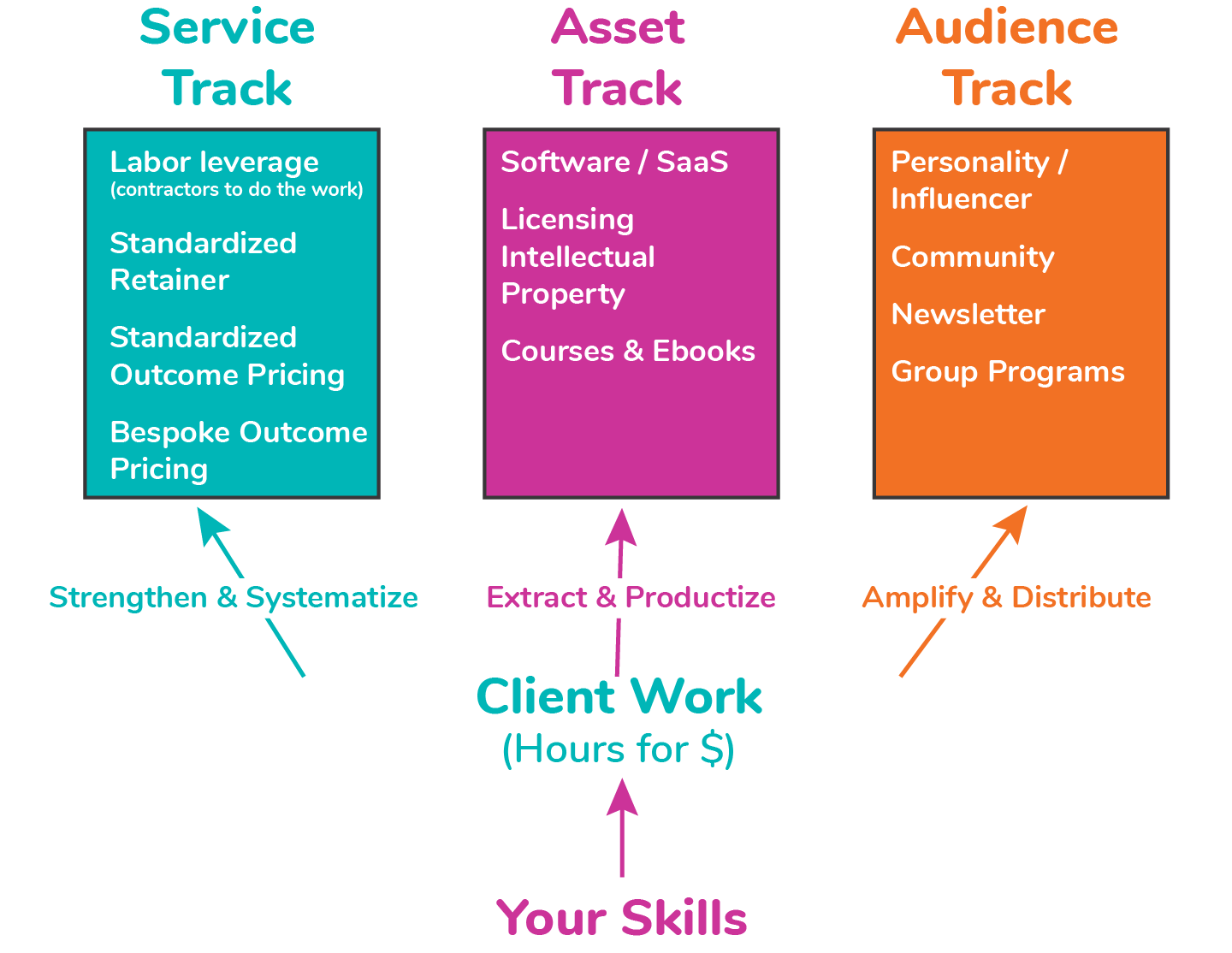
1. The Service Track: Strengthen & Systematize
If you enjoy client work, stay there. Just improve the structure around it.
Most ceilings in service businesses aren’t caused by a lack of skill. They’re caused by loose packaging. When you bill hours, you’re selling effort instead of outcomes. Tightening that structure often raises the effective rate without changing the work itself.
There are three common upgrades here.
-
Bespoke outcome pricing. Instead of billing for time, you price defined outcomes based on the client’s needs. The scope is clear, the value is anchored to results, and, if you do it right, the math changes in your favor.
-
Standardized offers. When you notice you’re delivering similar results repeatedly, you can package them into fixed offerings. A clear deliverable at a fixed price reduces variability and makes sales conversations cleaner.
-
Labor leverage. Once your delivery is structured, you can bring in contractors to execute pieces of it. You design the system; others help run it. This doesn’t work for every business, but when it does, it reduces fragility and frees your time for higher-level work.
Maya didn’t abandon client work. She moved from selling “strategy hours” to selling coaching packages to companies for their employees. She charges a nice fee and was available to the company’s employees should they need her. She capped the hours, so she always made money. Her expertise didn’t change. And she still kept some one-on-one clients. Her income increased because the structure improved.
No course required. No rebrand required. Just better architecture.
2. The Asset Track: Extract & Productize
If you’ve been serving clients for a few years, you’ve likely noticed a pattern: the problems repeat. That repetition isn’t stagnation; it’s pattern recognition. And patterns can be distilled into assets.
Assets might look like courses, eBooks, licensed frameworks, or even software. The format matters less than the principle: you are turning accumulated insight into something that can be delivered without you being present every time.
Client work becomes the laboratory. Assets are what you extract from that lab.
It’s important to say this clearly because the idea has become almost mandatory for solopreneurs:
You do not need to build a course to have a legitimate business.
But if you’ve solved the same problem fifty times, there is likely an opportunity to package that thinking into something that scales beyond one-to-one delivery.
Assets add a second lever. It doesn’t have to replace the first.
3. The Audience Track: Amplify & Distribute
The third track is distribution. Instead of working exclusively one-to-one, you build pathways that allow one-to-many impact.
That might mean running group programs where the cost per participant is lower but the revenue per hour is higher. It could mean building a paid newsletter, a community, or a thought leadership presence that attracts partnerships and sponsorships.
This isn’t only about chasing influence for its own sake. It’s about increasing reach per unit of effort.
Audience compounds. Trust compounds. Visibility compounds. Over time, distribution itself becomes an asset.
If Maya eventually runs group coaching sessions instead of twelve separate calls, she won’t be abandoning service. She’ll be multiplying it. The same expertise will reach more people in less time. The cost per client will be lower, but the cost per session will be much higher.
This Is About Having Options
Where people get stuck is in false binaries. They assume that building a course means they must stop consulting. Or that loving client work disqualifies them from productizing.
None of that is true.
You can run high-margin retainers and a modest digital product. You can keep bespoke projects and test a group program. You can remain entirely service-focused but aggressively systematize pricing and delivery.
When you have multiple levers, you get to decide how much to work, what to emphasize, and where to grow. Growth becomes flexible instead of strictly linear.
Maya didn’t need a new identity. She needed another lever.
Maybe that’s the quieter question underneath all of this: not “How do I stop trading time for money?” but “How many levers do I want in my business?”
Some people are perfectly content with four well-paid retainers and a calm calendar. Others want service, assets, and audience layered together.
Both are legitimate.
The only real limitation is assuming there’s only one way to design the structure.
So, if your expertise is already proven, where else could it live? What would it look like to add just one more lever, not to replace what’s working, but to make the ceiling less rigid?
It’s your business and your life. Design it your way.