









19 min read
The Mid-Career Solopreneur Myth That's Holding You Back
 Joe Rando
:
Dec 10, 2025 3:54:18 PM
Joe Rando
:
Dec 10, 2025 3:54:18 PM
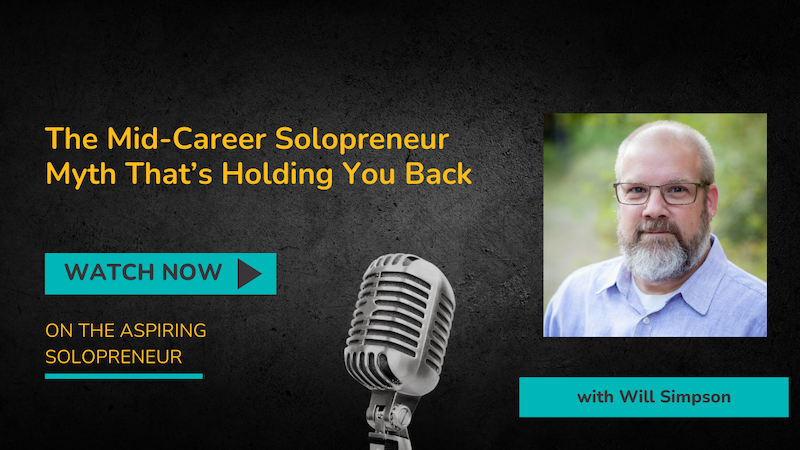
In this episode, Will Simpson gets honest about the moment he realized he didn’t want a boss. He breaks down the identity crisis that hit after leaving decades of COO/CTO life, the surprising advantage founders over 40 actually have, why solopreneurs must unlearn corporate thinking, and how embracing “good enough” is the key to launching anything.
If you’ve ever wondered whether you’re too late, too structured, too corporate, or too unsure to build something of your own…this conversation is the permission slip you’ve been waiting for.
Like the show? We'd love it if you'd leave a 5-star review!
Connect with Will Simpson
-
Connect on LinkedIn
- Visit PivotReady
- Email will@pivotready.co
Favorite Quote About Success:
"I grinded for five years and was an overnight success."
Episode FAQs
What makes this episode valuable for solopreneurs who come from the corporate world?
Will explains exactly why corporate experience does translate, just not in the ways you think. He talks through the mindset traps, the “ambient stress” you leave behind, and how to rewire yourself for small-ball thinking, fast execution, and building something that actually energizes you.
Does Will think it’s harder to become a founder after 40?
Not at all, he argues the opposite. According to Will, founders over 40 bring unmatched domain expertise, resilience, and clarity. The data supports it, and he shares why experience gives mid-career professionals an overlooked edge that younger founders simply can’t replicate.
What’s Will’s top advice for solopreneurs who want to use AI or no-code tools?
He stresses that AI can help you build prototypes fast, but not without structure, constraints, and actual expertise guiding it. He breaks down why you can’t “speak” a fully functional app into existence, how to think like a builder instead of a coder, and why you should ship an MVP that’s slightly embarrassing.
Being a solopreneur is awesome but it’s not easy. It's hard to get noticed. Most business advice is for bigger companies, and you're all alone...until now. LifeStarr Intro gives you free education, community, and tools to build a thriving one-person business.
So, if you are lacking direction, having a hard time generating leads, or are having trouble keeping up with everything you have to do, or even just lonely running a company of one, click here to check out LifeStarr Intro!
About Will Simpson
Will Simpson is not your typical C-Suite veteran, though he’s spent decades leading technology, operations, and engineering at the highest levels. His story is really one of reinvention.
- Version one: a pool-hall hustler and poker player in 1980s and ’90s Austin.
- Version two: a single father who launched a successful career in tech and executive leadership.
- Version three: the pursuit of joy—marrying his best friend on 7/11 (Slurpee® Day, of course) and discovering a love for storytelling. He published his first novel in 2023, with the next already underway.
That creative leap sparked version four: entrepreneurship. After realizing the “hustler” in his own fiction was really an entrepreneur in disguise, Will embraced that identity himself, co-founding two companies in just nine months.
Influential? Innovative? Sure. But more importantly, he’s a builder, a storyteller, and a man who’s rewriting his life one version at a time.
Episode Transcript
Carly Ries: Today's episode is for anyone who's ever thought, is it too late for me to start something new? Will Simpson spent thirty years climbing the corporate ladder before realizing he was showing up as who the company needed, not who he was. So he walked away and built a business that finally let him be his real authentic self. We talk about the identity crisis that hits after corporate, why over 40 founders actually have a huge competitive advantage, what people get wrong about AI and no code tools, and the mindset shift that helps solopreneurs stop overthinking and just start. So if you're craving that permission to reinvent yourself, this episode is it.
You're listening to The Aspiring Solopreneur, the podcast for anyone on the solo business journey, whether you're just toying with the idea, taking your first bold step, or have been running your own show for years and want to keep growing, refining, and thriving. I'm Carly Ries, and along with my cohost, Joe Rando, we're your guides through the crazy but awesome world of being a company of one. As part of LifeStarr, a digital hub dedicated to all things solopreneurship, we help people design businesses that align with their life's ambitions so they can work to live, not live to work. If you're looking for a get rich quick scheme, this is not the place for you. But if you want real world insights from industry experts, lessons from the successes and stumbles of fellow solopreneurs, and practical strategies for building and sustaining a business you love, you're in the right spot.
Because flying solo in business doesn't mean you're alone. No matter where you are in your journey, we've got your back. Okay, Will. So you you're such a breath of fresh air. You're kinda doing things on your own terms. I even said that your pitch was so authentic in reaching out to us, and I love that. You spent thirty years as as COO, CTO, VP of engineering. Correct me if I'm wrong about any of those. But what finally pushed you to say, I don't want a boss anymore. I just wanna have partners.
Will Simpson: You know, that's a great question. I learned it. I learned it as I became an entrepreneur, and I'm going through the corporate motions. I'm showing up the way the business needs me to show up instead of the way that I want to show up. So the two things that you mentioned right there were in conflict.
The authenticity and the getting it done, they conflicted. And so it's like, I was privileged enough to be able to make a choice and I did. I'm like, hey. I wanna show up like the real me every day, and I'm tired of playing the extra politics. that's it in the nutshell.
And then finding the partner part was as I have formed this last company and I found so much joy in it, it's because my partner in no way, shape, or form feels like a boss. And I really didn't realize it. I didn't realize what was missing until I had it. If that makes sense.
Carly Ries: Well, absolutely. And actually, Will, I got so excited about this conversation because I think it's so interesting that I completely forgot to ask you our icebreaker question that I think is relevant to the new world of solo entrepreneurship that you're in. What do you wish you would have known before becoming a solopreneur?
Will Simpson: That number one thing is my misconception of what an entrepreneur was. Was always, what's this visionary that's gonna go out and ding the universe? You're Steve Jobs. It's the ones we see on things. Right?
That's in my head what it was. I was like, well, that's not me. I'm the wet blanket. I'm the COO. I'm the guy that says no all the time.
That's not true. an entrepreneur is somebody who has an idea that solves a problem that brings it to market. It doesn't have to change the planet. I mean, it can. That's cool.
But like, it's okay to call yourself an entrepreneur if you have some ideas that you wanna bring to the world. And so I was like, okay. Or even if you're partnering with someone who does and you're helping do it, you're still an entrepreneur. So I had to change my paradigm.
Joe Rando: OK. I need some clarification. I've heard solopreneur, partner, entrepreneur. Where are we?
Will Simpson: they're marketing terms, so they get fuzzy. Entrepreneur means you're creating something from scratch to me. That's what it means. Solopreneur means I'm doing it by myself. There are lots of entrepreneurs.
Real estate agents, for example, are an entrepreneur that we don't think of as entrepreneurs, but they are every day. They're solopreneurs. It is really just them.
Joe Rando: I agree.
Will Simpson: I am both. I am both. I happen to be a licensed realtor. so I've done both things. An entrepreneur means I am building a company that can grow.
Joe Rando: Will, go to the partner one. what's the partner about?
Will Simpson: So the partner is and it goes to the thing I look for is someone who can cover my weaknesses. Right? I'm not the idea generator.
I don't have 71 ideas in every day. I'm not the person who who understands the go to market. I'm the behind the scenes delivery person. So I believe that it is often helpful to have a partner and say, hey. It's okay not to be a solopreneur here.
I wanna get one or two partners to come in and help me cover my weaknesses.
Joe Rando: I just wanna be clear. So we are talking about a partnership, not a solopreneur venture.
Will Simpson: Yep. Yeah.
Joe Rando: I just don't want to confuse our listeners. This is episode two thirty, I think, and we've been very clear about solopreneurs, being people that get help but don't have other equity people or employees. So I just wanna be clear to the listeners. It's fine. You know, I'm sure everything else is gonna be relevant.
Will Simpson: And to be clear, the company that I'm building with my partner is specifically for solopreneurs. So we share your thing. We're building it to support solopreneurs. It's like, we're gonna help you go it alone. We're your adviser. We're not your partner.
Carly Ries: Love it. So you said that you being the COO, you got really good at saying no, which is a good boundary thing. How did your decades in corporate leadership prepare you or maybe even not prepare you for life as a solopreneur or partner?
Will Simpson: So it did not prepare me to be a solopreneur. It did not. And the thing is that you gotta unlearn a lot of what you learned or wonder what you think it is. You may be a high level director or VP at Dell, and what you've learned there is like, hey. You don't have unlimited resources.
You need to think small ball. Right? You need to think like, hey. Do we need to bootstrap before we get funding, and we may need to. I can't just go down and pick up a new copier.
Oh my god. My copier broke. A new one is going to appear. All of those logistics have to change. So I was not prepared.
Carly Ries: Yep. The copier not or the ink not refilling itself magically.
Will Simpson: Right. Yes. Absolutely. Right.
Carly Ries: Well, so you've mentioned that the twelve hour founder day, and founder even being for solopreneur founder, gives more energy than an eight hour corporate day. Can you kind of explain that?
Will Simpson: You know, the term that I use is called ambient stress. The ambient stress of walking into the office every day is like, okay, I gotta make sure that I don't irritate the board or I don't irritate the CEO or that I don't go over here and do this thing or that I'm not too busy to take care of my employees. All of those, that's all ambient stress and sometimes it just feels like, okay, I'm carrying the weight and while you can get energy from it, it just starts to wear and now, I'm in here and I'm building something and I'm delivering something that is mine. I own it. This is my thing.
And to me, that brings me energy. So that's what I meant by the difference.
Joe Rando: And very little politics is what I'm hearing.
Will Simpson: Right. Yeah.
Joe Rando: I love that too.
Will Simpson: Yeah. I go to the mirror and say, okay. We're gonna do this. I'm like, no. We're not gonna do this.
I mean, that's the extent of the politics. what's going on in my own little head?
Carly Ries: Will, so you had decades of experience again in the corporate world, but you believe that over 40 founders have an overlooked advantage. So what do you think they bring to the table that younger founders often don't? Because I think when people think founders, they're like, oh, it's this tech guy and he's in his late twenties blah blah blah. Like, there's so much more to it for post 40. Explain.
Will Simpson: so look. The data backs me up. You can look at the successful founders, and I'm not talking about the one offs or the two offs or the three offs that go and hit it big. Right? They started off with 50,000,000 and made, you know, 200.
I'm talking about your normal founder that goes off and you can see experience matters. Expertise matters when you're a domain expert. And this is nothing against young people. They're smart. They're vibrant.
They bring lots of energy and lots of things that you need, but experience is only gained by doing and failing. And when you do and fail and you learn your market, that you chose a market for a reason. You didn't just find one that came out of your NBA group. Right? It to me, boils down to it sounds simple and maybe cliche, but it is experience 100% matters.
Carly Ries: So do you feel any extra pressure competing with the younger guys from, like, a fast moving tech landscape, let's say? How do you keep that competitive advantage, when things are moving so quickly?
Will Simpson: And so this goes back to experience. No. I don't feel pressure. I don't let it bother me, and this goes back also to the politics thing. It's like, I have learned through the years that high speed, low drag, speeding up to slow down and slowing down to speed up, those things aren't just little phrases that we hear.
Those are important things. You can choose whether or not. Is it fast paced? Of course it is, right? If you're gonna be an entrepreneur or especially a solopreneur, you're gonna need to keep up.
But you're also gonna need to, focus on what it is that you wanna keep up with. You don't have to keep up with everything. Right? And so that's the trap, keeping up doesn't mean, oh, I'm a know it all. And I'm gonna know what this is, and then I'm gonna borrow expertise from my other areas.
And that takes a little humility that comes with experience too. Right? It's okay. You're not weak when you say, I don't know, and that's an experience thing as well.
Carly Ries: Will, you have an energy about you. You just seem so excited about this solo journey and and kinda have a zest for life with it. So what advice would you give to someone over 40, let's say, who's afraid they've missed their window to start something new and why it's not too late for them?
Will Simpson: It's absolutely not too late for them. Not too late for anybody. And if I'm talking to anybody and said, hey. You have not missed your window. The life that you're living right now is a life that's been prescribed to you from some corporate environment.
You're almost certainly not living your true life right? So if you live your true life you will find energy that you didn't have since you were in the fourth grade. It's there. It's always been there. And so go leverage it and you're not performative anymore.
It's not performative. It's all about you. If you're a builder, especially if you're a builder, right? Like, there's builders, there's influencers, and there's funders.
If you're a builder and you want to create, anything. And I mean, I'm not an artist or, you know, whatever. I mean, I'm a geek. But you can get energy by being yourself because, again, that ambient stress is gone.
Joe Rando: I wanna second that. I started this business basically when I was 60. Turned 60. So forget 40. you know?
And my wife said finally, had to talk to me because she'd get up in the morning. I'd be downstairs, and I'd come out from my computer, and I'd start going on about whatever and she's like, I have to have coffee first. It's too much energy.
Will Simpson: Right. Yeah.
Joe Rando: I mean, it's just exciting. Right? It's exciting.
Will Simpson: It is. And you know, my wife is also a solopreneur, a 100% single person business. And we embrace our own solo together if that makes sense. That's all Carly ever says.
Carly Ries: Yeah. Definitely. Will, did you ever go through an identity crisis? Joe, I know you've been out of the corporate world for a long long time. But Will, did you experience an identity crisis leaving corporate and going out on your own?
And how did you navigate that? And what advice do you have for, mid career people who are jumping ship and have to create their own new persona?
Will Simpson: I 100% did. I mean, I've I officially left corporate and wandered around for three years. So my last w two corporate job, I hung out my shingle and said, okay. I'm a consultant.
And I picked up some consulting gigs and they were profitable, but I still had a boss. And I still had to play politics while I was working with that consulting, as a consultant. And I was like, okay. Well, I'm making money and I'm not working, you know, maybe a little less, but not really that much less. And this is not what I imagined it was supposed to be.
And so I wondered. And I was like, okay. Well, you know, boom. let me try some things and so what I did was throw things at the wall and try some things and I think that that's the important thing that I would say to people that are trying to find their identity, that has been created by the corporate world, right, that you're in and as you move here, look at your runway and find some time to experiment because you're not going to know.
I thought I knew. I was like, I'm gonna go be a consultant. I'm gonna hang out a thing. I'm a fractional COO. Here I come. And I didn't like it. I didn't like it. And while I still do it and I like some of my clients and some of the things, was like, boom. And so I did.
But I took completely off. I wrote a fiction novel. Who'd have thought? I mean, I'm not you know, that's not me, But I did.
I took my past experiences because, you know, I used to be a poker player and a little hustler. So I boom and made that in there. And through that process of not being engaged is where I found it. And then I just said, you know what? When I was writing that fiction novel, I looked down at that main character who was based on me and said, he's an entrepreneur.
And I'm like, shit. That's me. Sorry. And it's like, wow. And then that's when I first started approaching the people.
I was like, hey, man. You know, I heard the idea you wanna form a business, and here we are. And so that experimentation, that's what I would say. I don't think just because you're you know, 57, which is what I was at the time, 50 you know? And I didn't know.
I believe that you need to take some time to experiment. Nothing wrong with happy accidents. If you happen to leave corporate and jump right into something you love, great. But I don't think that that's the norm.
Carly Ries: I had a happy accident and then an identity crisis. Like, the happy accident got me out of corporate, and then it was just a project it was project based. So I knew it was a finite timeline. And then when that ended, I was like, oh, boy. Now I'm spiraling.
Will Simpson: Yes. I mean know where to go. It was like with networking. I mean, when I first left corporate, I kind of whispered, hey. I'm looking for some I'm looking for some gigs. And it just magically, they just came out.
And then when I found out I didn't like it, I was like, okay. Well, I'll switch to this other thing. And so I went to my same network, and I'm shouting. I want some gigs that is different from what they've all known me as. It's like, you're not being you, you're not doing engineering stuff?
It's like, you wanna work for a consumer product goods company? I don't understand. And all of a sudden, I'm like, oh my God, who am I? Am I qualified to do this? I mean, I've got a resume for days and success for years, but is it really good enough?
And so I think that if you're being honest, if people are really honest, it's like we all have gone through the identity crisis. We've all done. Everybody has impostor syndrome at one point or another, even when you're arrogant and old like me.
Carly Ries: Yep. Imposter syndrome is the magic word that we all experience end load.
Joe Rando: The scariest people in the world are people that don't have imposter syndrome because they don't know anything.
Will Simpson: Right? yeah, they're delusional or they're lying to themselves.
Carly Ries: Exactly. Well, Will, now you help mid career professionals build micro SaaS businesses without learning to code. So what is the biggest misconception people have about no code or AI powered tools? I think this is so relevant for solopreneurs because we always say I mean, AI is big right now anyway. From a time saving standpoint, this sounds crucial.
So what are misconceptions that get thrown your way?
Will Simpson: So a lot of people think that you can go and speak a viable application into existence, really without understanding anything about writing or code or anything at all. And what I would say is you can speak a prototype into existence, but if you're gonna have 50 users on it or more and you want any kind of security and you wanna make sure that your Stripe actually works and things like that, you're gonna still need some expertise to get it done. So I do believe and we do leverage AI a lot, but this is like any tool. If I give a shovel to my 16 year old daughter and I go out and have a shovel, even as a 60 year old man, I'm going to be able to use that shovel a lot better because I've dug a lot of holes. She doesn't know how to use a shovel.
And as simple as it sounds, it's like someone that doesn't know properly how to use a shovel is going to make a mess or they're gonna have some weird, not cool hole, right? It's the same thing with software, If you really don't know what you're doing, you're gonna make a mess, but what's worse, you're not gonna know it, right? I believe and I predict that there will be very soon a full industry of engineering people that come and fix all of these so called fully blown applications that are being pushed into the market today. We also talk about the fact that it's very important because it has shrunk to which you can build very fast.
Now for you for the initial prototype and the initial MVP. We also think it's very important to ask, should you build?
Carly Ries: Yes. Absolutely. Well, it's funny. We actually just did an episode, just the two of us this morning about having AI as like your employ treating your AI like an intern is what I kept saying. Like, it's there, but you gotta really really train it. So how do you teach people to direct AI rather than code? And how can solopreneurs best do that?
Will Simpson: Absolutely. So it's hugely important. And we're actually creating a tool that actually, you have seven AI personas. And what we call it is how do you constrain them?
How do you prevent them from hallucinating? How do you keep them from doing the things that they'll just go off and do to burn your tokens? Right? And how we teach people how to use it up to our very first tool. it basically comes out and says, use this prompt. You go through all of these long steps, and it's not fifteen minutes. you're gonna need to spend hours developing and answering these questions. And in the end, you're going to get a correctly created prompt. You need to have an expert that knows how to build prompts.
Better yet, you need to have an AI bot that can write a prompt for a builder AI bot. Machines know how to talk to machines. So learning this is not like I say, it's not like going to ChatGPT and say, help me. I wanna make some lasagnas night. Give me my grocery list.
That works great. Right? It understands all of those things. But if you don't constrain and control your things and you're just letting them run rampant in your code, you're gonna have issues and not know it. So having that initial constraint built is the important part. like I say, we're building one that has seven AI personas in it, and they're all constrained.
Carly Ries: Absolutely. Well and so I feel like using AI, starting a business, a lot of people, especially mid career professionals, tend to overthink before launching. So what's one system or principle that helps you move from idea to execution quickly, whether it's with AI or not?
Will Simpson: AI or not. so take AI out of the conversation. This has been true for twenty five, thirty years. Right? If your MVP doesn't embarrass you just a little bit, you waited too long.
It is going to be ugly. It is going to not work. Your users are gonna find bugs that you never thought of because they're gonna do it. And if you sit there and you let perfection become the enemy of done, you have burned through capital that you didn't need to. Period.
And as a solopreneur, that is especially important because we're living on runways that aren't the same. I don't have a VC back there writing billion dollar checks every time I'm three months late, right? As a solopreneur, I'm like, I only have to go get a new job because I'm out of money, right? Put it out there dirty. Put it out there ugly. Your early adopters are gonna be okay.
You're not gonna do it. We have lots of founders like this that we go through and we're like, you've already waited too long. You need to push the button. And it's a challenge. some won't push it.
Carly Ries: Do you have any sort of validation framework that you follow?
Will Simpson: Yes. And so our whole thing is a framework. Right? So we walk step by step by step. We start with validation.
We use general scoring, and then we move, for people in the marketing world, they'll know what ICE scoring is, but it is a true scoring mechanism that we go through that says, hey. This is valid. And then we produce actual survey questions that actually go out and validate. It's like, hey, real humans need to go out and answer these real questions and validate what you're doing. And all this is done before we write one line of code.
And that's important because that way, once we do, then we can say, look, the whole point of doing all of this upfront work is so that when we get here, we don't dilly and dally, and we don't wait. Just go out there, put the minimal viable product out there in the market, and let's go. We have validated that we have real people that will write us a real check for this thing. Let's get some real checks in the door. Believe me, they're gonna tell us what else they want if we miss something.
And so that's why we put the validation upfront while we're not waiting on the engineers to build it.
Carly Ries: Got it. Well, Will, I think you are like, I love what you're doing from just helping them make career professionals. I think they're kind of sometimes an untapped audience that definitely need those resources. And no doubt you'll help them find success. So we have to ask you, what is your favorite quote about success?
Will Simpson: I grounded out for five years, and I was an overnight success. I mean that's it. And the story behind that is, you can't measure success by you know, it's like, oh, I've been doing this six weeks, why am I not making a million dollars?
It's like, look, it's work. You're gonna have to put in some work. You should be enjoying the work. Right? Success is measured by what?
And if you can't answer that going in the door, that's where you gotta start. You've gotta start because you've got to be able to live through that five years in order for the world's version of success to be achieved. So that's what the meaning behind that quote is.
Carly Ries: That's great. Where can people find you if they wanna learn more?
Will Simpson: I'm in LinkedIn. Will Simpson. That's me. You can do your quick search.
You can find me at will@pivotready.co. That's my email address. Happy to hop and talk to anybody. And if you're, ever down in Austin, you wanna go hit up a great barbecue joint, hit my calendar, and I'll show you around.
Carly Ries: And you're a native, so you really know.
Will Simpson: you know Yeah. I'm sixty years in Austin. So, yeah, I know.
Carly Ries: Well, I will be sure to do that next time I'm in Austin. Will, thank you so much for coming on the show today. We really appreciate it.
Will Simpson: Thank you all.
Carly Ries: And listeners, thank you so much for tuning in. As always, please leave that five star review. We would so appreciate it. Share this episode with a friend and subscribe to our show on your favorite podcast platform, including YouTube, and we will see you next time on The Aspiring Solopreneur. You may be going solo in business, but that doesn't mean you're alone.
In fact, millions of people are in your shoes, running a one person business and figuring it out as they go. So why not connect with them and learn from each other's successes and failures? At LifeStarr, we're creating a one person business community where you can go to meet and get advice from other solopreneurs. Be sure to join in on the conversations at community.lifestarr.com.
THE BUSINESS HELP YOU WANT TO BE DELIVERED TO YOUR INBOX.
Posts by Tag
- Featured (196)
- Expert Interviews (88)
- Business Operations (75)
- Marketing (52)
- Inspiration (36)
- * Solopreneur Success Cycle (SSC) (32)
- Sales & Marketing (25)
- Solopreneur Stories (25)
- Strategy (24)
- Woman-Owned Businesses (23)
- Productivity (22)
- Success (22)
- Finance (19)
- Setup, Legal & Financial (18)
- Aspiring Solopreneurs (17)
- 2 Plan (15)
- Experienced Solopreneurs (10)
- Market Position (10)
- 1 Envision (9)
- Health and Wellness (9)
- 0 Create Goals (8)
- Content Marketing (8)
- 5 Refine/Reimagine (7)
- Deep Dive (6)
- 7 Adjust (5)
- Community (5)
- Self-Care (5)
- Business Models (4)
- Life Skills (4)
- Relationship Building (4)
- Social Media (4)
- Focus (3)
- Websites (3)
- storytelling (3)
- 3 Setup (2)
- 4 Execute (2)
- 6 Decide (2)
- Affiliate Marketing (2)
- Collaborations (2)
- Digital Nomad (2)
- Email Marketing (2)
- Intellectual Property (2)
- Tax Planning (2)
- outsourcing (2)
- Technology (1)
- automation (1)
- eCommerce (1)
- networking (1)