









32 min read
The Pricing Strategy That Doubled This Solopreneur's Income in Year One
 Joe Rando
:
Apr 14, 2026 1:49:36 PM
Joe Rando
:
Apr 14, 2026 1:49:36 PM
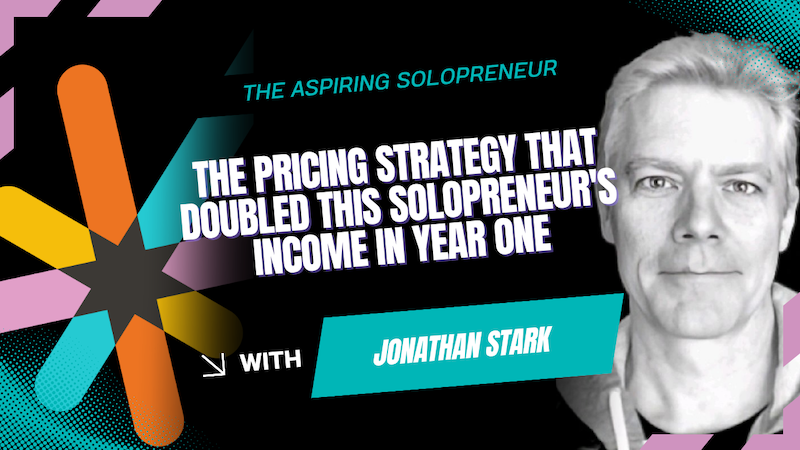
If you're a solopreneur billing by the hour, you might be stuck in a trap you don't even realize exists, one that's capping your income, straining your client relationships, and actually encouraging scope creep. In this episode of The Aspiring Solopreneur, we sit down with Jonathan Stark, the creator of Ditching Hourly, to talk about why hourly billing works against you and how to replace it with a value-based pricing model that benefits both you and your clients.
Jonathan isn't just theorizing. He made this switch himself early in his career, doubled his income in the first year, and has spent the years since helping other solopreneurs and consultants do the same. What surprised him most? It wasn't just his own life that got better; his clients became calmer, more trusting, and easier to work with almost immediately.
What Is Value-Based Pricing and Why Does It Matter for Solopreneurs?
Value-based pricing means setting your project fee based on the business outcome your work creates for the client, not the number of hours it takes you to deliver it. Instead of quoting an hourly rate, you determine what the result is worth to the client's business and price your services as a fraction of that value.
This matters for solopreneurs because hourly billing creates a direct conflict of interest. The faster you work, the less you earn. Your brain never turns on the creative problem-solving that would help you find efficiencies, because those efficiencies would punish you financially. Meanwhile, your client is pressuring you to go faster because every hour you spend is money out of their pocket. It's an adversarial dynamic baked right into the pricing model.
When you switch to a fixed project price rooted in value, that tension disappears. The client stops watching the clock. You stop feeling guilty for thinking. And both of you can focus on what actually matters — getting to a great outcome.
How Do You Figure Out What Your Work Is Worth to a Client?
This is where Jonathan's framework gets really practical. He uses what he calls the "why conversation" — a series of strategic questions he asks during the sales process, before he ever writes a proposal. The questions fall into three categories.
The first is "why do this at all?" You want the client to explain, in their own words, why this project matters. What business problem does it solve? What happens if they don't do it? Jonathan will sometimes try to talk them out of the project on purpose, asking things like "this is going to cost a lot of money and eat up your team's time, so why not just skip it?" If they can make a compelling case for why they have to move forward, you know there's real value on the table.
The second category is "why now?" Maybe they could wait six months, study the market, or do more research. If the answer is that a competitor is closing in, or a window of opportunity is shrinking, or the problem is getting worse every month, you've confirmed urgency, which is a key ingredient in value pricing.
The third is "why me?" Why hire you specifically instead of outsourcing it, doing it in-house, or having someone less experienced handle it? The answers here help you understand your unique positioning and what premium the client places on your specific expertise.
By the end of this conversation, you should have a clear picture of the business outcome the client is chasing and a rough sense of what achieving that outcome would be worth to them. That number becomes the anchor for your pricing.
How to Structure a Value-Based Pricing Proposal
Jonathan uses a three-option proposal format he originally adapted from consultant Alan Weiss, author of Value-Based Fees. It starts with a situation appraisal: a few short paragraphs that describe the client's current state, their desired future state, and why they're considering you for the job. This section is important because it should make the value of the project obvious to anyone who reads it, even someone unfamiliar with the business.
Below that, you present three options at three different price points. Each option builds on the one before it, offering increasing levels of engagement and business benefit. The prices are all set as a fraction of the value you identified in the why conversation. The client isn't choosing between you and a competitor, they're choosing which level of engagement makes the most sense for their situation.
A critical detail: Jonathan defines scope last, not first. He figures out the value, sets the prices, and then decides what he'd be thrilled to deliver at each price point. This is the opposite of how most solopreneurs price, and it's the key to making the model work.
How Does Value-Based Pricing Prevent Scope Creep?
One of the biggest fears solopreneurs have about fixed-price projects is scope creep. Ironically, Jonathan argues that hourly billing is what actually causes scope creep in most cases. When you bill by the hour, you have no financial incentive to find faster, smarter ways to deliver. Your brain simply doesn't look for shortcuts, so projects balloon in size and everyone ends up frustrated.
With value-based pricing, you handle scope creep by tying every request back to the agreed-upon goal. If a client asks for something new mid-project, Jonathan asks one simple question: how does this contribute to the goal we defined at the start? If it does, he's happy to include it at no extra charge because it gets him to the finish line faster. If it doesn't, if it's a shiny object or a nice-to-have, he logs the request for a potential future phase and keeps the project on track.
He also tells clients upfront, right from the first conversation, that he'll say no to anything he believes will jeopardize the project's success. Setting that expectation early makes it much easier to enforce later.
When Does Hourly Billing Still Make Sense?
Jonathan acknowledges that hourly billing isn't always wrong. If you're brand new to your field, still building skills, or in a cash crunch and need to take whatever work you can get, billing by the hour is low risk and easy to sell. Clients are used to it, and you won't lose money on a project the way you theoretically could with a bad fixed-price estimate.
But he's clear that it's a temporary strategy. If you're experienced, you have happy clients to show for your work, and you're good at what you do, staying on hourly billing means you'll eventually find yourself in a race to the bottom, undercut by younger, cheaper competitors with lower costs of living.
How to Raise Your Prices Without Losing Clients
For retainer clients, Jonathan's approach is simple: he doesn't raise prices on existing clients. Retainer engagements naturally taper in value over time as the big strategic decisions get made and the client moves into implementation and maintenance. Eventually the engagement ends on its own. New clients come in at a higher rate, and the cycle continues.
For project-based work, there's nothing to raise because every project is priced individually based on its value. There's no hourly rate for the client to see or compare. You simply price the next project based on what it's worth to that specific client at that specific time.
About Jonathan Stark
Jonathan Stark is a pricing consultant, author, and the host of the Ditching Hourly podcast. He helps solopreneurs and small firms replace hourly billing with value-based pricing so they can earn more while working less. His free email course at valuepricingbootcamp.com is a great starting point for anyone ready to make the switch. You can find him at jonathanstark.com.
If you found this helpful, subscribe to The Aspiring Solopreneur on your favorite podcast platform and leave a five-star review. Share this episode with a solopreneur friend who's still stuck in the hourly trap — it might be the nudge they need.
Episode Transcript
Carly Ries: What if the way you're billing your clients is actually the reason they're stressed out and the reason you're leaving money on the table? Today's guest doubled his income in year one just by changing how he priced his work. Jonathan Stark is the guy behind Ditching Hourly, and he's about to walk you through the exact conversation he uses to figure out what a project is truly worth to a client and how to say your prices based on that, not on how many hours you park in a chair. If you've ever felt stuck in the time for money trap, this one's for you, so let's get into it. You're listening to The Aspiring Solopreneur, the podcast for anyone on the solo business journey, whether you're just toying with the idea, taking your first bold step, or have been running your own show for years and want to keep growing, refining, and thriving.
I'm Carly Ries, and along with my cohost, Joe Rando, we're your guides through the crazy but awesome world of being a company of one. As part of LifeStarr, a digital hub dedicated to all things solopreneur ship, we help people design businesses that align with their life's ambitions so they can work to live, not live to work. If you're looking for a get rich quick scheme, this is not the place for you. But if you want real world insights from industry experts, lessons from the successes and stumbles of fellow solopreneurs, and practical strategies for building and sustaining a business you love, you're in the right spot. Because flying solo in business doesn't mean you're alone.
No matter where you are in your journey, we've got your back. Jonathan, I know we're gonna get into a topic today that I think is so so relevant for Solopreneurs. But before we even get into the icebreaker, do people tell you, you have the coolest name? I'm surrounded by Jonathan Stark and Joe Rando. Like, how did I get in this mix?
You guys have the best names ever.
Jonathan Stark: Yeah. I can always tell when an Iron Man movie is coming out because people are like, oh, like Tony?
Carly Ries: Yep. Exactly.
Joe Rando: I used to get the Rambo comments back in the eighties. Oh, Rambo. Glad that's gone.
Carly Ries: I'm a millennial, and blame our generation for making rando a thing.
Joe Rando: Wrecking my name. Yeah.
Carly Ries: So sorry about that. But, Jonathan, before we get into the meat and potatoes of today's episode, you have built your entire business around the philosophy of this escaping time for money trap. So let's just start with that as the icebreaker. What is one specific, maybe unexpected way that your life has actually changed? Or something you did or experienced once you restructured your business to your current model?
Jonathan Stark: So very first thing that happened was I switched from hourly billing and switched over to value pricing, which we probably are gonna talk about. And that's a form of a fixed price project. And when I did that, I could not believe how chilled out my customers got. So I was used to, you know, I worked at an agency and I had all of these clients that I was working with on an hourly basis. And I was just used to what I assumed was kind of like the physics of business, which was that they would be in a rush and they'd have deadlines and they would really want you to finish this feature faster and come to find out that really, they weren't really worried about deadlines.
What they're really worried about was the budget spiraling out of control. So they always wanted me to go faster, faster, faster, because that meant less and less and less money they would have to pay. And when it became like it's going to be $100,000 for this software system that we're going to build. Suddenly they weren't in a rush anymore because they believed that I wasn't going to charge them more than I quoted and I was going to do it the right way, the way that I thought was going to be best and I could not take forever, but I could take the time that was appropriate for the thing. And it was unbelievable.
Like I had a good relationship with my clients already, but when I switched over to a fixed price model based on value, it was like, a huge lifestyle improvement that I was not expecting at all. It was great.
Carly Ries: That is fascinating because we always think it impacts the business owner first, solopreneur first. But to have that impact on your clients, which in turn makes your life easier and it just goes back and forth. I never heard that yet. And that is fascinating to me and such a breath of fresh air I think for our audience. Like, oh, I can either switch my working relationship with my client from something that's not so great to something that's better, or an already existing positive relationship to something that's even greater.
That's cool.
Joe Rando: So Jonathan, I'm curious. When you made that change, did anything materially happen to what you kind of earned hourly?
Jonathan Stark: Yeah. I mean, I doubled my income in the first year. So it's a little bit apples and oranges because I was getting paid a salary at this firm where I was the vice president. I was managing these other developers. But yeah, when I went solo, my boss from the previous place, we worked out of sort of a fiftyfifty deal, I took some clients with me who wanted to stay working with me directly, and we did a profit share and you know, and I stopped billing hourly, but if you divide it out how many hours I worked in the year and how much I made, my effective hourly rate went way up.
And in tandem, my life got better in the way that I just described. So it was like more money, easier working relationship with the clients. It was great. I mean, it's still great. You know, that's it's amazing.
Yeah.
Carly Ries: Well, I feel like we may have piqued our audience's interest based off of the whole doubling your income. But for listeners who are just discovering you, which you have a great platform on your own? Can you give us the ditching hourly origin story? And what the moment was that you realized the hourly building was actively working against you?
Jonathan Stark: Yeah. It was at that firm. I was working at a dev shop in Atlanta. And when I got promoted, I started as a regular developer and then I got promoted to management role. And when that happened, I was doing one on ones with people and I was the guy you'd ask for a raise or whatever.
So I knew what everyone was making and it occurred to me that if we were going to hire someone, we'd want to hire someone like our most junior developer instead of someone like our best developer. because we're making way more money off of the junior developer, you know, paying one guy 45,000 and another guy 90,000 and they're both making us the same money. It's like, how is this ? This can't be right. so I thought about it for a couple of weeks and I was doing all these mental gymnastics where I'm like, well, the really good developer, he trains the other developers and he's a pleasure to be around and he's teaching everybody how to do better stuff and it keeps his clients really happy.
But all of those things, they end up unraveling because well, if he makes the other developers faster, then we're going to make less money from them and then they're going to want a raise too because now they know they're better than they used to be. And it just creates this cycle where you end up in an hourly trap. And what you really, I mean, incentives cannot be ignored in a business. And if you want to follow the financial incentives, you would want to get the cheapest labor you could get and then mark it up as much as you possibly could and sell it as long as you're not, as long as the quality, as long as the clients are happy with the output. And I was like, that just went totally counter to all of my intuition.
And so I thought about it for weeks before it even occurred to me to question the hourly billing at the base of it. And once I did that, it was like a lightning bolt. I was like, Oh, wow. Because that's not just this problem. That's also like, we're getting behind in invoices or people fighting about hours entries or people not getting their hours in or clients questioning entries.
All of a sudden, you take away that hourly billing at the base, all that stuff goes away. And there are some new challenges, but everything's got pros and cons, but that was the root cause of lots of different symptoms that I saw around that business. And you know, they're doing fine, they're still around today, but I decided to go solo because I wasn't sure what to do instead of hourly. I didn't really know what was next, so I went off on my own to kind of figure it out.
Joe Rando: Would you say there are some other aspects, you now, another side to this. I'm assuming one of them is figuring out how to price that fixed price. Is that a biggie?
Jonathan Stark: 100%. Yeah. That's a big one.
Joe Rando: Okay.
Carly Ries: Which actually I do wanna get to that. But before I do, a lot of solopreneurs are terrified to quote a flat project rate because they're afraid of scope creep, which is counterintuitive because you almost get more scope creep, I would feel like for hourly sometimes. But how can they get over that?
Jonathan Stark: A couple of things. That's actually a huge question. So let's start with the hourly billing causing scope creep, which I believe to be true. So with hourly billing, we can stick with the software model. You're a software developer and you're gonna charge a $150 an hour to build some software they're gonna use as an internal system to streamline their processes or something like that.
And guess what? It's in your best interest the longer it takes. And guess what? It's in the client's best interest if it doesn't take very long. So what ends up happening is your brain, it's almost like a subconscious thing as the hourly biller.
Your brain is not going to think of ways to save time Because that is going to punish you financially. If you come up with any way to save time, that is bad for your bottom line. So your brain just doesn't do it. And what ends up happening is, since you don't have any reward for controlling the scope or even making the scope smaller, finding a way when I say scope, I don't mean the list of features you're gonna build, I mean the work you have to do to create the features. So you don't find any faster way to create the features that the client asks for because why would you?
You just do the thing, you know, you don't think you're being unethical and you're not really being unethical, but you've just not turned on this mechanism in your mind that's going to think creatively about efficiency. So what ends up happening is you just do what they told you to do and like, geez, it's taking longer than I thought and geez, there was a surprise and geez, the API is not ready and we can't tie into it yet or the documentation is wrong for this other plugin and geez, sorry about that, sorry about that, sorry about that. And so just, the amount of time that it takes to get everything done just expands and expands and expands. And it feels like to people who are used to billing by the hour, it feels like the scope always creeps. It's always twice as much work as we thought it was going to be.
But it's a self fulfilling prophecy because you have no incentive to do anything more efficiently. well, you have no financial incentive. You might just like to do things more efficiently, but you have no financial incentive to do things more efficiently. So of course, the scope always ends up being bigger than you expected. well, we can go back to the original question though. But that's why it causes scope creep.
Carly Ries: Mhmm. Well, and let's actually circle back to what Joe was talking about in terms of what to price and everything. How do you help someone figure out what their work is actually worth to a client, especially when maybe the person themselves doesn't know what they're worth?
Jonathan Stark: Yeah. Right. This is the hard part. This is the hard part.
If you're gonna do projects using value based pricing, which is only one of the ways that I teach in terms of pricing, but it's a big one and it's for people that are doing project work, it's pretty important. So for a project, a project is something that has a beginning, a middle and an end. The client is going to be involved throughout the process. They're going to review things and approve things and give feedback and input. but it's got an end state.
The client comes to you and they say, we want you to build this software system for us. Okay. Why do you want it? Why do you want that? Well, we want to increase productivity.
Okay, what's productivity at now? How much higher do you want it? And so you talk about all of the business outcomes that they would want to have from this particular application of your skills. And I go through what I call the why conversation where I ask these three different categories of questions at the beginning of, not the beginning of the project, but like in the sales portion when I might do a project. And I find out if this potential client understands what the business outcome is that they're hoping this software or whatever you do, what is the business outcome that they're looking for?
So I'll ask questions like, why not not do this? Like, this is probably going to cost a ton of money, it's probably going to take a long time, it's probably going to eat up your employee resources, they've got a full time job already and now they got to be talking to me on top of it. Why not not do it? And have them explain to me why they have to do it, you know, for whatever reason, like we can't hire any more people to run our invoicing because we have no place to put them or if we did, it would cost us $100,000 fully loaded cost to get some new, accounts payable person in here. So we really need software because we want to scale to 10 cities and we can't do it by hiring. so we need the software to unlock the possibility that we can expand into new markets. It's like, okay, I agree, then software probably is the right way to do that. So then I get to the next why question, say, well, why now? Like, couldn't you wait six months, maybe eighteen months, study the market, maybe you don't wanna actually expand after all, maybe there's some reason to wait or research it. And they'll say something like, no, I don't know.
Amazon's coming into this space or OpenAI is coming into this space or some software vendor we know behind the scenes is working on something similar and if the window of opportunity is closing and we need to do it right now or it could be existential risk for our our business. So okay, that's a good reason to do it now. So now I know it's highly urgent. And then the last category of why question is why would you hire someone like me to do it? I mean, maybe they just told me they have software developers on staff, why hire me?
Why not have them do it? Why not outsource it to a lower cost of living country? Or why not have your cousin Vinny do it? Like you know, they can vibe code something with AI, right? Everybody's doing that.
And they'd give me all these answers like, no, we can't do that or we tried that or that's how we got in the trouble that we're in. That's why we're so far behind schedule. And so if you can get answers to all those questions and you're convinced that, you know, you haven't been able to talk them out of doing the project and you're convinced that you could contribute to this value, this project that they have, then I would say, alright, what is a home run? Like what does a home run look like? When this is done, how are we gonna know that it was amazing ? I want you to build a statue of me outside of the building.
You're so happy with this investment by the time we get to the end. So tell me what is gonna satisfy you in advance so I can be driving toward that goal. And they might say something like, well, right now it's taking us five weeks to close the books every month and that's obviously unsustainable. We're getting farther and farther behind on closing our books. If we could close our books in like two weeks, that would be life changing.
They'll say something like that. And I wanna map it to like how many people would you have to hire to do that if you even could hire? And they say, oh, we probably have to hire like five people to do that. And so now I'm starting to think, five people, that's probably about $500. They would do it, they would consider it, but they can't for certain reasons.
So this is definitely worth like at least a $100 to the business, if not more, but it's at least a $100, which now I've got a rough ballpark guesstimation of what it might be worth to this client to have this problem solved. And then I can just work backwards from there. So I'll set some prices that are a fraction of that. And then at each price, I would give them three price options for different levels of engagement. At each level, I would say, well, what would I be fist pumpingly happy to do for $10,000?
Or what would I be fist pumpingly happy to do for $22,000 or for $50,000? And then I come up with a scope last, after I have the value and then I set some prices that are less than the value, then I decide what I'm gonna do to move the needle for them. Even though they probably ask me for something very specific. I'll say, well, maybe that's what we'll do, maybe it's not. But what we really want is to achieve this goal, right?
Right. So I'm gonna come up with three ways that we can help get you closer to that goal. Does that sound good? They'll say, yeah, it sounds great.
So, you know, I teach a whole course on this. I could go for two hours talking about just this, but what ends up happening is, because you asked about scope creep, that's how you determine the value to them, through a questioning process, a credit questioning process. Then you come up with some prices based on the value, and then you come up with how you're gonna do it at each one of those prices. And the scope, you can control the scope. If they ever ask you for something that's out of scope or whatever, I would just say to the person, how does this contribute to the stated goal of this project, which is to allow you to close your books in two weeks instead of every five weeks?
And he said, well, it really doesn't, but you're working on the website anyway and there's this cool carousel that our competitors have. And since you're in there anyway, who figured you could just throw a carousel on the homepage? And I was like, that might be a good idea. But as I told you in the beginning, because I always tell them this in the beginning, I'm gonna say no to anything that will jeopardize the success of the project for your good and for my good. So I'll keep track of these requests that don't contribute to this stated goal, but they would be a distraction if we went and did that right now.
Maybe it's a good idea for a B2 or something like that. And I just keep them on target. Focus on not what I'm doing or what features are coming out, but progress toward the goal. So now books are closing every four weeks. Now books are closing every three weeks.
We're getting closer. We're getting closer. And keep them focused on achieving the outcome instead of what color the logo is or if there's a carousel on the homepage.
Joe Rando: I think there's a gem hidden in there that you didn't say out loud, which is that you basically figured out what it was worth to them and price based on that, which I'm guessing is what you're saying is that when you do that, it's really easy to imagine getting to any given point in the solution and still being able to make a lot of money.
Jonathan Stark: Yeah. Exactly.
Carly Ries: we're almost 300 episodes into this show and that was one of the most practical, helpful responses.
Joe Rando: Agreed.
Carly Ries: It wasn't abstract. It was like, oh, we'll do this. And it's like, that is so refreshing that you actually just gave the answer we were looking for. So thank you for that.
Have you ever gone through that whole process and been like, actually you might be better off hourly? Is there ever a scenario where hourly does work better than not?
Jonathan Stark: Well, there's a reason hourly is so popular and that's because it's very low risk for the seller. And you know, you basically can't lose money unless you go so far over your estimate that the client insists that you eat hours or they're gonna sue you. So it's very low risk for the seller, but no risk, no reward. It's very low margin. So but when would it be okay to do it?
Well, it's really easy to sell. buyers are used to paying by the hour for things, especially if that's the norm for your industry. you know, it's the first thing to last. Like, oh, we heard you were good at this thing. You know, Alice said we should talk to you because you built a great website for her.
What's your hourly rate? It's like the first question almost. And so if you are desperate for money and there's a client who wants to pay you by the hour or if you're new, if you're not that good at what you do, you're just brand new to it, maybe you're just out of school or maybe you haven't had a big job yet or maybe you're doing a career pivot and you're moving into something that you've never done before, then you might have to take a job or go hourly to just learn what you're doing. Even then, I would say probably you should go with a different approach like a productized service or something else because you're just gonna get stuck in the hourly trap eventually.
But if you know what you're doing and you've been and you're good at it and you've got happy customers to show for it, then with hourly billing eventually, you're gonna end up in a race to zero. You're gonna notice, younger people charging less, undercutting you because they've got a lower cost of living or the lower standard of living than you do because, you know, they're just out of school and you've got dogs and kids and spouses and cars and houses and stuff. And so these people who are pretty good, but half your hourly rate are going to start taking jobs away from you. And then it's like, oh no, now what do I do? I'm starting to feel like a dinosaur.
Carly Ries: Mhmm. Well, speaking of happy clients, if you have happy clients, you should stick with it, you should avoid the hourly. Let's say you've finished these projects for the client, and they do want to do the carousel. But you're like, I want to increase my rates. Like I am increasing my rates across the board.
How do you do that without losing clients? Because I do think that's another thing that, Joe, you look like you're gonna interrupt me.
Joe Rando: Well, no, I mean, they don't see your rates.
Jonathan Stark: Yeah. That's the answer. There's no rate.
Joe Rando: Yeah. But the thing I don't wanna leave behind here is that there's an elephant in the room that we haven't mentioned, which is how do you document all of this so that there's an agreement to what the work product is? So that, you know, scope creep is something that can even be defined.
Jonathan Stark: Yeah, so I have a proposal format that I originally learned of from working with Alan Weiss way back in probably 2006. if you don't know Alan, he's got a bunch of really good books for consultants. One in particular was my bible for a couple of years. It's called Value Based Fees and I read it around 2006. And he's got all of these really cool proposal examples.
I think they're in that book, pretty sure. But at any rate, it's a simple three option proposal. It starts off with just a cover letter, you know, whatever. And then a situation appraisal. And this is the key piece in my opinion, this is the key piece of any proposal for any kind of professional services project.
And it starts off with the company's current state, their current situation. It then has maybe three sentences, four sentences, then it has a paragraph, three or four sentences about their desired future state. And then there's a third paragraph that it basically just outlines why me? Like why would they talk to me? you know, did someone refer me?
Do I have special expertise in their field? Were they blown away by my book? Like whatever the thing is. So that anybody, they could show the proposal to anybody, people who've never met me or don't even know their business. And it should be a 100% clear right from those three paragraphs that they're in this current situation, it's bad for some reason, they urgently need to switch to something else, and here's what that something else looks like.
Hopefully, we've got some numbers in there. So you know, we're gonna go from, taking five weeks a month to close our books down to two weeks per month, which is gonna save us five full time salaries for accounts payable people or accounts receivable people. And the reason why they asked for a proposal for me is because I have special expertise in this field. I literally wrote the book on it and Alice said I completely crushed her project that was of a similar type. So they could show this proposal to anybody and be like, well, this is a no brainer, I can see the value here, I can see why you're considering this person.
And then if that's nailed, and you've got a rough approximation of what a home run would be worth to them, then the proposal writes itself. then you come up with three prices, underneath each price you just say like, here's what I'm gonna do, these are the business benefits to you if you select this option And then here's the next option. Do everything from option one, but also in addition I'll do some other things and here are the extra special benefits of this particular one in a business case, business terms. And then same with the third option. They're just incremental options that build on each other that outline these business benefits.
So then you put your prices for each thing. If you've got the basic value roughly in the ballpark and your prices are a fraction of that value, then close enough is good enough. And they can be considering well, with these three options, like what's the best way to work with him if we hire him? Like, should we do two or three or maybe we just need one? And now they're all talking about which one of these options makes the most sense.
Instead of them, maybe if I just gave them one option, they have nothing to compare it to, then they're going to go out and get other bids from other people and try and compare those two different things. So that's what the document would look like. And the way that you use it to control scope creep is , and I would echo this in the proposal, I say it to clients immediately or not immediately, but on the very first phone call, I will say, I will say no to things that I think will jeopardize the success of this project. So if somebody comes to me with an idea that we have not discussed yet, and I believe that it will contribute to the success, I'm happy to do it. There's no such thing as out of scope as long as it's going to help us succeed faster because it's in both of our best interests.
But if someone comes to me with shiny object syndrome and says, wouldn't it be cool if it had this? And I would say, I'm going make you make a case for any request like that and if you can't credibly do it, then I'm not gonna do it.
Joe Rando: So if it's a good idea, it fits the project, you're not raising the price, even if it's more work? Interesting.
Jonathan Stark: Correct.
Joe Rando: Okay.
Jonathan Stark: Well, why would I? If it's a good idea and it's gonna get me to the finish line faster, I'm gonna wanna do it.
Joe Rando: What if it's a good idea that takes a lot more time to implement?
Jonathan Stark: Yeah. It wouldn't be a good idea then.
Joe Rando: Okay. Even if it was gonna get down to a week and a half instead of two weeks, it wouldn't be considered a good idea.
Jonathan Stark: I mean, well, first, I mean, I suppose it's worth pointing out that projects to me are measured in months, not weeks.
Joe Rando: I meant closing in a week and a half instead of closing in two weeks. The goal is to close in two weeks to get, you know, something that would even exceed the stated goal.
Jonathan Stark: I understand what you're saying. I've never seen it happen. The client typically is not an expert at what I do. So usually what would happen is the expert will get halfway through something and say like, oh, there's a much better way to do this.
And all of their self preservational instincts are going to say, Do it. Because probably if you are, if you're like me, if you run your business like me, you want them to be maximally satisfied. You want them to be super happy. That you will know me by the trail of smiling clients. So you probably will throw away, gladly throw away three weeks of work if there's some new way to do it that never occurred to you until later, that's gonna be far better for them in the future.
Even if it's still two weeks of the close rate or maybe it gets down to one or whatever, it's totally up to you. You can do it, you can not do it. The way that the scope creep really comes from them asking for stuff that's just not related.
Joe Rando: Understood. And related to that, what about the fact that's I mean, I assume with what you do, what a lot of solopreneurs do, they need things from the business in order to do their job. And those people have to be responsive. And if they're not, then things get delayed.
Or if the information is incorrect, that can throw a lot of monkey wrenches. Do you do anything around that in terms of documentation
Jonathan Stark: In the proposal, I have a section called the risks and assumptions, and you just listed a bunch of typical ones like that I will have access to the senior executives that I need access to, they'll be responsive, you'll review the interfaces in a timely fashion, and things to that effect. So if during the project I start to see, a really common one is like, okay, I released the UI and the frontline workers haven't tested yet. I know they haven't tested yet because I can see nobody's logged in. Then I'll raise the yellow flag and I'll see it in my project contact. Like, look, you guys aren't testing it. I mean, it's fine if you don't want to, but I think you probably should, you know, because your clients are gonna see it or it's gonna go sideways later. But it doesn't really cause more work for me, it might cause more delay for me. So Right. If I'm not doing anything, I kinda don't care. it's a little bit nerve wracking if I feel the project momentum slowing down, but I get paid upfront.
So if they want to drag their feet, it's fine with me. at a certain point it becomes ridiculous and will have a heart to heart, but it usually doesn't happen. It's usually just people are getting really busy and they don't have time to look at the thing. But if they go silent for a couple of weeks, I'll just do other stuff and it's not that big a deal. So I'm not waiting for the checks.
Not waiting for an invoice to clear.
Joe Rando: That's interesting. I didn't realize you got paid upfront. So yeah. That changes the dynamics a lot. But, yeah, no. This is fascinating.
I'm wondering what happens. Let's just say somebody goes completely dark on you, ghost you. You got the money, and then they start complaining that you didn't do something, I mean, do you have anything in there that kind of protects you if somebody becomes unreasonable?
Jonathan Stark: I try to weed those people out early, which is sort of a cop out because if you're new to these kinds of conversations, then it's kind of like saying, just don't work with those, just detect those people magically in advance. But it's really important to be super picky with your clients. my phrase back then was like, don't want to work with anybody I wouldn't go out for drinks with. Yep. Period. life is too short to deal with jerks or people that even never mind jerks, just people that have a completely different risk profile or a different sense of humor or it's like I'm going be working with these people on and off probably for a year. So I want to feel like everybody is coming to the table with the same goal, everybody's running in the same direction. But let's say that here's a classic one. You get along famously with your project contact, that person leaves. The person gets sick or fired or whatever.
And now some new person comes in and they're not your type of person. That is a dangerous, that's a dangerous situation. You're almost, in my experience, you're highly likely for the project to get killed. Highly likely. It depends on, if it's a high level person, if the projects in trouble.
I mean, can hope for the best, but plan for the worst. So you could end up in a situation where they kill the project, could have a hard conversation around that. and what to do with the payment and what the deal is, is probably gonna be a hard conversation. The bottom line is if you have let's say you have an ironclad contract that you had, drawn up by the leading law firm in New York City. I'm a solo operator.
Your people, your listeners are solo operators. Are you really gonna go through a lawsuit? I mean, I've been through lawsuits at other companies, and can be a three year process and then end up just spending as much as you would have anyway if you just gave them their money back. So, you know, I am not a huge fan of like, fine, have a contract, a statement of work, all of that stuff. But ask yourself, what are you really gonna do with that contract?
Like, if the company's acting in bad faith, they're probably way bigger than you is my point. And so they can yeah. They can probably eat you alive if they felt like it, even if you're in the right. So I would say to people, minimize the legalese stuff because that's going to trigger their law department to go through everything and their legal team to go through everything and then back and forth and now I'm spending $300 an hour to maybe close a deal. No thanks. especially when I wouldn't litigate the contract anyway if they violated it. So I don't know. Ask any lawyer and they'll say I'm insane because of course they would, but yeah, it's something to think about as a solopreneur, really what do I gain by having a signature on the bottom line?
Joe Rando: But do you find that there's any use in I mean, you have a proposal, I would call it a statement of work, but we're just laying out expectations so nobody's surprised?
Jonathan Stark: Oh, a 100%. Yeah.
Joe Rando: Yeah. so the people know we're gonna meet every two weeks, and these are the people that are gonna be at the meeting and, these are the roles assigned. Okay.
Jonathan Stark: Just Yeah. You don't you No one surprises.
Carly Ries: Okay, Joe.
Joe Rando: I'll stop. I'll stop.
Carly Ries: No. You could go on as long as you want, but I do wanna restate a question that it's good because you cut me off rightfully so to ask all these questions. But let's say you're on a retainer with a company and it's not a project based like, hey, once this website is completed, you're good. You're just a consultant and you're doing retainer month to month. At that point, how do you increase your fees?
They don't see your hourly, but you're like, I've been with you for a while but I feel like it's time for me to up my game because people get nervous that they're gonna have to hire if they're gonna scale when that's not necessarily true. So what is your recommendation there?
Jonathan Stark: Yeah. So retainers are the main income of my business for years. I don't mean the lawyer type of bucket of hours kind of retainer, I mean 24/7 access to my expertise. If you have questions about this initiative that you're nervous about, it's like buying an insurance policy to the bat phone. It's like, you got a question about, you know, for me it was always, especially after my iPhone book came out, a lot of sort of fortune 500 companies had these big mobile projects in the 2010, 2011 2012, around there.
And they were gonna spend a ton of money on some revamp of their website so that it was phone mobile friendly. And they didn't wanna mess it up. They didn't wanna have to do it twice. They felt like there was some time pressure, so they would hire somebody like me to kind of be a sounding board for their internal web team. And, the contact could ask me as many questions as they want.
So they'd funnel questions from the team to me. And you can get paid to I think, I don't know, I think my highest one's $15,000 a month, which isn't even that high. But you can handle like two, three of those clients simultaneously because you just need to be smart about mobile. And if that's what they're hiring you to do, then it becomes, you know, the studying that you do or the research that you do feeds into all of your benefits, all of your clients equally. So how do you raise your rates on those people?
The answer is you probably don't because those retainer engagements, they tend to have a very high value near the beginning and then it tends to taper off over time because you've helped them with all the really big high level strategic decisions. And now they're into the implementation level or maybe even into the maintenance level nd and it's just lower value. So unless they have some new project that you're also highly qualified to assist them on, I mean, you probably have them for two or three years, depends on how long the project is, but in the enterprise it was not uncommon for a project to take two or three years. And at the end you'd be like, all right, we're all set, your project's over, you don't need the insurance policy anymore. So you part ways. so how do you raise your prices? Well, you raise them for the new clients. So the existing clients, basically the way I always did it was , once we started working together on retainer, that was going to be the price the whole time unless something really fundamental shifted like we I had to start flying internationally a lot or something like that. But that only happened once and we worked it out. But most of the time it would start off, we would, work probably at least a year.
They pay me for usually at least a year and then maybe up to three years. But they tail off and then you just get new clients at a higher monthly, to come in behind them. I think when I started doing that, I was probably charging 5,000 a month and worked my way up to maybe 15 depending on the size of the client. But yeah, I don't think I've ever sent out a letter to my clients to be like my rates are going up. I just raised my prices and new clients or new customers pay the new prices and the old the old ones keep the old prices until they just naturally churn.
Carly Ries: Mhmm. Oh, Jonathan, I love the way you think about all this stuff. I feel like we need round two of this interview because this could go on forever, and I would love for it too. But we also wanna be respectful of your time. And I think like, so many people listening right now will find this helpful.
It'll help them find greater success moving forward. So we have to ask you, because we ask all of our guests this question, what is your favorite quote about success?
Jonathan Stark: I don't think about success as much as I mean, I guess this is a success quote. It's like how do people ask me like, how to succeed at business? And the thing I always say, the way that I run my business is by this quote which is help people you like get what they want at scale for free. And so that's a combination marketing strategy plus business strategy. And it's got a lot of stuff baked into it.
If I could take out one of those words, i would. But I've thought about it a lot and like that's the sort of mantra. It's more of a mantra for me around my business. And if you can do that even as a soloist, you can do really well, you know, making people's lives better and getting paid handsomely to do it.
Carly Ries: Love it. Love it. Love it. Well, Jonathan, where can people find you if they wanna learn more? Where's your podcast? Just everything.
Jonathan Stark: Yeah. I mean the best place to go, if you wanna learn more about value based pricing, I've got a free email course. You can go to valuepricingbootcamp.com and it'll redirect you to my website. You can sign up for that. Just go to jonathanstark.com or Google for the ditching hourly guy, it'll come up.
Carly Ries: It does. It comes up. when I was trying to do some background research. It's very, very, easy to find you. And Ironman. But thank you so so much for coming on the show. We so appreciate it, Joe. I feel like we have stuff that we can even discuss after this about this episode.
Joe Rando: Absolutely.
Carly Ries: Great. But thank you so much. This is fun.
Jonathan Stark: My pleasure. Yeah. Thanks for having me.
Carly Ries: And listeners, thank you so much for tuning in. As always, leave that five star review. We keep getting more coming in and we're so grateful for it. So thank you so much. Share this episode with a friend that you think might need help with pricing because obviously this is very valuable.
And subscribe to our show on your favorite podcast platform, including YouTube. And we'll see you next time on The Aspiring Solopreneur. You may be going solo in business, but that doesn't mean you're alone. In fact, millions of people are in your shoes, running a one person business and figuring it out as they go. So why not connect with them and learn from each other's successes and failures?
At LifeStarr, we're creating a one person business community where you can go to meet and get advice from other solopreneurs. Be sure to join in on the conversations at community.lifestarr.com.
THE BUSINESS HELP YOU WANT TO BE DELIVERED TO YOUR INBOX.
Posts by Tag
- Featured (194)
- Expert Interviews (88)
- Business Operations (73)
- Marketing (51)
- Inspiration (36)
- * Solopreneur Success Cycle (SSC) (32)
- Sales & Marketing (25)
- Solopreneur Stories (25)
- Strategy (24)
- Woman-Owned Businesses (23)
- Productivity (22)
- Success (22)
- Finance (19)
- Setup, Legal & Financial (18)
- Aspiring Solopreneurs (17)
- 2 Plan (15)
- Experienced Solopreneurs (10)
- Market Position (10)
- 1 Envision (9)
- Health and Wellness (9)
- 0 Create Goals (8)
- Content Marketing (8)
- 5 Refine/Reimagine (7)
- Deep Dive (6)
- 7 Adjust (5)
- Community (5)
- Self-Care (5)
- Business Models (4)
- Life Skills (4)
- Relationship Building (4)
- Social Media (4)
- Focus (3)
- Websites (3)
- storytelling (3)
- 3 Setup (2)
- 4 Execute (2)
- 6 Decide (2)
- Affiliate Marketing (2)
- Collaborations (2)
- Digital Nomad (2)
- Email Marketing (2)
- Intellectual Property (2)
- Tax Planning (2)
- outsourcing (2)
- Technology (1)
- automation (1)
- eCommerce (1)
- networking (1)