









26 min read
Solopreneurs, Stop Chasing Work-Life Balance And Chase This Instead
 Carly Ries
:
Jul 14, 2026, 10:15:01 AM
Carly Ries
:
Jul 14, 2026, 10:15:01 AM
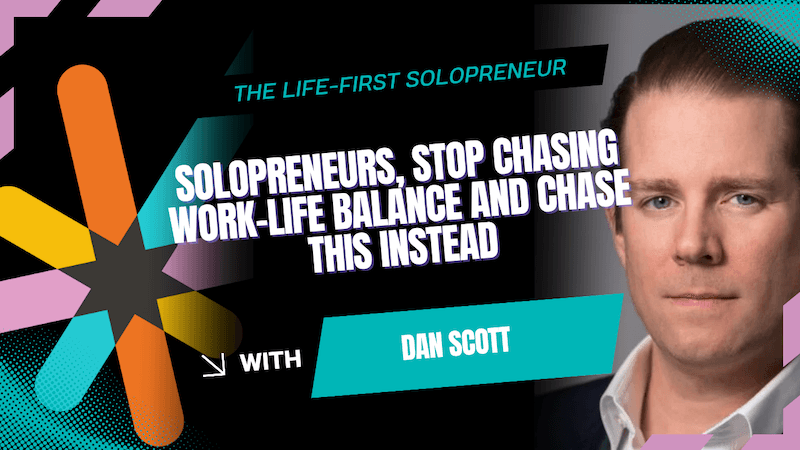
Can you build a stable income from creative work without selling out? According to Dan Scott, founder of Spotlight Advisory Group and a former law firm attorney, the answer is yes, but only if you stop chasing "balance," stop chasing "more," and start treating your creativity like the business it is.
In this episode of The Life-First Solopreneur, Dan joins hosts Carly and Joe to reframe how creatives should think about money, purpose, and success.
What is the difference between work-life balance and work-life harmony?
Balance implies an equal allocation of time between work and life. Harmony, Dan argues, is when the parts of your life work together seamlessly, even if the time split is unequal. Entrepreneurs living their purpose often work far more than they "play," yet experience deep satisfaction because everything blends toward the same goal. The takeaway: stop measuring hours and start measuring how well the pieces of your life fit together.
What does financial freedom mean for creatives?
Dan defines financial freedom as having enough money to live your purpose, not accumulating the most money possible. That definition has two parts:
First, "enough" is the goal, not "more." Research consistently shows that once people clear a survival threshold, additional income stops increasing happiness. Second, financial freedom includes freedom from the value system we've built around money, escaping the hamster wheel where business success is measured only in dollars.
Why do so many creatives struggle financially?
According to Dan, the biggest culprits aren't lack of talent, they're planning failures:
Aspirational spending. Creatives often spend as if success has already arrived, incurring debt they plan to "make up later." Living within current means, and treating windfalls as cushions, not lifestyle upgrades, is the sustainable path.
Misallocated budgets. Independent musicians, for example, pour money into producing a record but budget nothing for promotion, so the work never reaches an audience, and streaming alone pays almost nothing.
Trading ownership for paychecks. Wealth is ownership. Dan points to Taylor Swift buying back her catalog as the model: if someone offers you $100 million for your catalog, it's probably worth ten times that. Selling your work also means losing control over how it's used...your legacy, not just your income.
Is your art actually your purpose?
Dan's most contrarian point: your craft is not your purpose. Sculpting, songwriting, and design are vehicles for a deeper purpose — and you don't always get to choose where you're needed. Joe shares the story of a sculptor friend who found his audience (and his income) in landscape architecture, applying the same 3D skills to a market that valued them. Staying open to where your creativity is best received maximizes both impact and revenue.
Key quotes from the episode
Dan closes with two guiding quotes: Steve Jobs' reminder that everything around you was built by people no smarter than you (so your ideas belong in the room) and Dan's own philosophy: "The life you live is the legacy you leave."
About Dan Scott
Dan Scott is the founder of Spotlight Advisory Group, where he helps creatives, entrepreneurs, and business owners transform their purpose into sustainable businesses. A former law firm attorney, Dan writes a weekly blog on purpose, money, and freedom.
- Website: spotlightadvisorygroup.com
- Email: info@spotlightadvisorygroup.com
- Instagram: @DanScottSpotlight
Frequently Asked Questions
Q: Can creatives make a full-time living from their art? A: Yes. Dan compares creative income to the full salary spectrum, from a teacher's modest living to a lawyer's six figures. A creative career at any point on that spectrum is achievable with planning, discipline, and execution.
Q: Should artists sell their catalogs or creative work? A: Dan advises against it in most cases. Ownership is the foundation of wealth and legacy, selling trades long-term value (often worth many multiples of the sale price) for short-term cash, and surrenders control over how the work is used.
Q: How much should creatives save for retirement? A: Enough, but not more than enough. Dan argues many entrepreneurs over-save for a traditional retirement while under-investing in themselves and their business now, which is often the higher-return move long term.
Listen to the full episode on Apple Podcasts, Spotify, or YouTube. If it resonates, leave a five-star review and share it with a solopreneur building a life-first business.
Episode Transcript
Carly Ries: What if the goal was never a lot of money, but just enough to live your purpose? In this episode, lawyer turned advisor, Dan Scott, joins us to blow up a few myths about creativity and cash. We get into why work life balance might be the wrong goal, and why you should aim for work life harmony instead. Why chasing overnight success sets creatives up to fail, and why making it isn't necessarily the yacht. It's the power to wake up every day as a working creative living within your means.
So whether you're a struggling musician, a sculptor eyeing a pivot, or a solopreneur wondering if you're doing it right, this is your permission slip to define success on your own terms. And fair warning, there are lot of musical puns in this one. Sorry, but we are not sorry. You're listening to the Life First Solopreneur, the podcast for those in pursuit of a life first business. I'm Carly Ries, and my cohost, Joe Rando, and I spend every episode with solopreneurs who are proving there's a better way to run a one person business and experts who are helping make it happen.
We like to say life first, then business. So let's get right to it. Dan, I got here a little late and I know you and Joe were talking offline about a little jam session that you have going on. I'm so sorry to interrupt your plans for that. That's so weird of me.
Maybe we can end the episode with a jam session, you guys.
Dan Scott: Maybe we could. Yeah.
Joe Rando: It'll be made better by the delay, the Internet delay, you know.
Carly Ries: Exactly. Well, Dan, we're talking about your session. It's because we're talking about, like, kind of some things with creatives today that not a lot of people talk about when it comes to creatives. You're kind of like a unicorn in your space. So I wanna start with our icebreaker question that kinda leads into that.
You didn't necessarily take the safe, predictable career path. Was there a specific moment or a conversation, a client, whatever, where you thought I can't keep doing this the traditional way, and then decided to bet on yourself and did and started what you're doing today?
Dan Scott: I can't say there was a specific moment. There was a gradual growth over time. And you know, I was thinking about this this morning. I think it really began, the itch really began when I became a father. Because at that time, I was already, into sort of self improvement and all these other things like sort of being my best self. And being a dad, I became really committed to I have to live by example. And, you know, be my best and be my greatest self. And so it was shortly after my kids were born, probably two or so years that I took the leap. But that was really the beginning and, couple that with I had been a lawyer in law firms for many years and had increasing, opinions about the business model and also my practice and things.
And so I was kinda, hitting a wall there and not loving what I was doing and thinking there was a different and better way. And, finally, probably the, kind of straw that broke the camel's back was going through a divorce. And, being in a moment of my life where it's kind of a crossroads and just an insistence on, like, I'm gonna do everything 100% right and, why not take on that challenge, you know, sort of a nothing left to lose moment.
And haven't looked back, it's been whatever, so many years now. Twelve years or something like that.
Carly Ries: Well, I think you have started to or if you haven't already found the balance, well, you found the balance. You teach people how to find the balance, and that's what I wanna talk to you about today. Because looking at you, you have a guitar in the background. You're an adviser. I wanna know like, why do creatives often feel like they have to choose between their art and stability?
Dan Scott: Well, I wanna catch something you just said, which was the word balance. And there's a difference between balance and harmony. Right? I think balance implies an equality.
If you think about something balanced, it's equal weight. And when somebody tries to achieve balance in their life, they're sort of thinking of things as an allocation or equal allocation of time. Harmony is really when parts work together. seamlessly, perfectly.
But it's not necessarily about a quality of time. It's, more about, hitting the right notes. And sort of everything blending correctly. So I'd like to think I have harmony in my life, not necessarily balance.
I mean, I currently work a lot more than I play in some sense, but just an interesting distinction to think about.
Joe Rando: You know, I really love this because you see all these people on LinkedIn these days going, work life balance is a fallacy. It's not real. It's blah blah blah. And I never, really understood it, what they were saying. And I think what they're trying to say, nearly as eloquently as you did, is that it's not about balance.
It's about harmony. Work life harmony. And I love that. That is so, on point to what's real in terms of balancing your work your life. You're not balancing them equally.
As you say, you're working more than we play. But to have them work in concert in such a way that, they're not harming each other, that they're going together. That's really neat.
Carly Ries: both of you keep saying musical puns, whether it's intention or unintentionally. Chasing Harmony, Joe, you just had one. are we just gonna do that the whole episode?
Dan Scott: musical pun. That's the name of the episode is musical puns.
Carly Ries: Thank you. Now I feel like I need to channel my dad jokes out
Dan Scott: Still the symphony of life that we're talking about is orchestrated by yeah. So the only thing I'll just add to that, Joe, to your point is when we talk about work life balance, I think when you hopefully that when you're an entrepreneur, you're really doing something that you believe in and love. Right? I talk a lot about purpose. I think, each of us has the purpose and, your time should be spent trying to sort of fulfill that, to bring that value to the world.
And when you do that, when you are focused on purpose, it's all consuming. Right? I mean, and so when you , I don't like the word work. Right? I'm living my purpose and that's twenty four seven.
And so when it comes to helping other people, which is I guess my job or what I do as a business. You know, when you love it, when it's who you are, you don't even pay attention. It's kind of like being in flow, right? People talk about the flow state where, time is lost, right? It's not a pressure. I think that it is so important to find something that doesn't feel like work, so that you don't even have to think about that balance again of time. It's again harmony, right? And so it integrates into everything you do, including being a parent, and all those different things.
Joe Rando: I wanna challenge you on something, because I get it, and I love being in flow, But at least for me, and I'm curious if it's for you, in order to do the things that put me in flow, I have to agree to do certain things that I don't flow with. Some things I don't even like in order to run an actual business. And I'm just curious , sometimes I feel like we put out that everybody's just these people get into this job where they built this thing where they are just in flow all the time, everything's wonderful. I mean, is that true for you? Or are you doing some crap that you wish you didn't have to do in order to maintain that?
Dan Scott: Well, I understand your point. I think the question comes back to what is your goal, ? And so when I talk about, you can live your purpose and have it have a certain level of impact, right? And you can incorporate that into your private life, and your social life, and things like that. I think if you wanna make the greatest impact on the world and sort of fulfill that purpose to its greatest degree, doing it in a commercial way through commerce is the most effective, right?
Then who is listening today and who is receiving is a consumer. And so that's where I make the leap from purpose to business, right? To transform your purpose into something that is a business is a necessary step if you want to effectuate that purpose to its greatest degree. And in choosing to start a business and choosing to have the experience of being a business owner or an entrepreneur, there are sacrifices that inevitably come with that.
Such as, administrative tasks or things that people don't consider, fulfilling. But it's, like anything in life, I mean, you don't have to choose it, but when you do, understand what you're choosing. And there are sacrifices, if you want to be successful in terms of not, I mean, not even just financially, but in terms of having success and having your impact on people. It requires sacrifice. It absolutely does.
And there are things you don't. but even let's be a little bit more abstract and talk about, happiness. Happiness is not continual heightened moments of joy. It is a prolonged sense of satisfaction that we're talking about.
And there are ebbs, there are peaks and valleys along that, line of life and happiness. So the same is true of business. You're not gonna enjoy every moment, but when you step back, if you do it right, you're going to have a prolonged satisfaction and I would hope your greatest satisfy, you know, you're doing the thing that brings you the greatest long term satisfaction.
Joe Rando: Awesome.
Dan Scott: But, yeah, nobody likes to do invoicing and books
Joe Rando: I knew someone. She loved invoicing, and that's why she had a job doing invoicing.
Carly Ries: Yeah. Hard pass over here. So speaking of invoicing and the money side of things, do you equate financial freedom to harmony for creatives? Or are those one in the same way? Are those different to you? How would you define financial freedom for creatives?
Dan Scott: Well, freedom, I think the answer is for everybody, really. It's not just for creatives. What are we trying to achieve? You know, the first thing you need to think about or clarify is what financial freedom is not.
Okay? Financial freedom to me is not about having a lot of money. The goal in my opinion is to have enough money. And that's a big distinction because it empowers you to stop chasing at some point. We live in a world where we have to, in order to provide for our living needs, make money. So if you're gonna live your purpose and you wanna do that around the clock, you have to transform that into something that makes money. But the goal shouldn't be the most amount of money, the goal should be the most amount of impact or purpose, and achieve having enough money to provide for a comfortable life. So that's number one.
The other thing that I talk a lot about is, it's not just about the amount of money. Freedom is also freedom from the value system that we've created around money. To sort of divorce yourself from that financial hamster wheel where the goal of your business becomes about, and is measured in terms of dollars.
That to me is not success. You know, success to me is measured in something greater, in terms of happiness and fulfillment, which you know, PS actually long term leads to the most amount of money anyway. So that's the first two things I would clarify. Then the question is, when we talk about having enough money, enough money to do what?
I think it's really about, the simple question. Everybody wants to be happy. Right? You ask a 100 people in a room, what do you want out of life? And the simple answer is happiness.
And so really what we're talking about , financial freedom is having enough money to live a happy fulfilling life. And the step that I go beyond that is my conclusion that living your purpose results in your greatest happiness and sense of fulfillment. So for me, the definition is having enough money to live your purpose.
Joe Rando: And I mean, the research has shown that, as people make enough money to not struggle, you know, to be able to kind of meet their needs. And as their income goes up from there, happiness doesn't increase.
Dan Scott: No, it's true. There's a number of studies around that. There's a threshold, which is sort of like a survival threshold. Like once you're not fighting to survive and you have enough money to put food on your table, then, you know, increasing your dollars increases your spending. It doesn't improve your lifestyle.
You know, there are some arguments against that or some sort of qualifications I would put around that. I mean, reality is money can be a lot of fun. There's nothing wrong with money. Right? And this shouldn't be a discussion that money is bad.
Money is completely value neutral, and it's about what we do with it. And that's the biggest point I make to people is it's what you do. Money is a tool. The mistake that we've made is that we've made it a goal, and we've made it a status symbol, we've made a measure of success. And so what we want to do is achieve money.
But really we should be looking to achieve something else, right? That's purposeful, and utilizing our resources of which money is one of many, to build that life, right? I mean, always say , you don't need more money than you need, I mean, sitting on a pile of money that's doing nothing is pointless. It doesn't do anything.
So whether it's money, that's not to say that savings and things don't make sense, of course it does, because there's a purpose to what you're saving, right? Whether it's retirement or something. But having again, more than you need for retirement, doesn't make any sense. And one of the things I always advocate for with entrepreneurs and creatives, is make sure that you are investing in yourself, right? I mean, a lot of times we oversave for things like retirement,
And again, traditional financial advisors and things, you know, their goals are financial and material typically just because that's the nature of the beast. So we think about, well, you gotta get that, second condo in Florida or something and retire down there and have a budget for travel and sort of all of these luxury items or lifestyle items. Whereas, I would rather you plan for maybe, enough money, a little bit more of a modest retirement, so that you can have more money now to really invest in yourself and your happiness and your fulfillment, and building something that is long term sustainable, that brings your purpose and impact to the world. And PS, it's probably gonna produce more money anyway, so you'll have that more money for retirement. It's just not being so conservative now.
Carly Ries: So let's say a creative is listening to this episode and they're like, Dan, this all sounds great. I wanna live my purpose. I want just enough money. But I'm a struggling creative right now and I have not hit that threshold. I keep seeing all these people on TikTok and Instagram who are overnight successes and it looks so easy, and that they could just hone in on their craft and live on a yacht.
What do you say to the people that are listening that might feel discouraged saying, Dan, this all makes sense, but I'm not there yet. what's your answer?
Dan Scott: So there are so many things to unpack there. One is TikTok and Instagram. Right? that's a quick a get rich quick scheme.
It doesn't work. And the statistics, you're seeing the exceptions to the exceptions in terms of people that make so much money online and things. Again, what are you trying to achieve as a creative? I think again the mistake is that we're sort of taught and what's embedded in us from a value system is that the idea of being a successful creative is this idea of quote unquote making it, which is a more extreme version of success. It's having again a lot of money as opposed to enough money. I tell creators all the time that if you take the spectrum of salary that is out there for somebody, you know, call it a teacher or somebody making a modest living, 50 or $60,000 a year maybe, to doctors and lawyers who make hundreds of thousands of dollars, you know, you can fall on that spectrum of salary. You could have a respectable job, and that job being your creativity. It just takes planning, discipline, execution.
And one of the biggest problems I see is a lack of financial planning and budgeting. There's a tendency for creatives to be aspirational when it comes to spending money. And so they act like, I'm gonna sort of spend now because I'm gonna make it later and make up for the debt or whatever it is that I've incurred. Instead of realizing that making it is that power to wake up every day, be a working creative, and building a lifestyle that lives within your means there.
And that can be done. That can be achieved. I mean, again, because it's the spectrum of salary out there. And you know, people make a living and it can be a modest living, but they live within their means. And so building the life where you're being more realistic, less aspirational, that's key.
And being smart on where you're spending your dollars, you know, creatives, if we're talking in the arts, can put a lot of costs into producing their art and strive for perfection and overspend or misallocate their dollars. Right? You know, a classic example is, independent musicians will, pour a lot of money into producing a song or a record. And they don't necessarily have a plan to monetize that, because the music itself today doesn't make any money.
Streaming doesn't make any money. And they won't necessarily have a budget for let's say promotion, right? PR and marketing. And so they don't get the song out there even, right? And so how they're spending their dollars, there's a misallocation of funds that sort of lacks that long term planning.
And there's also this idea of the mistake of being aspirational, where they're better off trying to live within their current means. And if they make it and there's a windfall, well then, first of all, you can, create a cushion for yourself. And then you can maybe increase your lifestyle once that's regular. But that's another mistake.
Somebody who has, you know, songwriters for example. A lot of musicians, make money writing songs for other artists. The Taylor Swift, well, she writes a lot of her own music. But you know, a lot of the sort of a list pop stars don't write their own songs and they have songwriters.
And so a songwriter could get a modest, what's called publishing deal. Right? They get paid to write songs. And if they have a major hit, they might, have a financial windfall. And when that happens, the mistake that commonly, follows is they feel like that's gonna continue. And so they adjust their lifestyle or they buy a large home. And they increase their living expenses well beyond what is sustainable. So long story short on that, is that most creatives would do a lot better in terms of making their ends meet or surviving as a creative if they had better financial planning early on and manage their money more efficiently.
Carly Ries: I really hope Taylor Swift figures out a way to monetize her music.
Dan Scott: She's really trying to learn.
Carly Ries: Yeah. She's really trying learn. One day she will figure out the answer to that.
Joe Rando: Yeah. She's figured out a way to monetize the NFL.
Dan Scott: I love Taylor Swift. I'm not just saying that because that'll make my wife smile. But she's done so many things right. And one of the biggest ones recently is, buying back her catalog.
She now owns her music. And you know, when we talk about again sort of success, and particularly wealth or wealth building, or financial success, ownership is everything. and that's something a lot of creatives also don't understand is, you know, they'll take a paycheck because it's real and it's now. But wealth is ownership. I always talk out, you know, I speak a lot against artists that sell their art or sell their catalogs. You're selling ownership. And you know, if someone's paying you a $100,000,000 for something, well guess what? It's probably worth, 10 times that. t there's just a lot more work involved. And I think that's also a lesson for everyone who's an entrepreneur. And artists and creatives, if they're going to build a career, right? If they're going to monetize that creativity, they have to be an entrepreneur.
They're a business owner.
Joe Rando: Just a question on that, though. Is there another aspect to ownership with music, especially where you're controlling how it's used? I mean, if you write songs and somebody else owns it, now they're using it for a commercial to sell dog food. I mean, not nothing I love dog blogs, so dog food's great.
But, you know, they're selling something and you don't like it, or they're using it licensing it to a political candidate that you don't wanna support. You don't wanna lose that control either. Right?
Dan Scott: so you're hitting it on the head and that comes to the idea of like legacy, right? Which is sort of continuing purpose of someone's life. Like, why did you do what you did and what does it stand for and what does it mean to the world, right? It's a lot more than money. and sort of back to the point I was making about, selling versus owning, ownership is hard.
It's hard work, you know? But when it is your purpose, you should be willing to put that work in. And that's again, coming back to the idea of sacrifice. There are sacrifices involved in doing things right. And the short road is never I don't think it's ever right in the sense of the long term.
So that's something artists need to think about and sort of again commit to. I think that when you know, if you wanna be an artist more than a hobby, or you don't wanna have a job on the side that pays for your living expenses, you transform your art or your creative expression into revenue, that's a business. You are now an entrepreneur, and you need to do the things that entrepreneurs do if you're going to survive. And that's just the nature of the beast. I didn't invent the system, I just need to be honest with you about it.
And it means that that's a lot of work, and you know, you can't just write a song and have money come in. You have to monetize that song. And in order to do that, that's work. And it's probably work that you won't enjoy if you're doing it yourself, but it's unnecessary. It's a sacrifice.
Joe Rando: I have a dear friend who was a sculptor. He had his degree in sculpture. And he was a good sculptor, but, you know, it's just not a lot of money in sculpting things these days. And all of a sudden, discovered landscape architecture. There you go.
Guess what? Same skills, three d, Took those skills and turned it into, placing, stones and plants and trees and brickwork, and he's done very, very well and, been able to start his own business. He's a solopreneur. And it's just what you're talking about here, taking the skills and finding a way to monetize it.
Dan Scott: Well, you're really touching on something that I believe in. You know, again, I come back to purpose. So whether you're a sculptor or, whatever you think, a lot of creatives think this is purpose. My purpose is to sculpt, my purpose is to make music. And I tell them immediately it's not, right?
What you do is not your purpose. It is a vehicle and a form of expression that embodies that greater purpose. You have to know what that greater purpose is. Then it becomes a question of how do you bring it to life? And I believe that creativity is sort of the gateway to fulfilling that.
Our creativity is what makes us unique in terms of our ideas and things. And people are creative and have different talents, right? So you then need to look at sort of what are your natural talents and gifts, and how do you sort of turn those into real skills. Most people have, whether they realize it or not, more than one form of creative expression. And I believe that we should all be fully expressed. Because the kind of, the catch that I tell creatives, and again, this comes back to the goal of being purpose, not necessarily monetization. A purpose is something served, Right? It implies that there's a need for you in this world. And fortunately or unfortunately, we don't get to decide where we're needed. And so we need to be open to the possibility that, you know, my biggest audience and where I'm needed might not be on a stage. That might be something I still do and maybe I reach a certain audience there. But all of a sudden my landscaping has taken off. Right?
And the level of sort of reception that you have, is an indication of maybe where you're needed. And that's something that I think there's an element of faith involved and acceptance, and sort of surrender to that, you know, what you're supposed to be doing might not be what you think. And that's so important when it comes to building a successful life. Because again, springing it back to entrepreneurship, there is a need to monetize, there is a need to generate revenue, and your greatest success is going to come from embodying that purpose in a form of commercial expression that reaches the most amount of people, and therefore right does two things.
It maximizes your impact, right? And that maximizes the delivery of that purpose on people, what will affect them, and it maximizes your revenue stream. It's a win womb. But you have to not be stubborn. I always explore with business owners, with anyone who's a creative artists, entrepreneurs, etcetera.
You know, what are the possibilities there? And how do we sort of cap the widest net to sort of see where we are best received?
Joe Rando: I will say that we have a lot of solopreneurs that we're involved with at LifeStarr. Some of them deliberately don't choose the largest demand, largest audience for their skill because they're building a life first business, and they just decided I want to serve these people because this is what I love. And I think that's legit. You know, I think it's you don't always maximize your impact as in terms of numbers of people or in terms of dollars, but you maximize your impact in terms of what you wanna see, happen in the world.
Dan Scott: I totally understand that. I totally agree with that. In fact, there's plenty of people I work with who they don't necessarily care if they have an impact on the world, right? I mean, that's fine. That's their world view.
The reality is when it comes to building a business or a legacy of any kind, like it or not, you do have an impact. So I always encourage someone to try to choose that. But the scale of it, to your point, totally up to you. I mean, if you have total financial independence and you don't need to ever make money, you're free to do whatever you want. You don't have to build a business, but you would still be creating something in this world.
Some people you know, would be very content staying at home and creating without anyone ever really receiving it. And that's completely fulfilling for them and wonderful. Right? Other people need an audience or need to sort of convey that purpose or expression.
So that's the other thing too interestingly is the idea of participating in the economy or being a business, it's I don't know how to say this. It's not a given necessary. Right? again, we're just sort of trained to think that's what you do. And define in this culture who we are by what our profession is.
And I just think that's all wrong, Work and money, this is why when I teach about money, the first thing I have to help people understand is what money is. Money is completely made up. It's a fiction.
It's not real. It doesn't have like, an inherent existence. It's something we created in order to make the exchange of value easier. Because when we traded, it was hard.
I had a sheep and you had a bundle of apples. Right? Sometimes, it didn't line up. So how do we embody something and create value? So it was intended to be a tool.
And we transformed it into a goal, it's just, overtaken our society, where everything we do is defined by the economics and the economy. And I tell people all the time, the economy is supposed to serve you. Right? Money is supposed to serve our needs. And we've kind of, lost the plot on that.
And we now serve and are slaves to the economy and money. When it comes to you know, and this comes back to financial freedom. This is where I say you have to escape that mentality if you're going to live a happy fulfilling life. Because happiness and fulfillment and satisfaction have nothing to do with money.
Carly Ries: I think we should start a challenge where the next time you go to a dinner party, and Dan maybe you already do this. But the next time you go to a dinner party, the next time listeners, you go to a dinner party, instead of asking, so what do you do? Say, what's your purpose? We should just start that.
Dan Scott: Right.
Carly Ries: Right. And like, let's change the narrative because you're right. Default is what do you do? Yeah. So I'm gonna go somewhere and I'm gonna say what's your purpose?
Dan Scott: What do you do? Say, why do you do? Why do you do today? Yeah.
Carly Ries: Yeah. Exactly.
Dan Scott: you know, I would love for there to be a cultural shift because, and maybe it's just I always kinda joke there's there's just some punk rock in me that wants to tear the institution down kind of thing. You know, I mean, it doesn't seem to serve the people's needs anymore. We've become, held back by it. And so the trick to me is, I'm all about choice.
We have a choice in everything we do. You don't have to participate in this economy. You know, you can go live in a mountain somewhere and and live off the land and not, you know, that's a hard choice. You know, it's a lot of sacrifice. So it makes sense that people choose to participate in the economy.
So what that means is, you have to understand the rules. You have to understand how it works. You have to, keep in mind that it's entirely made up. And so that like, allows you to navigate it in a way without it becoming your personality at the same time. It's just, it's a necessary, it's a sacrifice.
Again, I wanna participate in the economy because of all the benefits, right. When it comes to providing for my own needs as well as reaching people, right. Again, purpose to me comes best through impact. I mean impact comes best through commerce. So I make a decision to participate.
And you know, that is my decision, and I can opt out. But so long as I do, I need to understand the rules, so that I can you know, do my best within that system. But I don't have to subscribe to the system.
Carly Ries: I just love the way your mind works and the way that you view things because I think it's very unique and I think it's very refreshing to look at the world through this lens. So yeah. I just wanna say thank you.
Dan Scott: Oh, I appreciate it. I kinda always joke like, I'm either crazy or I'm right at this point.
Joe Rando: So Dan, are you a Star Trek fan?
Dan Scott: I can't say that I am. No. I mean, growing up, I was a Star Wars fan.
Joe Rando: Okay. Just your philosophy sounds a little bit like the philosophy of the people on the next generation show. It's about self improvement. It's about accomplishment and achievement of the things that you want to pursue. And, obviously, it's a post capitalist society, but we don't know how it works because they never explained that.
But I was just curious if you that was an inspiration or not. But, yeah, I'm a geek. I'm a geek.
Dan Scott: So I yeah. I honestly am not familiar at all with this, but that's always cool when your when your ideas line up with something you're not familiar with. You know? Yep. You know, it might sound at times like I'm not capitalist, and in essence I sort of am.
A lot of, you know, I believe in limitless success, right? And the opportunity to sort of do that and capitalism in its truest form provokes that, I think, and propels that. Time for another discussion for another time is whether or not we actually live in a capitalist society. I would argue we probably don't at this point.
Joe Rando: I think you could call it, you know, corrupted capitalism, at least in The United States at this point. It seems to be corrupted capitalism, but, you know, I mean there are some countries that, you know, seem to be making it work pretty well.
Dan Scott: Again, money is a tool, you know. And I think the biggest crime we've committed is really it's more the value systems we've placed around money. And, you know, it's just a false idol, you know.
Carly Ries: Fair fair point. Well, Dan, like I said, I feel like we could just talk to you all day. This is so fascinating to me and I feel like there's a wealth of knowledge that so many people know about. We're gonna wrap things up. But before we do, we ask all of our guests this question.
What is your favorite quote about success?
Dan Scott: I think I knew you were gonna ask this, and so I gave it some thought because there's a quote that I I'm gonna give you two. Okay? So the first is, I love Steve Jobs once said, I think alright. Let me pull up the quote so I can read it.
Here it is. Everything around you that you call life was made up by people that were no smarter than you, and you can change it, you can influence it, you can build your own things that other people can use. And I love that because I think what holds people back so often in life is them thinking that they're not capable or they're not good enough or that, you know, things are the way they are because people much smarter and much more qualified than them created the system. So they have this inherent acceptance and even support of the way things are. And, again, maybe it's the punk rock, but it's like, no, that's not the case.
You know, the world was created in our systems and institutions and everything were created by people no smarter than any of us. And so that's two things. Right? One is, know that you belong in that room with them. Know that your ideas are valid even if they're different, because things don't have to be the way they are.
It just ended up this way. So that's a big one for me when it comes to you know, somebody else's words. The other quote I just wanna give you is my own. And right there on my website. And it's that the life you live is the legacy you leave.
And then I think it's so important to focus on the life that you're living, and understanding that, it is to live by example. It is making the most of the life you have in terms of the impact, in terms of the to go back to Steve Jobs, the dent in the universe that you're making. So those two are really what resonate with me, I think most.
Carly Ries: Well, Dan, speaking of your website, where what is your website? Where else can people find you if they wanna learn more or reach out?
Dan Scott: Great transition. www.spotlightadvisorygroup.com It's a long one. You know, you can also just email infospotlightadvisorygroup dot com, and I will respond and get back to you. There's a blog on our website that has, you know, it's a weekly article I write on all different kinds of things around purpose and money and freedom, all of that.
So there's a lot of information you can get there. And yeah, if it resonates with you, contact me, . or you know, Instagram is @danscott spotlight, and I post things on there as well. So would love to, have a conversation with people. I love it.
That's what we're all up here about.
Carly Ries: Visiting all of that will be an encore to this show. I got to throw in a music thing. Right? I love it.
Dan Scott: The encore.
Carly Ries: Yeah. Last minute.
Dan Scott: turned it up to eleven today.
Carly Ries: I think we did. Oh, man. Guys
Joe Rando: I see what you did there.
Dan Scott: You like that one? But please go to eleven.
Carly Ries: Well, Dan, thank you so much for coming on the show today. This was so fun and we really appreciate it.
Dan Scott: I had a great time.
Carly Ries: And listeners, as always, thank you so much for tuning in. Please leave that five star review. It helps us spread the word to other solopreneurs leading a living a life first business, especially creatives. Subscribe on your favorite podcast platform including YouTube, and share this episode with a friend. And we'll see you next time on the Aspiring Solopreneur.
You may be going solo in business, but that doesn't mean you're alone. In fact, millions of people are in your shoes, running a one person business and figuring it out as they go. So why not connect with them and learn from each other's successes and failures? At LifeStarr we're creating a one person business community where you can go to meet and get advice from other solopreneurs. Sure to join in on the conversations at community.lifestarr.com.