









23 min read
Why Betting On Yourself Is the Safest Career Move Now
 Carly Ries
:
Jun 30, 2026, 1:40:23 PM
Carly Ries
:
Jun 30, 2026, 1:40:23 PM
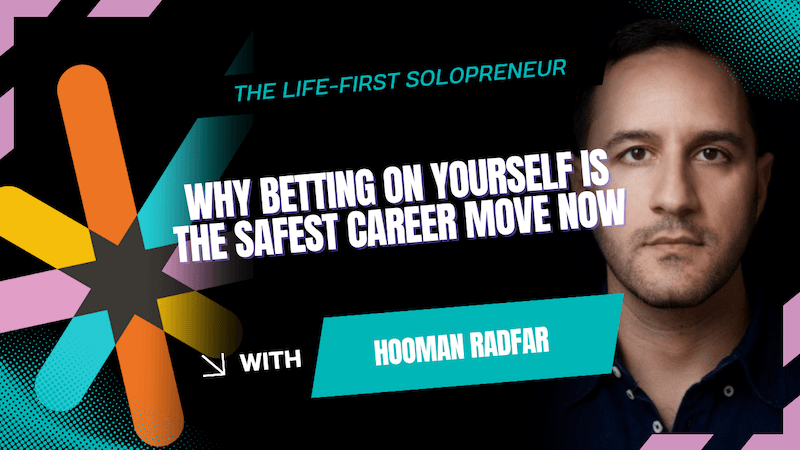
Hooman Radfar, co-founder of Collective and an early investor in Uber, SpaceX, Stripe, and OpenAI, joins The Aspiring Solopreneur to explain why he believes solopreneurship may now be a safer career path than traditional employment, how AI is reshaping what one person can build, and why back-office operations are the most overlooked risk for solo business owners.
What is a solopreneur? A solopreneur is someone who owns and operates a business by themselves, without employees, taking full responsibility for everything from client work to taxes, bookkeeping, and legal formation.
Why does Hooman Radfar say corporate jobs aren't as safe as they seem? Radfar argues that large-company "safety" is an illusion: employees at companies with tens of thousands of workers often have no personal relationship with leadership, and layoffs increasingly happen even when companies are financially healthy, sometimes specifically because cutting headcount boosts the stock price.
How is AI changing solopreneurship? Radfar believes AI is acting as a productivity multiplier that allows very small teams, and in some cases a single founder, to reach revenue levels that previously required dozens of employees. He points to real examples of solo operators scaling from low six figures to seven figures in revenue within months by automating parts of their business.
What's the biggest challenge for solo business owners? According to Radfar, it's not the core work itself — it's back-office operations: entity formation (LLC vs. S-Corp), bookkeeping, payroll, and taxes. He estimates solo business owners can spend roughly 25% of their time on financial administration without realizing it.
What separates successful solopreneurs from those who struggle? Radfar says the most successful solo operators have extreme focus on one core competency and a repeatable service model, rather than taking on a wide variety of mismatched client work that prevents them from building expertise or a track record.
What's the first step to becoming a solopreneur? Radfar's advice: stop waiting for a perfect plan. Start with something small and concrete (even just a folder and a document outlining your idea) and build a daily habit of moving the business forward, even in small ways.
Guest bio: Hooman Radfar is the co-founder of Collective, a back-office platform built for solopreneurs and business owners. He previously co-founded Expa with Uber co-founder Garrett Camp and has invested in companies including Uber, SpaceX, Stripe, and OpenAI.
Listen and subscribe: Apple Podcasts | Spotify | YouTube
Episode Transcript
Carly Ries: What if the safest career move you can make right now is betting on yourself? This week, we sit down with Hooman Radfar, serial entrepreneur, computer scientist, and cofounder and CEO of Collective. In this episode, he makes the case for why corporate, quote unquote stability is more illusion than reality, why the back office trips up so many solopreneurs, and what AI could unlock for businesses of one. His advice for anyone on the fence, just start, show up every day, and remember that every overnight success actually takes time. So let's dive in.
You're listening to the Life-First Solopreneur, the podcast for those in pursuit of a life first business. I'm Carly Ries, and my cohost Joe Rando and I spend every episode with solopreneurs who are proving there's a better way to run a one person business and experts who are helping make it happen. We like to say life first then business. So let's get right to it. Okay.
Hooman, you have quite the resume. And since we're talking to a bunch of solopreneurs, we always like to bring our guests to human level, if you will. So we have an icebreaker question for you. you've invested in everything from Uber to SpaceX. So if you could start a completely ridiculous business that has zero chance of making money, but would bring you so much joy, what would it be?
Hooman Radfar: I was actually talking to my wife about this. You know, I was thinking about what I would do next. it's a thing. You know, I actually don't switch jobs a lot. I've only had three jobs in my career, believe it or not.
And actually I was really into comics and art and drawing growing up as a kid, and in another world would have been drawing for Marvel comics. I have a young daughter, and I think just making Pixar movies, I would start a studio up in you know, kinda like what Pixar did, and I think I would just make movies, like animated movies for kids.
Carly Ries: Oh, I love that. I have young ones too.
Joe Rando: And not a terrible business.
Hooman Radfar: Well, so this is the thing, I struggle with the question, because I'm like, you know, I think you can actually make a good amount of money, but if I was just doing it for pure joy, that's one. The other one, if I want to really not make money, and this is a dorky thing, is I'm an engineer by trade, so I'm really into complex adaptive systems. So these are like really, really, really complex systems. Like, you are a complex adaptive system. There's a life form.
The universe is complex. So I would literally go back and just do my PhD and do research there, or you know, if I was so inclined, start an institute and just study that particular area, these really, really complicated systems.
Joe Rando: We gotta talk offline. I love this.
Carly Ries: I will let you guys talk offline.
Joe Rando: I identify as a geek, so I love it.
Carly Ries: He does. Well, okay. So you may not have had a lot of jobs, but you have made quite an impact. You've built companies that have reached billions of users.
You've invested in companies, like I was saying, but also with with Stripe and OpenAI, and worked alongside the founders of Uber and Foursquare, which are some pretty big companies. With all of those options in front of you, why did you decide to dedicate this chapter now to solopreneurs?
Hooman Radfar: Yeah. So I was at Expo with one of the founders of Uber, Garrett Camp, had decided really was important to him, and he was passionate about helping be the partner that we wanted when we were first starting out. Joe, we talked about folks like Ron Conway in the pre discussion. He was a great partner. But there aren't a lot of folks like Ron.
And so what we were specifically looking at is the class of venture capitalists that were there, they tended to be more classic bankers, consultants during our cohort. And what we needed at the zero to one stage was someone who could help us product market fit, go to market, really tactical issues. And so that was something that really identified with Garrett did, Naveen who was founder of Foursquare, our other partners early on like Roberto and others. And just we really thought that was a missing gap. So we had a passion for founders.
Now when I was doing this for years, I had a couple of insights. The first was I love serving founders. It's been the great joy of my life to be one, but also to work with them either through my family office as an investor or through XBA through that platform. It's just so fun. You learn so much.
You learn what you're good at. You learn what you're bad at. It's just humbling. The second thing though that I learned is my first company AddThis , we achieved pretty tremendous scale. And we had about 15,000,000 customers.
We helped those 15,000,000 customers draft traffic for about 2,000,000,000 unique users that would visit their websites. I mean, for a first job, it was a lot. but I missed that. I missed that level of scale. So I love Surrey Founders.
I missed the scale. And so when I started thinking about those two together, the largest group of founders, and that is true today, and it was true then, are these businesses of one? Are these solopreneurs? And when I started looking at it, I started ironically because of Uber in some ways, the gig economy. That you know we had a shared kind of view on that because of the history of expa.
But as I opened up and I realized my parents were solopreneurs, I just didn't think of them that way. They were doctors. So you don't think of doctors as a kid at least,as businesses. Right? But they were.
They had to incorporate. They had to do their books. They did the taxes. And just it became personal. So here I had this like, I'm passionate about serving founders.
I'm passionate about the scale, and I can identify, I really can, with the customer at a visceral level, both in terms of my experience, but also in terms of my parents. And I thought, okay, I realized I stay on things for a very long time. If I'm gonna stay on a hill for a while, this is one that I can spend some time on.
Carly Ries: I love that. Okay. So speaking of solopreneurs, you have actually said that the safest career move right now might be betting on yourself. And that's a pretty bold statement when we live in a world where most people cling on to that stability. So can you make the case for someone listening who's on the fence whether they should stay corporate employee or whether they should become a solopreneur?
Hooman Radfar: So I'll give you maybe a broader answer. I'll give you a story, okay? And then I'll tell you my answer.
Joe Rando: We love stories.
Hooman Radfar: Great. So my first business, it was 2008. If you guys remember, it was obviously not an easy time economically. And so I had just had to do a layoff. I'm in my twenties, and there wasn't a playbook for this. And I would say top three worst days of my life. You know, because these are people you care about, friends. And it wasn't like now where there are a lot of material online, or even ask GPT for playbooks. I called my investors, and was like, how do I do this?
Nobody knew. It was really scary. So I'm coming off of this terrible day. I get home, go to my apartment, I get in the elevator, and I walk in and this woman, I mean, I shouldn't even say woman, she was maybe 22, something like that, 23. So I'm not much older at that time, but I was still older.
She's just visibly shaken. And we start going up the elevator. Elevator closes. She starts bawling. and she falls on the ground. She's just crying. And I Of course, I'm taken aback. What do I do? So I sit down and I sit on the ground.
I said, are you okay? How can I help? And she's like, lost my job. And she apparently was at I think it was Wells Fargo. And she's like, I just moved here. I got this apartment. I can't afford it. I mean, sucks. Right? and she's young and that.
And so I end up sitting here with this poor girl, up and down the elevator. People are coming on and off the elevator here. I'm like, didn't do this, if you know what I mean? This is not mine. I'm cleaning up the mess, but I didn't do it.
Finally I get her off and take her to her floor, and hopefully she ended up okay. But you know, I remembered that, it was so visceral for me, because I realized something. It's like, there's this illusion of safety with large companies.
And even then, in 2008, it was there. And having done this, you know, people think, oh, well, these are big companies. These are solid companies. I'm safe. But now more than ever, particularly around tech, when you look at Facebook, Google, Microsoft, I mean, I hesitate to say this because I don't run those companies, but it almost seems fashionable to do these layoffs, because your stock goes up.
Right? You do it, and your stock goes up. I look at this thing, and I remember this girl, and I think to myself, do you realize that at that scale, you know, tens of thousands of employees, you're like a cell in a spreadsheet, and there's a CEO who probably doesn't have a personal relationship with you. I'm not dehumanizing the CEO by any stretch or the person. I'm just telling you the facts.
Right? That's your safety. And they're going to look at it, they're going to say, or, they might have a process. You're early. So we're keeping senior people, or we're keeping people at this level or this skill set.
Regardless, it boils down to a cell. And so if I was in that position, would it occur to say, do you really think you're safe? So I'm a big fan, and of course, I've made my career this way, so I'm incredibly biased. Bet on yourself.
And you can bet on yourself by starting a solo business. You bet yourself by starting a start up or, even joining a small company. Well, at least you know the people and you know the finances and you have some level of transparency. It may not be low risk in the classic sense, like they're running out of money, but you know they're running out of money. You know what's happening, and I'd rather know what's coming at my face, versus a large company, and you have this blanket of safety.
And you don't know that upstairs, Zuckerberg or whoever is, like, oh, well, you know, it's time, and we're moving from a to b. So yeah.
Joe Rando: That's true. You see these layoffs, and the companies aren't even struggling. I hadn't thought about that. But, you know, the Wall Street, they have their quarterly report, and everything's ducky. And then, oh, by the way, we're having layoffs, and you're like, oh, I never thought of that.
Hooman Radfar: But look at the top line stock. I mean, the valuations have never been higher because they're getting rewarded for it. So it used to be that they asked for things that you would really dread doing. There would be an indication that the company's not doing well. And now it's an indication that the company is efficient, and that the company is AI first.
And so the market has retrained the CEOs of the top companies to say, no, this isn't a thing to dread. This in fact could be a thing that's could be Very positive. And now some CEOs are just saying, you know, the narrative is, I'm gonna put out a press release and say this is because of AI. It might be, candidly. It might.
Joe Rando: Might not.
Hooman Radfar: FourSquare layoff half their company because they got so good at AI. I'm not sure. I'm not sure. Again, I don't run that company, but I don't know.
Carly Ries: Who knows? But yeah, I'm glad you brought that up now, because I mean, you mentioned 2008, but that is equally relevant today with all of the layoffs that are happening. Well, so for the people that are listening to this, and they're like, alright, that's it. You convince me. I'm going solo.
I don't want somebody else making the decisions for me in my career. You've talked about the biggest challenge for solopreneurs isn't necessarily the work itself. It's the back office. So can you paint a picture of what that looks like day to day for someone who's never gone solo, who is like, I'm making the leap now?
Hooman Radfar: Yeah. So the interesting part, and it dovetails into the reason why we exist. When you're starting a business, from scratch and it's a venture backed business. We talk about this a lot at Collective. I have a CFO, and sorry Jeff, I'm gonna mention your name, but Jeff has got a finance department.
So I don't think about compliance, me human, my business. I don't think about the books getting closed. I don't think about taxes getting paid. I don't think about all of these things that are necessary for the business to run. I'm thinking up a level or two of abstraction, because I've been afforded that right because of him and his department.
By design, a solo business is never gonna have that, because they're choosing to run small. My mom had an EA, and every once in while maybe like a therapist or something like that. Right? She just wanted to have that level of business. And that's, again, 80% of American businesses choose that structure.
I have the same problems, everything from formation to filing. And so if you're starting your business, and we could spend hours on this, but you've got to think about what formation structure to have. You know, we've talked to people about things like s corps, for example, if you're making a lot of money. But you could even having an LLC, there are so many great benefits to that, separating your business from personal, your liability and whatnot, going ahead and making sure that you have your books done. And people, I think, often think about bookkeeping as something you do later, and that tends to be a real huge problem because actually yes, the initial thing you want to do is for your taxes, so your taxpayer can do their job, and it's very critical.
But you need to understand your business. You need to understand what your expenses are. You need to look at those reports and say, hey, am I doing okay? How do I change the business? And then of course, things like payroll and whatnot that come very quickly afterwards.
And so all of these things, when you stack them together, it's funny, you know, the research basically says you're spending 25% of your time on finance administration before you know it. And people say, well, I don't do that. Nah, you know, you spend it Sunday and then nights and weekends, and all of sudden you add up, it's like, oh wait, yep, I am. I'm spending all this time on it.
So I don't think, with humility, I don't think it's the most important part of the business. In fact, I think it's not. But that's why we're here. And I think, again, Joe back to the geeking out, I actually use the analogy of Amazon Web Services when I talk about our businesses. So back in the day, when you want to start a tech company, you had to go think about your data center, think about what machines to buy, think about the operating system.
You had to think about what software was gonna be on it, and you would design your software with those constraints in mind. And then if, god forbid, you missed your growth forecast because you were left with all these machines that you've leased. I mean, it was, really scary. Okay? And then it comes along, I think it was, 2017, in AWS, and you could just click a button and pop up virtual servers.
Oh, woah. I made a mistake. Delete. Delete. Delete.
Delete. The level of innovation that that unlocked is unprecedented. The reason why startups exploded and blossomed in large part was because the cost became a variable cost, it was so easy to build and create. We wanna do the same thing for creators and solopreneurs, all these people. Because if they can just not worry about this part, this operations piece, just spin up an entity, go ahead, and it's all you know, I'm just gonna plug collective.
You have my credit card. You have this and the other. Have a couple of pieces of inputs, and it just runs. Right? And I could tell you about the experience because I'm a customer, and this is our vision.
Then what could happen? And you don't have any fear of any of this stuff. Like, how much innovation could we unlock through society, in particular with AI, given AI is ripping up the revenue per business?
Carly Ries: Well, so speaking of AI, what possibilities do you see for solopreneurs with AI these days? Like sky's the limit?
Hooman Radfar: So I'll go big and I'll go small. I think if you look at the math, and 2023, we got invited to speak at a conference called Collision. I don't know if you guys are familiar. It's a conference by the Web Summit folks, a pretty big conference. And then we did a keynote, And I was racking my brain for a topic, when I went to speak.
And I was thinking, I don't know, for whatever reason, I saw this recent sale of a company for a real large amount of money, and they only had order of magnitude twenty, thirty people. It's an AI company. And I was reading about AI, and I thought, what's the real crazy economic impact of AI? And if you'd look at the what's AI at the end of the day? It's unleashing productivity.
Just like back in the day, there were productivity tools, but it's like orders of magnitude. If you do the math, wait a minute. Could a business just become an orchestrator, a conductor, a good business person, whatever, with their agents, and become effectively a billion dollars and exit. Instagram was, sub 20 people and exited for a billion dollars. Could there be one person?
So I think at the big side, I truly think that you'll see, whether it be Pixar style studio, whether it be a tech company, and it doesn't have to be one person, three people. Let's not get sticklers here, but whatever it is, some absurd amount of value creation by people in the way that you would traditionally think was a larger company. But more, I think, and to me as attractive and exciting in the near term, I'm seeing it. I'm seeing it right now, is that these businesses are turbocharging, I would say normal businesses, using AI because they're substituting or enhancing some areas. Like, we have a guy.
He runs a community in a newsletter, and I won't say his name because I don't wanna give his financials, but it's like, you know, about fractionals and what have you. Guy went from 200 to like 700 k in six months, and I think he's gonna cross a million by through automation. And so that to me, you have this big vision, that could be big, and I think there are people that go after it. But like, more practical, you'd be making a million, $2,000,000 a year, and I think you're going to see this rising, I don't know what the right word is, but like a middle class, if you will, of folks that are just crushing it. Just crushing it.
And I think it's become normal.
Joe Rando: So I just wrote an article or a post on it's always a blog and a post on LinkedIn, you know, that about the billion dollar solopreneur. And, you think about it, and you say, well, what if there were three of them, you know, that actually became billion dollar businesses with one person? And then you look at 30,000,000 solopreneurs, and so that's 0.00001% of solopreneurs. So, it's exciting.
It's interesting, but it doesn't really affect the vast majority of us. And, our position is that being a solopreneur is a great way to build a life first business. Right? That you're basically designing a business to serve the life you wanna live. And if you wanna scale like crazy, why give up employees? I'm wondering, do you have a critique on that, or is that something you agree with? just curious.
Hooman Radfar: I think it really is context dependent. Like, what is your business, and what are you trying to accomplish? I think people get a bit dogmatic with these types of things. And and again, and not to think we were the first people to say billion dollar business won in 2020 Right? So, now it's become commonplace, and I think people are enamored with this concept.
But even when we say business, so when I'm really talking about owners, operators that are really, really small, and they just wanna keep it small, whether it's, like, one person up to 10 people, this is the backbone. This is, the real economy. And so I think some businesses you're better off. If you and your friends wanna hang out for, institute of you, it's great. you know, because I think they talk a lot about like, the flip side of this is, yes, AI can be a partner and improve your productivity.
I actually think it can improve your creativity, but there's something to be said about doing something with, one or two people that bring out the best in you. And they compliment you. And it's not just about their skill set. It's something about their personality that motivates you, that drives you, that keeps you moving forward. And, you know, the dynamic of a team is is not something that is lost in terms of the value in this ecosystem.
So I think it's up to the entrepreneur, Joe, to kinda, figure that out. And they shouldn't feel bad if they're like you know, I have a lot of people.
Joe Rando: Yeah. No. I'm just saying if you wanted to be a billionaire, you would probably say not give up employees as your kind of first stop in the process. You'd say, well, maybe I'm solo now, but as soon as I can hire some people, I'm gonna hire them.
Hooman Radfar: I think so. I think so. And I think it's gonna be an interesting couple of years. I really do think it's gonna be an interesting couple of years, but my gut is in like five years, you're gonna see some pretty wild economic outcomes. Like really wild.
And it's not just the anthropic and open. I'm talking about everyday people that just like I mean, you're already starting to see it. It's like it's pitter pattering there.
Joe Rando: Yeah. No. I agree. It's just I think it's gonna give what you said before. A lot of people are gonna basically have a lot more security and freedom because they've decided to better themselves and applied the modern tools the way that makes them able to actually make a living the way they want to and the life that they want.
And I think we're seeing a lot of that happening now, which is great.
Carly Ries: Well and speaking of these stories, you have thousands of them from, like, 200 plus types of Job types inside Collective. What do the solopreneurs who thrive have in common, and what do the ones who struggle tend to get wrong?
Hooman Radfar: I think the ones that we've seen that are the most successful, and this is probably not atypical of a successful business regardless of the scale, extreme focus on the core competency. They're just really, really good at their atomic unit of work, whatever it is. Whereas some of these other ones, they'll tend to take on you know, I was talking to one lady, the clients look all different. You know what I mean? And so she doesn't have this repeatable model, if that makes sense.
And maybe I'm injecting kind of a venture bias into this, but I've tended to see people who do well as just boring. Not to keep harping on you know, my mom and dad, but a psychiatrist sees patients. If they're really good at it, they have n patients, and they charge m per hour. You know? And so the atomic unit is solid, and it's needed, there's a demand there.
And so it's really a question of scale and execution. That's kinda like where I've seen more success, is when you just really master what you're doing versus, the spray and pray, like, hey, I'm consulting. I'm a business consultant. And then like, well, I have one customer that wants this, and one customer wants this, one customer wants this. And it turns out, well, you're not really great at any of those three things.
So when you wanna get your next three customers, it dries up because you haven't built any track record. You haven't built competency. And so, again, it's the same thing I would say to a larger business, frankly. It's just you have to really be violently good at what you're doing.
Joe Rando: That's, so true. And even if you are good at all three things, you're still not efficient, You know? And you're not making the kind of money you could be if you were focused. So it's a great point, I mean, across the board.
Hooman Radfar: You get a lot of false positives, Carly, I think when people start because they have a network, and they'll get initial clients, and that can almost be the worst thing that ever happened where they get a couple people that are just, ready to help them out, and they're like, oh, the business is gonna work. And then they wanna go build an s corp, and they wanna go in, and then all of sudden, you're like, hit a wall. Business didn't do as well as I thought. And you go look at, you know, their client list, and you're like, you run three businesses. You're not running one.
Joe Rando: Yeah.
Hooman Radfar: Well, Yeah.
Carly Ries: So if someone listening today has a skill, side hustle, or they just have a growing resentment for their nine to five, what do you think the first concrete step is that you would tell them to take this week if they're interested in solopreneurship?
Hooman Radfar: The very first step. So I don't know if I have a great generic step that's gonna give you that but I'll tell you what I would do, and when I do. I think the reason people don't start businesses is because they look at the thing as in You know there's this famous adage, the journey of a thousand steps starts with a single step. And I think they look at the thousand, and they look at the end and say how hard is. People often ask me, especially younger kids, do you just start a business?
This seems so overwhelming. I think of all the people in the org, and what do you do here and here and here. It's like, well, if you just reduce it down and say, first thing I had to do, the very first thing I had to do was start a folder on my desktop, call it a project name, open up a doc and dump all my thoughts out about what that business looks like. I started my business. Right?
That's the first step. And there's this book called The War of Art. And if you read it, it's really interesting about creativity in it. There's a lot of parallels in entrepreneurship. But the idea is there's this force called the resistance.
And you don't not start a business because you're like, oh, you I'm not gonna write my great symphony. You're like, well, I'll write it tomorrow. That's what kills you. And so my advice is don't try to think that you have to have this gestalt where, you see the matrix and, everything's perfect one day, and then the business is just gonna flow through you.
It's not a thing.
Just start, write it down, and then have the discipline to create a process where you're gonna hit it every day. You're gonna do something every day to try to move it forward. If you do that, then I think you start having that. you start seeing momentum build. And like some days are shitty.
I'm sorry. Not gonna be full of swears
Carly Ries: You're good.
Hooman Radfar: You don't do anything. like I'm staring at a blank sheet. But you know what? You showed up. And if you keep doing that every day, the compounding is tremendous.
And that to me is like people ask, how do you succeed? I'm like, don't run out of money, and don't give up.
Carly Ries: Easy enough. It's funny because the next question apparently, is the motivational part of our interview today. Because the next question I have for you that we ask all guests is your favorite quote about success. But I'm already feeling like I'm running up the stairs like Rocky after your last answer. But do you have a favorite quote about success?
Hooman Radfar: So I have a lot. Actually, every week, I share a quote with my team. I call it POV from great entrepreneurs. I'm a big fan of quotes.
So this was actually both easy and hard for me to think about. One from Bezos, I believe it's all overnight successes take about ten years. And I think that's really salient in this world of AI. Everything happens really quickly, and it's not interesting anymore if you're not growing quickly. I think about Amazon a lot when we're building our company because what we're doing is we're trying to create, this autonomous back office.
And all the magic for the member or customer is in the back end. Right? Whether we do the books with a thousand people or a thousand robots, if they're done well, they're done easily. I think the outcome is really what's critical to them. And I remember talking to this guy, Jeff Wilkie.
And Jeff at the time was co running most of Amazon with a guy named Andy Jassy for Jeff Bezos. So Jeff ran I think consumer, and Jassy ran enterprise. Obviously Jassy became CEO, and Wilkie had left and started a new company. And he's a Pittsburgh guy. He shows up in a Steelers hat.
Sorry, Joe. And you know, he goes in and and we're talking, and he's jamming. Super smart guy. And he goes, how long do you think it's gonna take for this to work? And they were just starting.
And I knew obviously if I said a year or two, he's gonna be like, you're crazy. So I said five. He goes, I like seven or eight. Seven or eight. He's like, when I joined Amazon, and I might misquote here, but it was like, I think it was ninety eight or something like that he was saying.
Like, early but not ninety three early. He's like, yeah. It took us till about, February, 2005, 2006 for the Amazon system to work. I walked away thinking to myself, wow. Like, the discipline that you have. to just think at that level, and it's not just him. Like, Musk and SpaceX, they're about to go public. You think about even OpenAI. people talk about how fast this stuff goes. The first couple years OpenAI were like crickets.
Know what I mean? Like nothing happened for years until the chat GPT moment occurred and everyone was like, oh wow, this is a thing. Well, there were people working for, I don't remember, five, six years to try to tinker around until that happened. And you know, a lot of money spent. So it keeps me through it. I would tell people, if you really wanna play this game, it's a marathon not a sprint. Mhmm. Such good words of wisdom, and especially in the age of AI. Well Hooman, I've just so appreciated your insights. I'd say it's one of the most unique set of insights we've had. Right, Joe? just from your perspective.
Joe Rando: Oh, definitely. Well, because you've got that kind of big picture Silicon Valley perspective and now taking it down to the level of the solopreneur, which is really, really great. Really interesting.
Carly Ries: thank you. But where can people learn more about you, your company? Give us all the links.
Hooman Radfar: Great. Well, good news. I am Googleable. I'm SEO able. So my name is Hooman Radfar.
So you Google me, I'm really easy to show up. And my handle is often just at Hooman Radfar. So you can find me on LinkedIn and on x as @HoomanRadfar. And then also my email is just Hooman@Collective.com
Carly Ries: Awesome. Well, thank you so so much for coming on the show today. It's been so fun.
Hooman Radfar: Thanks for having me. I really am passionate about this, and I'm glad you guys are bringing the stories of and kind of the gospel, if you will, not to get too spiritual about this. I become more passionate about this every year and I really do think that it's a movement. And people who are part of this while they're alone should just celebrate together because there's a really large community of people that are creating a new lifestyle that's great.
Carly Ries: We always say flying solo in business doesn't mean you're alone.
Hooman Radfar: My first blog post was alone but together. And that was why we picked Collective as a brand.
Carly Ries: I love it. Well, and listeners, thank you so much for tuning in. As always, leave that five star review. It helps us spread the word to other people who want to become solopreneurs or are already on that journey. Share this episode with a friend and subscribe on your favorite podcast platform, including YouTube, and we'll see you next week on the Aspiring Solopreneur.
You may be going solo in business, but that doesn't mean you're alone. In fact, millions of people are in your shoes, running a one person business and figuring it out as they go. So why not connect with them and learn from each other's successes and failures? At LifeStarr we're creating a one person business community where you can go to meet and get advice from other solopreneurs. Be sure to join in on the conversations at community.lifestarr.com.