









23 min read
Why Your 40s and 50s May Be the Best Time To Become A Solopreneur
 Joe Rando
:
May 12, 2026, 9:23:32 AM
Joe Rando
:
May 12, 2026, 9:23:32 AM
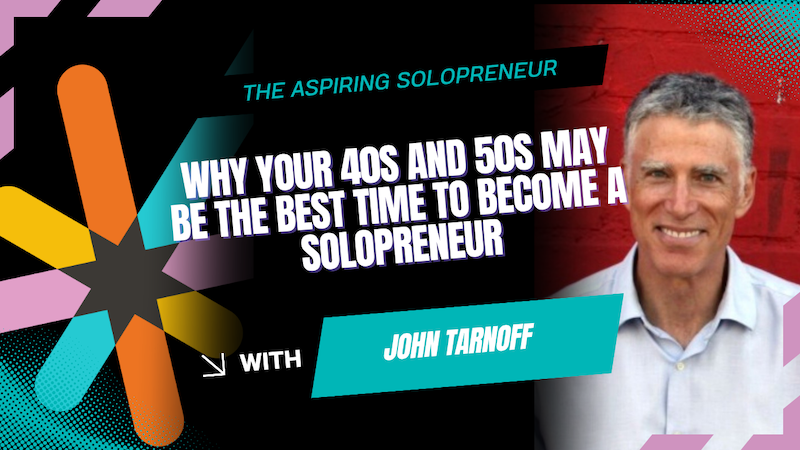
What does it really take to reinvent your career in midlife and go out on your own?
John Tarnoff knows firsthand. After being fired from 39% of his jobs in the entertainment industry, including roles as a film studio executive and producer, John survived the dot-com crash, went back to school at 50, and landed a custom role at DreamWorks Animation before building his current career coaching practice.
In this episode of The Aspiring Solopreneur, John breaks down the mindset shifts and tactical steps mid-career professionals need to successfully transition into solopreneurship.
Why Mid-Career Is Actually the Best Time to Take Risks
John argues that mid-career professionals, those in their 40s and 50s,have a unique advantage when pivoting to solopreneurship. Decades of experience provide a deep well of skills, relationships, and pattern recognition that younger professionals simply haven't accumulated yet. The key is learning to reframe a varied career history as a strength rather than a liability. John describes how he realized he wasn't someone who "couldn't keep a job," he was a reinventor and an explorer, and leaning into that identity changed everything.
The Three Pillars Every Solopreneur Needs
John outlines a three-part framework for solopreneur success:
Pillar 1 — Clarify Your Superpower. Identify the specific niche where your skills, experience, and vision converge. John emphasizes that if you think your market is everybody, your market is nobody. Solopreneurs must do the due diligence to define their product-market fit rather than relying on enthusiasm alone.
Pillar 2 — Build a Personal Board of Directors. Surround yourself with a carefully selected group of advisors — not yes-people and not critics who want to control you. Like casting a movie, each member should bring specific expertise. John has a full protocol for evaluating and assembling this group.
Pillar 3 — Become a Thought Leader. Stand up for what you and your business represent. Articulate your value concisely so that people trust, respect, and validate your expertise. As a solopreneur, you are the product, your credibility is your business.
How to Network When You Hate Networking
For solopreneurs who dread traditional networking events, John recommends a completely different approach. Rather than attending mixers, do your research first. Identify the specific people you want to connect with, learn about their values and interests beyond their job title, and lead with a genuine person-to-person connection before talking business. Networking done right is never about selling — it's about finding shared values and building authentic relationships.
Why Confidence Comes Last, Not First
One of the most counterintuitive lessons from this episode: don't wait until you feel confident to make your move. John points out that nearly every successful entrepreneur started scared. The universe rewards bold action, and confidence is something you earn in hindsight, after things work out. Waiting for confidence before acting means you'll be waiting indefinitely.
The One Habit John Recommends Before Anything Else
Before registering an LLC, before building a website, before any of the tactical steps, John recommends starting a daily handwritten journal. Based on Julia Cameron's Morning Pages concept from The Artist's Way, the practice opens a channel between your conscious and unconscious mind. Even when you have nothing to say, the act of writing every day surfaces ideas, connections, and insights that move your business forward. John's version is simpler than Cameron's: just one page per day, handwritten, every day.
Frequently Asked Questions
How do I turn a messy career history into a compelling solopreneur brand? Look back at all your roles and experiences and identify the common thread, the skills, instincts, and passions that carried through even the jobs that didn't work out. Build a narrative where each career chapter contributes logically to who you are today and what you offer. This becomes your LinkedIn story and your client-facing pitch.
What is a personal board of directors for a solopreneur? It's a small, carefully chosen group of people (former colleagues, mentors, friends, industry contacts) who provide honest feedback, share expertise, and bring opportunities to the table. Unlike casual advisors, each member is selected for a specific strength, much like casting roles in a film.
Is it too late to become a solopreneur in my 50s? According to John Tarnoff, mid-career is actually an advantage. You have accumulated experience, a professional network, and the self-knowledge to identify your unique value proposition. John's own biggest pivot happened at 50 and led to the most successful chapter of his career.
How do I build thought leadership as a new solopreneur? Start by clearly articulating what you stand for and the specific value your product or service provides. Use organic social media reach, especially LinkedIn, to share insights, validate your expertise, and build trust. You don't need to advertise; consistency and authenticity build credibility over time.
Episode Transcript
Carly Ries: Today's guest, John Tarnoff, was let go from 39% of his jobs in Hollywood, and instead of seeing that as failure, he turned it into a superpower. Now a career coach and author, John breaks down what every solopreneur needs to nail finding your true superpower, building a personal board of directors, and who to keep off of it, becoming a thought leader without feeling sleazy, and why confidence is actually the last thing you need to get started. Plus, he shares the one daily habit that costs nothing, but could be the difference between a business that thrives and one that stalls out. So if you've ever thought about going solo or you're already there and feeling a little stuck, keep listening. You're listening to The Aspiring Solopreneur, the podcast for those in pursuit of a life first business.
I'm Carly Ries, and my cohost Joe Rando, and I spend every episode with Solopreneurs who are proving there's a better way to run a one person business and experts who are helping make it happen. We like to say life first, then business. So let's get right to it. John, I just think you have such an interesting story and so many nuggets of wisdom to share today because I think so many of our listeners go through career transitions, many of them later in life, and I cannot wait to get into that. But we wanna start with an icebreaker because we like to make our guests feel like our audience, like we're all in this together.
If you could go back and give your 35 year old self one piece of career advice, knowing everything you know now, what would it be?
John Tarnoff: Well, first of all, Carly and Joe, thank you for having me on the show. It's great to be here. The one piece of advice that I would give to my younger self is take more risks. When you're younger, you have a lot more opportunity to recover from taking risks. The world is a lot more forgiving.
It may feel like it's difficult to take risks younger in your career, but I would maintain that younger is the ideal time to, take this idea that you've been thinking about forever and give yourself six months, twelve months, eighteen months to see if it's going to fly. You're going to learn a lot even if you fail.
Carly Ries: What is younger? Are we talking twenties and thirties and forties? Like, what are we talking here?
John Tarnoff: Yeah. I mean, I think certainly, you know, I would say entry level career is, twenties, maybe depending on the field into your early 30s. And I would say that, mid career really picks up in your 40s. I would say 40, 45 to 55, 60 these days because people are working longer. People are living longer, working longer.
The economy is very different. Lots we could unpack about the way that the world of work has changed, over the last twenty, thirty, forty years.
Carly Ries: Mhmm. Okay. So I wanna start diving into things, because you said take the risks, fail, recover, learn from it. And speaking of recovering, you were actually fired 39% of your time during your entertainment career. And yet you turned those setbacks into a thriving coaching practice.
So what was the defining moment that made you realize those failures were actually preparing you for something bigger in what you're doing now?
John Tarnoff: You know, I would say there was not a single moment where I realized that this is where this was all going. I think there are pieces that kind of dropped into place over time, but I will tell you of an incident that happened to me. I think it was in the late nineties. so I had this early part of my career where I was kind of straight into entertainment, studio executive, film producer. Kind of hit a wall around early forties, at the same time as I was kind of getting more interested in what was going on in computer entertainment, interactive, what was called c rom back in the day.
And so I made this pivot in my forties, into interactive entertainment, wound up starting a tech startup with a partner, raising money into the .com bubble, kind of wild go go days. And then that all collapsed in 2001 when the Nasdaq went from, you know, 1,800 to 900 in a week or something. I mean, was kind of a crazy fall. And everyone was heading for the hills. All our investors, kind of dropped us.
The contracts that we had that we thought were rock solid kind of evaporated. And I was in this place of kind of oh my god you know here I go again having to kind of pick myself up off the floor. I ran into a old friend of mine, hadn't seen him long time. And I think he was a talent agent, had been a talent agent at one of the big agencies for many many years. Very stable business. we're talking and he says, you know, John, I just have to say, you're not asking me the question, but I just want to tell you I've always admired the way you've handled your career. And I was floored. my first instinct was to say, Oh you have no idea how difficult it's been and I'm in the process of kind of unwinding this company and you know all the studio jobs that didn't work out and then the film that I had a lot of hopes for that bombed and and I thought wait a minute maybe there's something to this. Maybe from his perspective, I've done a lot of very interesting things and worked with interesting companies. I was working in Australia in the early, 90s, running production for a company that I had kind of saved you know, I kind of helped pull it out of the wastebasket.
People are going to kind of shutter this company, and I had this proposal about making films and doing distribution with Australia and all. Anyway, that was one instance. And then of course getting into the .com era. It's like no one was doing these kinds of crazy things. I feel like in giving the advice about taking a risk, I felt like I was forced to take risks because I had to pivot from whatever misfortune was going on and whatever volatility was upsetting the apple cart.
But I thought, well maybe I'm a kind of a reinventor. Maybe I'm an explorer. Maybe this is kind of who I am. And while there's a part of me who would just love to have a steady state job where I'm getting the same salary every year and just keeps going, I would get bored doing that. And I know that about myself and I kind of realized that about myself at the time.
So that in a way was kind of a pivot, very freeing moment for me to realize that I'm not this dysfunctional kind of crazy person who can't keep a job, which is something that kept echoing in my ear from something that my mom had said to me way back. It's like, you're in this crazy business, why can't you keep a job? I thought, no, no, this is the way it's supposed to be. Let me lean into that and proceed from that point of view.
Carly Ries: Well, and suffice to say, your biggest pivot was around 50, right? so what did that reinvention actually look like midlife? And why do you think it's an advantage rather than a disadvantage when you actually went out on your own quote unquote?
John Tarnoff: Yes. Well, I did go out on my own, but I did kind of come back into mainstream entertainment as a result of that pivot. And the pivot happened after the .com company went up and I thought, okay, what am I going to do now? I'm not going to go back to those jobs that I had in entertainment. They probably don't want me.
I really don't want to do those jobs anymore. I mean I've been running a company, I've had to pay employees and you know worry about P and L. So I thought I don't know what to do. No one's hiring in tech.
Everyone was kind of heading for the hills. And I thought okay, I'm gonna go back to school. I need to do a kind of a hard reset. I need to think differently about the world, about myself. And I knew about this psychology program here in LA, University of Santa Monica, which was doing some really interesting work based on a program that had been training marriage family therapists for the California state license.
But they kind of veered off into a much more open life mastery behavioral psychology overview program that was very much based on self responsibility. Very kind of a stoic approach to psychology and to behavior change and to, issue resolution. And I thought, I can probably learn a few things about how people's minds work, about how my mind works, maybe change up the the way I'm presenting myself, and let's see what happens. Within nine months, I mean this was kind of like a miraculous turnaround from going to a place where people were talking about in class, were talking about these successes they were having. And I remember one day listening to someone's story about how they'd just gotten this great job, da da da, and was paying what they wanted and relocated where they wanted and I thought oh great miracles are for other people they're not for me.
And within nine months I was at DreamWorks Animation making more money than I ever made before in a job that they designed for me based on six months of meetings that were kind of happening in this random fashion where we figured out unbeknownst to me at the time a sweet spot that they were not covering and where they saw that my background really applied directly to this area of development, talent development, that they were missing. I never thought of myself as a talent development executive. Talent development was always something that I did because you had to do it in every, corner of the world that I was in, the work that I was doing. They thought, Oh, this is a talent development guy. And I thought, Well, yeah, and you need this.
And they're saying, do you want to do it? And I said, yeah, of course, and work at this company and work around all these amazing artists and technologists? Absolutely. So that's how that came about. And where it led to the work that I do today is that coming off of that I realized that the one single factor that made the difference was my ability to consolidate and define a very niche set of best practices, results, outcomes, and visions that both described or derived from my background, so it made sense, it was verifiable, but it also matched where they were going.
And this is a mindset and a paradigm that I think is so important for career seekers to understand because that's how you get jobs today.
Joe Rando: So I'm curious. How do we apply this to solopreneurs? I mean, these are the people that said, I don't want a job. and also, in that process, can you just elaborate a little more on this process that you just described of, you know, distilling down, what you have to offer, you're saying in the context of what people are looking for.
Because that's obviously very powerful, but I still don't know how to do it.
John Tarnoff: Solopreneurs are on the leading edge of this concept, intrinsically. Because as a solopreneur, you're not looking to get hired by a company to be in a boring job, you know, deal with all the BS that goes along with that, you have a vision that you want to bring out into the world. back to Tim Ferriss in the Four Hour Workweek. The last twenty years have been an amazing period for solopreneurs to even exist. This was a word which did not exist twenty years ago, right?
Because it cost you a lot of money to start a business, right? You need a lawyer to set yourself up. You needed to put phone lines in. Remember phone lines? Remember getting all the equipment?
So we can do this today with a phone. but the same principles still apply for solopreneurs. You have to have a vision. You have to be able to articulate that vision. You have to understand what your product market fit is.
And most of all, you have to understand that if you think your market is everybody, your market is nobody. And getting off the dime as a solopreneur requires you to do a lot of due diligence that I think many solopreneurs don't do because they're so caught up in the enthusiasm they have for the product, for the service, for who they think is going to love this. And being a solopreneur even more so than being an entrepreneur which means a larger kind of group around you. The solopreneur is very vulnerable to being isolated and to being in a very small, feedback loop. So one of the things that I think is really important once you have figured out what your superpower is as a solopreneur, is to bring this to a wider limited feedback group.
And whether you are looking for a ten ninety nine contract position, whether you are building your own business, whether you're being a W-two employee, you need a personal board of directors. You need to put around you a cadre of people who know you well, who have worked with you perhaps in the past, family, friends, whomever, to give you the really hard feedback about your idea and help you bring it to reality. So that's number one. Second question, once you've kind of figured out that vision and now you've got your little network, your community really of people who are there to support you, is you have to understand how to be a thought leader around your practice, your product, your service, your identity as a solopreneur, right? Who are you in that mix?
As a thought leader, you want to be able to stand up for what you stand for and what your product or service stands for and be able to articulate this very concisely within a limited kind of a framework or with a clear voice so that other people both respect you, validate what you're putting out there, and trust you most of all to be an integrity around the product and service you're providing, but also as a person. Right? Because as a solopreneur you're kind of the product. So those are the three factors.
Know that solopreneur superpower, the community around you to give you the feedback and bring opportunities to the table, and three, to be able to stand up as a thought leader to defend your position, to grow in your position, and to be able to earn the credibility and the trust that you need.
Joe Rando: I love it. I just have one thing with the people around you, where you called it a board of directors. I mean, it obviously, if you're an LLC, you probably won't have a board of directors that's formally a board of directors. But don't you feel that it's really important to choose those people very carefully?
John Tarnoff: Absolutely.
Joe Rando: Because there are people that will not help you. They have the wrong perspective. They're risk intolerant. And yeah. So it's really critical that that group of people can make or break you.
John Tarnoff: Yeah. In the work that I do with my clients, I have a whole protocol around how to set this group up and about how to have the initial meetings with your prospective Board of Directors, candidates, so that you really get a sense of whether they are going to be, you know, fanboys and fangirls who just blow smoke up your butt no matter what, or whether they are there to n kind of squash you under their thumb because they're so important and they're so experienced and they know what's what. You have to kind of exclude those two contrasts on both sides and really go with the people who are there to support you and have very specific expertise to share, just like in a corporate board. Each member of that board has a particular strength, background. you're casting this little movie of your board of directors kind of in my Hollywood terms. It's all about the casting, So yes, Joe, to your point, this is really the number one challenge that you face as a solopreneur when you're building your advisory team.
Carly Ries: I love the analogy there. So you say that there's a hidden job market that most professionals don't know how to access. What is that? And how can solopreneurs approach it knowing that they're not looking to be hired by a company, but they are looking to be maybe hired by clients or individuals that are looking to hire their services? What does that look like?
John Tarnoff: So the hidden job market really applies to people applying to w two jobs. I mean, the solopreneur has the luxury really of not having to deal with all of the terrible injustices and dehumanization that's going on today in the job market. And you just have to kind of open up LinkedIn and look at all of the outrageousness and ghosting and scams that are going on for people who are in the job market who are unfortunately acting the way we were taught to act thirty, forty years ago. You know, you send out your resume and they're gonna come and they're gonna bring you in for an interview. It's like, no.
You're gonna send your resume into a black hole and you'll never get a call for an interview. So solopreneurs don't have to deal with that. But the hidden job market is the referral market. Plain and simple. if you are a hiring manager, you're going to prefer to hire someone who is referred to you by a trusted source versus just, you know, entertaining a candidacy coming in over the transom or some, stack of resumes that's been dropped on your desk by HR.
Again, for Solopreneurs, it's about reputation. It's about connection. And this is where interestingly I think, thought leadership becomes very much a part of it. If you are able to clearly persuasively articulate the value of your product and service, and you are able to build some traction around that through, doesn't have to be advertising, it can be organic, social reach that you use to validate the work that you're doing. But also, reaching out, through social channels. using LinkedIn Sales Navigator to identify leads and to personally reach out. It's tough on LinkedIn today. I think it's tough everywhere today to make, contacts to really generate leads. But it is all a personal question. It's a personal, person to person, challenge that you have as a solopreneur. And, in that sense, the hidden job market is the normal client market for any solopreneur.
Carly Ries: Well, so with that, you're saying reaching out on social. You could reach out in person too. But what if there's a solopreneur that's like, okay, I need to help or improve my reputation. I need to be the thought leader. That probably means I need to be networking to get to know more people, but I hate networking.
How can they reframe, for people that don't like it, how can they get rid of the cringe of the idea of networking . And actually do genuine relationship building if they're starting over because maybe not their resume because they're not submitting a resume, but maybe their LinkedIn profile has a whole history of their past, and they're trying to talk about what's going on now and their future.
John Tarnoff: Right.
Carly Ries: How do they do that?
John Tarnoff: Lots to unpacking your question. First thing, to kind of cover the LinkedIn profile and the background. One of the career narrative challenges that we have is to take all of the different experiences that we've accumulated through many of the jobs that we've done or the businesses that we've started and create a coherent story. So that someone looking at that profile today goes, Oh, that makes sense. That background, each step on that background contributes to who that person is today, what their experience is, what their product and offering and service offering, is, and it's relevant to my interest.
So the solopreneur who is looking at that profile and going, oh my god, I mean, how do I put all this together? I would challenge you to look back to your early years. What kind of got you into the world of work in the first place? What really inspired you? Question I often ask clients very early on in our process is, when did you have the most fun in your work, in your job? When was that? What was going on there? Because when you're having fun, you're free, you're creative, you're enjoying the work experience, the people that you're working with are loving you, you're loving them. It's a great energetic, time in your life.
You want to be able to maintain that, recapture that if necessary, because that's when you're doing your best work. So what are the elements starting from that place that you're now carrying through? How can you talk about all these different experiences in terms of where this is taking you, right? What are you picking from that miserable job that you lasted in six months? What's the lesson that you learned from that that you're now applying in your business? So there are all sorts of ways of really creating this profile. This helps you in building the relationships, as you're talking about, for people who are concerned about networking, are kind of hesitant or feel awkward about networking, because they think they have to sell themselves. And my philosophy about this is that networking is never about selling yourself. It's never about trying to, create this salesy, glib, expression that's going to persuade someone to work with you.
You want to be authentic. You want to be giving. You want to find out if the person that you are meeting, shares values with you. Right? So, networking is no longer very much of a mixer kind of a thing.
I'm sure I know that they still exist. These are I think very pointless gatherings. What you want to do is do your research. You want to be able to decide who are the kinds of people that you want to target. And then you want to do a little digging on who they are.
You don't want to kind of contact people randomly and you don't want to contact them simply from a transactional basis. It's like you look in what's that business that they're in. Okay. Well, yeah, that fits. So let me contact them.
You want to go a little bit deeper to find out what makes them tick, right? Where are they from? What are their values? Where do they go to school? What are some of their interests that are different or complementary to the work that they do? Start there. Start with the person to person connection and then build on that into the business connection. So that's one way of going about it.
Carly Ries: Okay. Well, and another thing I wanna touch on that I think a lot of people that are transitioning careers, specifically, from like corporate, let's say, to solopreneur ship is they kind of have an identity crisis. And you went from a film studio executive to a coach author and thought leader, which are all very reputable on their own, but it's a big identity shift. what advice do you have for professionals who are leaving a prestigious title, let's say, to go out on their own and do something on their own terms?
John Tarnoff: I think the first thing you have to recognize about identity is that your identity is never your job. Our language kind of undermines that because you meet someone and you say, well, what do you do? And they say, well, I'm this, I'm that, I'm a director of whatever. But that's not really true. that's not really who you are. That's how you work.
It's like, I work as, would be a more accurate way of saying it. But we get into this habit of identifying ourselves with the role, which is very dangerous. So this may explain why people have this lingering difficulty in standing up for the role that they are doing, the work that they're doing as a solopreneur. As a solopreneur, you actually are more entitled in a way to identify yourself with the work that you do because as a solopreneur, it's really an expression of you in so many ways.
You are the product again. So I think that the journey from corporate to solo is or should be a liberating process where you're able to free yourself of that identity that was holding you back as a salaried professional. And really step into this new identity as the solopreneur providing value to your clients. So in that sense, I think it's a great opportunity, to step up as an individual.
Carly Ries: So in my opinion, when you go through this shift, you wanna go into it confidently. But you say confidence comes last not first. I don't understand. How do people lean into this when they're taking a really big career move?
John Tarnoff: If you talk to, any number of, solopreneurs, entrepreneurs, people who've started businesses, and you said, so, did you know this was gonna work? I would say 99% of them are going to say, I had no idea. I was scared blankless going into this. But I had this vision and I had this drive and I had to do it. I had to see if it really was going to work.
And I think that describes the process for me. That if you think, oh, let me wait until I'm more confident, before I take this step, before I quit my job and start this business, then you're going be waiting a long time. You know, the universe rewards the bold move. You want to understand that there are risks involved, so you want to manage those risks. That may look like you know, doing this as a side gig, right?
This may look like you're going to make sacrifices in other areas of your life in order to get the time and the energy or the money necessary to kind of take those first steps into your own venture. Whatever that might be, right? You have to understand that it's not about confidence. It's about vision. And in retrospect, you can say, well, now I feel a lot more confident because it worked out.
But don't let that lack of confidence stand in your way from taking action.
Carly Ries: Okay. Touche. You win. I get it. I get the reversal.
Joe Rando: You gotta do it. You're never gonna be confident until you're successful.
Carly Ries: Yep. Well, John, your mission now is to empower mid career professionals to never have to look for a job again. And in our audience's case, work for yourselves, be yourself moving forward. So for someone listening who wants that kind of career freedom, what is the very first step you think they should take this week?
John Tarnoff: This is gonna be a strange one. And this is kinda like the core practice that I recommend to everyone. And that is start a daily journal. Write one handwritten page per day in a small diary or notebook, something like you know. Eight and a half by five and a half.
Moleskine, whatever. And use this as not log as journal, where you're kind of jotting down what you did, but as a kind of free form exercise in checking in with yourself. How am I feeling today? What's going on? What am I afraid of?
What am I feeling good about? What happened to me this week that really is nagging at me, lingering, that was a bad thing or a good thing? Where do I want to go? How do I feel? What's my temperature check?
Right? The process of the journal, and this is very much based on a book by a woman named Julia Cameron called The Artist's Way, where she was working with writer's block. And the morning pages concept that she came up with was really to distract the artist from what was blocking them, and set up a communications channel between their conscious mind and their unconscious mind. Just through the action of handwriting in this journal. And so this applies in my world as well. I tell people don't bother with the three pages a day. That's too much. A page is fine. But do it every day. In the morning when you wake up, at night before you go to bed, and just keep doing it even if you have nothing to say.
Even if you're kind of blank and even if you're angry at the fact that you're even having to do the process. Write those pages because it sets up this communications channel. And you may be writing about stuff like, okay, I don't know what to write about today. Well, let's just kind of start here. So you know, I got off work and whatever and that guy was bothering me and then I got on the bus or the subway or got in my car or whatever.
And then all of a sudden, as you're writing, you're gonna get an idea. You're gonna get an idea. Oh my god, there's that person that I haven't thought about for months or years, and they would be a really good person to talk to about this problem that I'm struggling with in putting my business together. As an example, so the journal really is the kind of the this this foundry, intellectual emotional foundry that you can get into to help you overcome and engage with the issues that are going on below the surface, that are either available to you for inspiration or necessary for you to handle in order to move forward.
Carly Ries: Such great advice.
John Tarnoff: It's very counterintuitive. I know if people say, well, here's a cheat sheet, you know, to start your business and get an LLC together and do all these things. It's like, yeah, that's the easy part. The hard part is showing up every day for yourself and for your vision. Because again, you're a solopreneur, right?
You've got to be relying on yourself a 100% of the time. There's no one there to prop you up in any meaningful way other than, honey, keep going. It's gonna be fine. You're gonna be it's like, ugh. You don't understand.
Carly Ries: Yeah. Well, John, you have been so successful at helping mid career professionals kind of navigate transitions in their career. So we have to ask you, what is your favorite quote about success?
John Tarnoff: you're gonna laugh at this one. So the one that keeps coming back to me forever, and this is something that a very wise and funny teacher once said to me, and that is, God fires you from jobs you're too dumb to quit.
Carly Ries: you know, we're on episode 300, and we have not heard that one
Joe Rando: That's a new one. Absolutely.
Carly Ries: That is an original.
John Tarnoff: And what he means by that is that you know when things are going right and things are going wrong on some level, and you want to be in integrity with yourself first. I think this is so important for solopreneurs. No one's going to be as honest with you as you at the end of the day. So before the world falls apart because of your inattention and denial, you need to step it up and look at yourself really really hard in the mirror and go I need to deal with this, right? I need to make a change either in myself or on the outside, but it's all up to me at the end of the day to face the music.
So don't put it off, don't delay, don't let the outside world control you, You control it, and start by controlling yourself.
Carly Ries: Awesome. Well, John, if people are intrigued, where could people find out more about you and learn more?
John Tarnoff: I would just look me up on LinkedIn. I'm the only John Tarnoff career coach on LinkedIn. So, j o h n t a r n o f f. Check out my profile, connect with me, and, let's see if we can do stuff together.
Carly Ries: I love it. Well, thank you so so much for coming on the show. We so appreciate it.
John Tarnoff: It's a pleasure.
Carly Ries: And listeners, thank you so much for tuning in. As always, leave that five star review. It helps us spread the word to other solopreneurs that are going through what you're going through. Subscribe to our show on your favorite podcast platform, including YouTube, and share this episode with a friend. And we'll see you next time on The Aspiring Solopreneur.
You may be going solo in business, but that doesn't mean you're alone. In fact, millions of people are in your shoes, running a one person business and figuring it out as they go. So why not connect with them and learn from each other's successes and failures? At LifeStarr, we're creating a one person business community where you can go to meet and get advice from other solopreneurs. Be sure to join in on the conversations at community.lifestarr.com.