


22 min read
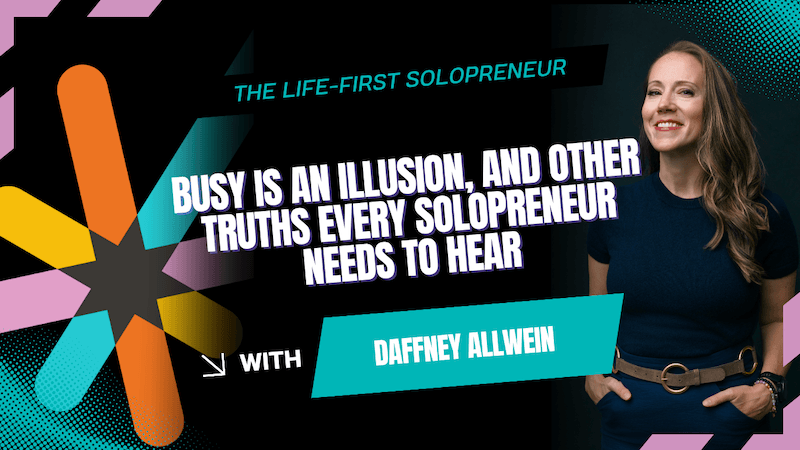
Busy Is an Illusion, and Other Truths Every Solopreneur Needs to Hear
 Carly Ries
:
Jul 28, 2026, 8:43:56 AM
Carly Ries
:
Jul 28, 2026, 8:43:56 AM
Most solopreneur advice focuses on the business. Better funnels, better pricing, better systems. Almost none of it addresses the single point of failure in every solo business, which is the person running it.
Daffney Allwein has spent two decades working with over 700 CEOs, executives, and high performers on what she calls a whole person approach to health and performance. In this episode of The Aspiring Solopreneur, she explains why your physical fitness, your nervous system, and your mental fitness are business infrastructure, not personal hobbies.
What is a whole person approach to health?
Daffney defines it across three areas. Physical fitness, meaning your body. Your nervous system, meaning your capacity to handle stress and stimulus. And your mental fitness, meaning your mindset. A solopreneur can be strong in one and depleted in the other two, and still wonder why the business isn't moving.
How does your nervous system affect business performance?
The nervous system is best understood as a security system. It lives inside your body but is largely shaped by your environment, including your relationships, your physical surroundings, and the stimulus competing for your attention. According to Daffney, it consumes roughly 30 percent of your daily energy. If you begin each day braced for a problem or cycling through the same unresolved issues, you are starting at an energy deficit before any real work begins.
What is the productivity trap for solopreneurs?
The productivity trap is the habit of trying to bill every available hour and maximize personal capacity. In Daffney's framing, this is optimizing yourself instead of optimizing your business. It feels productive and it looks productive, but it keeps you working in the business rather than on it.
Why do some solopreneurs thrive while others plateau?
The consistent difference Daffney observes is willingness to bring in the right people. Most solopreneurs could handle a given task themselves. The question is what they would gain by handing it to someone whose genius sits in that area. She frames outsourcing as an investment rather than a cost, because the return is exponential rather than linear.
What health gaps are professional women facing?
Many women are building careers and having children later, which means postpartum and perimenopause increasingly overlap. Symptoms become difficult to attribute, including joint pain and cognitive changes that go far beyond the commonly discussed ones. Daffney also emphasizes that after childbirth, the brain physically rewires and prunes. What people experience as brain fog is often a functioning brain that has reorganized around new priorities. The expectation of bouncing back to a previous version of yourself is biologically unrealistic.
Where should a burned out solopreneur start?
Start by auditing your time. Daffney uses a clock exercise, asking clients to draw a 24 hour day and mark where their hours actually go. The result usually reveals how much busy work has been invented and protected. In her words, busy is an illusion and a decision. It is a signal that everything else has been deprioritized.
From there, the entry point is smaller than most people expect. A 15 minute walk between meetings. No equipment, no change of clothes, no gym membership. The shift that makes it stick is redefining health as feeling strong and clear rather than looking a particular way.
Why cross training matters for longevity
Doing the same exercise every day is the fastest route to breaking down. Daffney trains for marathons on four running days a week, each with a distinct purpose, distance, speed, pace, and incline, with cross training and rest filling the rest. Variety and recovery are what build resilience.
Key takeaways for solopreneurs
- You are the product, so your health is business infrastructure
- Your nervous system uses about 30 percent of your daily energy
- Optimizing yourself is not the same as optimizing your business
- Outsourcing is an investment, not a line item
- Busy is a decision, not a circumstance
- Fifteen minutes counts
- Cross training and rest build resilience, repetition breaks it down
Guest resources
- Lift Pro Wellness, including a free two minute quiz to identify where to focus first
- Daffney's podcast; Don't F*ing Shrink
Listen to the full episode
The Life-First Solopreneur is available on Apple Podcasts, Spotify, and YouTube.
EpisodeTranscript
a standard thing but eating your feelings is a lot of times when we're bored, when we're sad, when we're stressed, we start ingesting unnecessary calories because it is our body, our nervous system trying to fill that discomfort. Even just fill that gap, sometimes when we are at a dinner party, often we find ourselves drinking a little extra, eating a little extra because it's something to do with our mouth and hands, right? It suffices that oral fixation and keeps us from feeling awkward. So if you're feeling stressed, if you're feeling anxious and not necessarily hungry or curious about what you're eating,
Always choose joy over over your feelings.
Carly Ries: That is such good advice. I love that. It's funny when you're talking about like at a wedding and people are nervous around their plate. And mine's a dermatologist. And when I go meet her at a park or something with our kids, I put on the long sleeve SPF shirt, hat.
Daffney Allwein: Yes.
Carly Ries: And my husband's always like, are you going to see your buddy? Because you'd never dress like this unless you're going to see her.
Daffney Allwein: You don't want to be judged or monitored. You're like, I'm taking care of my skin. Yes. Exactly.
Joe Rando: And then if you knew somebody that was like an MS doctor, you'd be the other way around because you'd need the vitamin d to avoid getting multiple sclerosis. So there's that.
Carly Ries: Well, so we might have some listeners right now. They've heard the intro, but they may also be like, alright. We're talking about eating well at weddings and covering your arms. I'm a solopreneur. What the heck are you guys talking about?
Daffney Allwein: We are human being first. Yes.
Carly Ries: But yes. Exactly.
It's called an icebreaker question, folks. It ties to everything because as a solopreneur, you are your business and the thing you need to take care of the most before you can take care of the business is yourself. And you have to make sure that you are firing on all cylinders before your business can fire on all cylinders, which definitely is why you are here today. To help a person do that. You talk about a whole person approach to health and performance.
So for solopreneurs who are used to grinding through their to do list, what does that actually mean in practice and why does it matter for their bottom line even?
Daffney Allwein: so when I say whole person, because I know sometimes we get a little overwhelmed with the holistic mindfulness sort of thing, and I think it kind of loses its efficacy in that way. When I say whole body, I'm really when working with clients, I'm talking about their physical fitness, right, their body. I'm talking about their nervous system, right? And I'm talking about their mindset or their mental fitness. So when we say whole body or as a solopreneur, you need to be very healthy at every level.
And being very aware of how you're treating yourself in all of those capacities. So when I say that, yeah, maybe you got your workout in, maybe that sort of thing, but you're also not paying attention to who you're hiring. Right? And how their energy is affecting your ability to move forward or picking a vendor or even just stacking your schedule. I mean sometimes we fall into the productivity trap which is something I talk about a lot where as solopreneurs, we are constantly trying to bill every hour, and we're trying to max capacity like we're optimizing ourself instead of our business.
Carly Ries: Yeah. that's a fair point. And, ugh, I my brain is going a million different directions. I have so many questions for you and I'm like, okay, Carly, pick one.
So you've said that the nervous system is just as important as the physical and mental game. Can you kind of break that down for someone who's never thought about it really? Like what's happening in the body of a stressed out solopreneur and how does that actually sabotage performance?
Daffney Allwein: Well, let me explain the nervous system. I think we all have sort of an idea about a nervous system is something inside of our body, which is absolutely true. But the nervous system at large is a security system. It's a response system that lives in our body, but it's predominantly affected by our environment. And that means our relationships.
That means our physical environment, our geography. It also means what sort of stimuluses are calling to us. And the reason that the nervous system is so important to consider, is because a lot of times a lot of the mental energy or the physical energy we have during the day is lost when we're already starting the day expecting a problem or constantly dealing with repetitive issues in our business. So the nervous system is really important because it's there to armor us up, but it's also taking 30% of our energy throughout the day. So if we're starting the day at a loss because we're not in a productive mindset, we're not in a productive environment or relationship with the people we're working with, that's something we really need to consider too in our business.
Carly Ries: Yeah. And again, it's just, so interesting to me because when people talk about their business, they are focusing on their business and not themselves as they relate to the business. I think it's really good to have that background knowledge. So, Daffney, you have trained over 700 CEOs, executives, the list goes on. And solopreneurs are CEOs and executives.
What is the most consistent difference you see between the ones who thrive and whose businesses thrive, and the ones who plateau? I mean, sometimes people think it's a learned thing or an innate, I can't say that. An innate thing , can that be learned?
Daffney Allwein: I think there's a real difference in solopreneurship, because you are the main product, right? In some ways. And for a lot of people, it's hard to step out of working in your business as opposed to working for your business, if that makes sense. So when you're a solopreneur, you don't have a lot of support, right? You don't have a big team.
You don't have a lot of extra help. You end up spending most of your day working in your business as opposed to on your business. And so I think the big difference in the advice I've given in a lot of capacity is when I see someone in the problem, working the problem all the time as opposed to finding somebody whose actual strong suit or their genius is in that specific area. It's a lot of conversations with them recognizing that they probably could do this task. They probably could handle this thing on their own, but how much more would they gain if they brought in the right person?
So it's really tough to do. It's hard to let go of the reins. whether it's a CEO or it is a mid tier business, wearing the same hat and actually thinking in that same way. Instead of being the CEO, you're being the middle manager. Right? So when you can find somebody else to bring on to your team to sort of handle that specific area, you really set yourself apart.
Joe Rando: We go on about this all the time of outsourcing, finding those things that you don't have to do. So you put your energy into the things where you're adding the most value to the business or the best quality to your life. so cool. We're of the same mind here.
Yeah. It's always awesome.
Daffney Allwein: It's an investment. Right? and if you think about it that way, it doesn't feel like a cost or a line item because if it's an investment, you're bringing somebody in, you're exponentially seeing where that potential could go. So that's awesome.
Carly Ries: Not on this show, but in other shows. Sometimes there are people that speak and it's kind of a do as I say, not as I do scenario where they're preaching at people and they're like, you need to do this, you need to do this, but they don't do that. And it's infuriating and it's very clear when that happens. And there may be people right now, they're like, Daffney, this all sounds great, but I've gone through this, I've gone through this, it's impossible to do this with this circumstance and excuse, excuse, excuse.
And you're like, hold my beer or whatever you wanna have
because you have navigated COVID, you had years of IVF treatments, and a first pregnancy while expanding your practice. So in terms of curve balls and excuses that could deter you from building your business, you've experienced them. So you are not one of those people that just talk about it but don't actually do it. How did you keep the business moving during what sounds like these are the crazy seasons of your life? And what did they teach you that about resilience and what you talk to your clients about today?
Daffney Allwein: This is a question, and this is actually something I find really consistent with my clients. Many CEOs, especially women, are also athletes early on in their development. And this athlete's mindset, I talk about this quite a bit, is really interesting is like when the chips are down, right? The average person sort of just shrinks, And decides, you know, what is the easiest path?
What's the quickest way? How do I shortcut this and still get by? And I've always sort of taken on this mindset that when a challenge hits me, that's when I personally decide this is the time to double down. And I think as a solopreneur, especially early on, I realized that the greatest investment I can ever make is in me. And I think that's really hard for some people to see themselves as the initiator and something that deserves an investment.
So what happened in every case, whenever something sort of set me back or actually caused me to say, gosh, wow, where's this going to come from? How am I going to do this next? You know, when it was an IVF, when it was constant failed IVF, I really had the mindset where I was like, listen, I cannot be the only person that I'm working with or that I know in this realm that doesn't have an answer for why this isn't working. So this is the time for me to expand my knowledge. So for me, it was always the curiosity of why isn't this working?
And not just accepting the outcome saying, okay, well now I think I need to dig deeper and find another certifying body or another expert in this that I can learn from. when it came to COVID, that was another big huge chapter for me. And the fact that I was working with these people at a physical level often. And there's always a coaching element to what you do where supporting them and their relationships and their work. But during COVID, people became very isolated and then not in a very healthy way.
In fact, a lot of my clients, because I had to move my entire practice virtually, I was recognizing that I might have been the only person that they were seeing on a regular basis. And I realized that the demand for this sort of health support they needed wasn't something that I had available to give them or at least I felt comfortable. So what I did is I went back and entered a graduate program that was being offered virtually at American University so that I could actually expand my leadership and my CEO skills to give people a broader range of of support. So every time, the world or circumstances sort of handed me a bag of what are you gonna do next? I was like, I'm gonna double down on me.
Carly Ries: Remember how I was like, sometimes I want people on for the general audience and sometimes it's self serving. I'm gonna pivot really quick and ask a question that I think will apply to a lot of our audience. But conversations that I have with friends of mine, I feel like women and specifically moms have a hard time investing in themselves when they are giving to their kids, their spouses, their careers. Like it feels like you're being pulled a million different directions.
And a lot of times, the things that fall by the wayside are prioritizing physical, mental health, self development. Am I wrong in saying that ?
Joe Rando: Can I add, just for having observed my wife in that role? Food, sleep.
Carly Ries: Yes. Okay. So it's not just me. It's a blanket thing. Okay. So you are doing actually specific work to close the critical gaps in women's health. What are those gaps and why do they matter for professional performance? And why do you think industries across the board have kind of ignored them until now?
I'm starting to see more and more of it being addressed, but I'd love your take.
Daffney Allwein: I think in the representation is changing, obviously, in the c suites, in the professional environment. Anyway, Women are recognizing that they have this calling to stay in their careers, to still be part of the workforce in a lot of capacity. So the entire, landscape is shifting entirely. The big gaps that we're seeing right now are the support as it comes to, pregnancy, and even IVF and things like that because it does change and there are a number of things health related that occur during those those cycles. I'm glad I'm not going back to this now. But also during pregnancy and how you're supported in your work.
So what I'm noticing when I'm working is the biggest gaps are postpartum. And later, we don't always know the difference between postpartum and perimenopause because a lot of us are having babies later. Right? So we're choosing to have children later.
We are older in our career because a lot of women don't make it partner until later because there is still this gap. There is still this consideration that a lot of places do not or a lot of firms don't choose female associates until later because they're not sure that this is going be a productive match. It's really, tough and it's hard to say it, but it is the truth. So we are choosing to push back our fertility, or to our childbearing years, which really butts up against postpartum and perimenopause.
And a lot of times in the health frame, right? So when I'm working with people in that age range, it's hard to know when the symptoms are one or the other. So in that, that's one of the biggest gaps that I'm working with right now is we're having joint pain, we're having different symptoms coming up and we're not just talking hot flashes or things of that nature. There are actual big biological changes. And as a mom, you know, when you come back after you've invented a person and pushed them out of your body in any means possible, your brain actually changes at a physiological level.
So you're never going back to your job as the same person, right? Someone's like, oh, I gotta bounce back. I have to bounce back. But the truth is you can't. Your brain has actually rewired itself.
So a lot of times we have this concern that when we bounce back that we're having brain fog and things of that nature. Which is really the reality that our brain has done some serious pruning. So no, you don't need to remember who your third grade math teacher was anymore and it's so hard for you to remember it was so easy and available to you before because your brain did this incredible thing of pruning out things that didn't keep your, now spawn, your child alive. So I think it's really hard because we think we're coming back to the workforce. We're coming back to work with the same capacity brain function.
And it's not that it's wrong. It's not that our brain is broken. It is literally pruned differently, and we start functioning and operating differently, and that's sometimes uncomfortable for the people we're working around too.
Carly Ries: Yeah. And just, I mean, for the women listening who might relate to this, for me, it also is a reminder to contact with the right people
Daffney Allwein: Yes.
Carly Ries: People Who understand and who are supportive. because we solopreneurs don't have employees, but like Joe said, we do contract many many people. And Joe, I mean, I just have to sing your praises. Joe is the shining star for supporting women, supporting women in the workforce, supporting, work life harmony. We changed it from balance to harmony like yesterday.
Joe Rando: Yesterday's podcast.
Carly Ries: Yesterday's podcast.
Daffney Allwein: Love it.
Carly Ries: But he is just, like, with my second, I had to leave earlier, and my out of office doc wasn't ready, and Joe was just like, who cares? I will figure it out.
You're just the best of the best of the best, Joe. I cannot say you're praises enough. And I think that's just very telling that when you're a woman in the workforce, contract with people who get it, who support you. Because I have been fortunate enough to be with you for so long now, Joe, that you just get it. And I don't think people appreciate those kind of people enough.
Daffney Allwein: It's okay to let go of things that don't work anymore. And I think that's a struggle we have as women is we think we need to go back and be in the same spot and start over and you know, it's okay to let go. If a relationship's not working or someone doesn't understand that, it's okay to let go.
Carly Ries: Yeah. This conversation took a turn in a different direction than I thought. But I like it. I think a lot of people need to hear these kinds of things and it makes people not feel so isolated when they're already feeling isolated as a solopreneur. It might help help put things in perspective why they're feeling a certain way, why things feel different. But going back , Joe, we'll rope you back in the conversation.
Joe Rando: It's okay. It's alright. just keep complimenting me. I'll just sit here
Carly Ries: Oh, I will sing your praises all day every day. You know that.
Daffney Allwein: Joe, blue is definitely your color.
Carly Ries: Okay. Joe, your eyes today, they're just glowing. Your skin is glowing.
Joe Rando: we can fool the people that aren't on YouTube. Well, okay. So circling back, we're talking about how health is so important, such an integral part of a successful business. But a lot of solopreneurs see their health as something that they'll get to quote unquote when things slow down. What would you tell someone who keeps putting it off? Because what is the real cost for not only themselves but also their business if they keep pushing it?
Daffney Allwein: I think that's the biggest question, like what are you leaving on the table? If you were in better health, how much more productive would you be? So if you reverse engineer that question because that's usually where I start with people is, I don't know if I can fit it in. I don't know if I can fit it in.
I'm like, what's not a priority if you're fitting it in? So if your priority is to be healthy, you make that first, right? You put that out and you make that very obvious. And that is, I know this is hard to say and hard to hear if you're a mom sometimes, it's just a decision I had to make. And not even as a fitness professional, but as somebody who recognized that my body went through some incredible, incredible things and incredibly taxing things.
That if I wanna keep showing up in a healthy way, even to my family, even to my friends, to my community, especially my business. If I wanna show up healthy in the best possible version, if I wanna give the best product to my clients, then health has to be the first thing on my plate. It can't be the last.
Carly Ries: Also, what if there's a solopreneur listening right now? We actually just talked to one of our community members who's in complete burnout mode. And she's just like, taking a break. And we hear, not from us, not burnout from LifeStarr, but just burnout from her business. And there are so many people that are already like underwater with work.
They are stressed out. They're burnt out. And they know they need to prioritize their health, but they just don't see a way to do that. What would you say the first step should be that they should take to start improvements so they can better themselves in their business?
Daffney Allwein: This is gonna sound like the hardest thing for someone in that spot to hear, but they need to create time in their schedule. And what I mean by that is, really start looking at what are they doing that's necessary, what's moving them forward, or what's busy work.
Joe Rando: Doom scrolling.
Daffney Allwein: Right. Exactly. I was like, it's funny but I have definitely on occasion sat with a client and said, draw me your clock. And it's like, what do you mean? Draw me your clock in a twenty four hour day cycle.
What is the wedge? Where are you putting your time? And let's see what happens and what's your biggest investment? It is surprising how much busy you put into your day. And I've said this before, busy is an illusion.
Busy is something you have decided and busy is basically saying everything else is not a priority. So when you shift your priorities and say, I want to show up in my business this way. I wanna grow my business. I wanna feel healthier. All those busy things that we created in our brain can make way.
Joe Rando: I have a question, Daffney. I read an article a while back, and you know more about this than I do for sure. I can't remember, it might have been the New York Times. It was a reliable source at least. And they were talking about the fact that there's some evidence now that just a really brief spell of intense exercise, you know, like four minutes Of really working up a sweat is a lot better than nothing.
Daffney Allwein: Absolutely. Anytime you're showing up, I think that's one of the bars to entry for a lot of people. Even to what you're saying, a twenty minute walk can improve your productivity exponentially during the day. You don't need special equipment. You could literally slip on a pair of sneakers with your business suit.
And I say that a lot of times to my clients who say I can't get this in. I can't do the cardio today. I wanted to do it. I'm like, I don't care. What's your space between the next two meetings?
Fifteen minutes. Great. Put your shoes on, go. it's one of those things where most of these meetings are virtual for them. no one knows if you reapplied your deodorant, just go.
And I think it's one of those things where if your priority is to be healthy, if your priority is and I think that's the trap. Can I say this? I know this probably isn't perfect. We think we need to be healthy. We don't believe we need to be healthy, we think. And what I mean by that is that it becomes a checklist.
It just becomes one more thing to do as opposed to something that you are dynamically committed to. Because when you think healthy, most people are thinking skinny. They're thinking how they or other people perceive them as opposed to how they feel strong in their own body. So when we make that shift, especially with clients and say, this is about you feeling strong, not about how other people perceive you.
It makes this dynamic shift because then all of a sudden they're like, yeah, I want to feel stronger. Yeah, I want more energy in my body. I wanna be clear with my thoughts. Then a fifteen minute walk doesn't feel like such a big push.
Joe Rando: Everybody should get a dog.
Daffney Allwein: Okay. Okay.
Joe Rando: Because you gotta walk the dog.
Daffney Allwein: That's right. yeah.
Joe Rando: And you meet people, especially if it's a cute dog. Meet other people. So that's healthy too.
Daffney Allwein: Yes.
Joe Rando: I have a question on this because here's me. Okay. Sunday, 30 mile bike ride, hilly bike ride.
Daffney Allwein: Love it.
Joe Rando: Monday, barely able to go up and down the stairs. no. I should say I went for a short walk with the dog. Yesterday, little bit of weightlifting. but what I'm saying to you is I do little bits, and then I do these ridiculous thing. Not ridiculous, but, you know, big things. And would I be better off being more measured and balanced, or, is the, crazy you know, not crazy, but, intense and then kinda taking it a little easier approach healthy in your opinion.
Daffney Allwein: Can I ask a bigger question?
Joe Rando: Sure.
Daffney Allwein: Why do you work out?
Joe Rando: Well, honestly I just like feeling good.
Daffney Allwein: Okay.
Joe Rando: And my afternoons , I will fall asleep with the keyboard at three, 04:00, and so I'd go out and walk the dog or Move some weights around or whatever.
Carly Ries: That's why they can do a meeting at that time.
Joe Rando: Yes.
Carly Ries: We're two hours apart.
Daffney Allwein: This is what I'm talking about. If your intention is to feel strong in your body, to continue to push yourself, No matter what you're doing, there's an exponential benefits. If a 30 mile bike ride is a push for you mentally, physically, and gives you clarity and balanced nervous system, get it, right? But it's not reasonable for you to do 30 miles every single day.
So the fact that you are technically, whether you know this or not, you are cross training, which is as we've learned is very vital to longevity.
Joe Rando: Oh, cool.
Daffney Allwein: The most important thing you can do is work out with a purpose. And what I mean by that is work out for you, not for the people around you. And if you're doing that, if you are connecting physically, mentally, and your nervous system is getting that reset. Yeah, if cross training is exactly how we refer to it. So you're doing a multiple of different things, keeping your your body resilient, in different ways because it is the people who do the same exercise every single day that usually break down the fastest.
So when I marathon train, I run four days a week. You know, there are so many schools of marathon training where you're like, you run every day and this is it. Wrong. Zero wrong. I will fight anybody any single day. I've got a Boston Marathon jersey on my wall to prove that. Take that!
Joe Rando: You really should have had Stacy on this podcast and not me.
Carly Ries: I know
Joe Rando: Our community manager, LifeStarr Community Manager. She's Done Boston a bunch of times and Marine Corps and all kinds of races.
Daffney Allwein: Awesome. Yeah.
Joe Rando: And she's the Doing the Great Wall. Yeah.
Daffney Allwein: Oh, I love it. well, she and I should hang out later. That'd be fun. But here's the thing. I run four days a week when I marathon train. And I'm very specific.
So there is one distance day, as any marathoner will know. There's a distance day where you gain distance, right, and you start building that in your program. But otherwise, I'm running one day for speed. I'm running one day at pace. I'm running one day with a goal in mind, maybe it's incline training.
Whatever it is, I'm not running every single day because I'm smart enough to know that cross training and giving my body adequate rest in between makes me a bulletproof athlete.
Carly Ries: So inspiring. And Joe, cross training, you're so trendy.
Daffney Allwein: Yeah. You're cross training. Go.
Joe Rando: I had no idea.
Carly Ries: So trendy. I have so many questions that I could be asking. But to respect your time, we'll start winding the show down. We end every episode asking our guests the same questions. So we wanna know, what is your favorite quote about success?
Daffney Allwein: Oh, luckily, you gave me a little bit of heads up on this one because I am not a quote person. But I do remember early on, having a conversation with another solopreneur actually, and she and I sort of talked in-depth and she's a very philosophical person. So when she and I shared this together, I was like, you know what, I need to share this with Carly and Joe. Can I read it to you though?
Carly Ries: Please.
Daffney Allwein: Okay. Alright. So when health is absent, wisdom cannot reveal itself. Art cannot manifest, strength cannot fight, wealth becomes useless, and intelligence cannot be implied. So if you are not starting foundationally at how you feel, how you move, and how you connect with the world around you, no amount of money in the world is gonna matter if you're in bad health.
Carly Ries: Definitely, I think you and I are around the same age. when I hear stuff like that, I have the more you know rainbow,
Daffney Allwein: Yes, Okay. Got it. I love that. yeah. I was paying such close attention to each phrase and it just all makes so much sense. So thank you for that.
Carly Ries: Well, if people want to learn more about you, your business, anything, where can they find you? Give us all the links.
Daffney Allwein: So the work that my team and I are doing, our website is LIFT, l I f t, pro wellness. And that's really just to understand a little bit about how we are helping the c suite and the professionals, and sort of working those three areas, both the physiology, the mindset, and the nervous system to be at full performance. And it's really important. There's also a quiz up there. So if you're actually kind of back and forth, not sure how to get started or what sort of staying your way, you don't have to be a CEO to do this. But if you're a solopreneur, you are a CEO. So jump in. There is a actual quiz. It's a two minute quiz that just gives you a place of where should I get started? Where should I focus my attention? I think that's the biggest blockade for a lot of people. So that's that one. I actually have a podcast of my own that I started late last fall, in sort of tandem with this work that I've been doing for twenty years. And it is a podcast that just encourages people to not focus on being skinny or fitting into things, but to not f*kn shrink. And I can spell that for you.
So it's don't f asterisk k n, shrink podcast. So we really have a lot of fun having women's health conversations and about being your most productive and performance based self.
Carly Ries: Love it. Well, so so awesome. Thank you so much for coming on the show today.
Daffney Allwein: Thank you.
Carly Ries: And listeners, thank you so much for tuning in. As always, leave that five star review. It helps us spread the word to other solopreneurs leading a life first business. And I think we talked about it would be so helpful for our audience. So please do that.
Share this episode with a friend or fellow solopreneur, and subscribe to our show on your favorite podcast platform, including YouTube. And we'll see you next time on the Aspiring Solopreneur. You may be going solo in business, but that doesn't mean you're alone. In fact, millions of people are in your shoes, running a one person business and figuring it out as they go. So why not connect with them and learn from each other's successes and failures?
At LifeStarr, we're creating a one person business community where you can go to meet and get advice from other solopreneurs. Be sure to join in on the conversations at community.lifestarr.com.