


22 min read
Solopreneurship Starts With One Question: What Do You Really Stand For?
 Carly Ries
:
Jul 21, 2026, 9:40:27 AM
Carly Ries
:
Jul 21, 2026, 9:40:27 AM
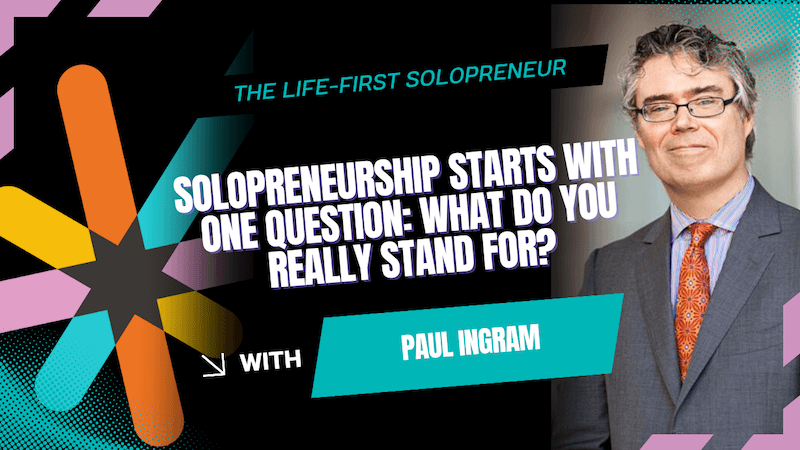
When you're a solopreneur, you are your brand. Marketers will tell you to niche down, and that's not wrong, but Columbia Business School professor Paul Ingram argues that the deeper lever is authenticity, and authenticity comes from knowing your values. In this episode of The Aspiring Solopreneur, Paul explains why values are the most direct path to feeling authentic and being perceived as authentic by clients.
He points to a research study of mid-career leaders: those who were primed with their own values before writing a team speech were rated by peers and communication experts as more authentic and more worthy of trust than a control group. Authenticity, Paul notes, is often called the gold standard of leadership.
How to discover your values: the triad "laddering" exercise
Paul shares a hands-on method any solopreneur can do alone. Start with a real decision, then name three options. Group two as similar and one as different, name the distinction, and ask which side is "better"—and why. Keep asking "why is that better?" until you reach a peak you can't go beyond. That peak is your chief executive value: your ultimate ideal inner state, your personal word for "good."
In the episode, Carly's ladder moves from summer activities (the zoo, the pool, geocaching) through preparation, organization, clarity, and focus, all the way up to peace of mind, and, after some polishing, Zen.
Applying your values to real business decisions
Once you know your values, Paul explains how to put them to work:
- Choosing clients: Prioritize clients whose values align with yours. When they don't align but are still good, explain your values and learn theirs, understanding builds smoother collaboration.
- Avoiding burnout: Each morning, ask how the items on your to-do list move you toward your values. Anything that can't be connected to a value may not belong on the list.
- Pricing and confidence: Being grounded in your values builds the confidence to ask for what you're worth (paired with practical negotiation skills).
- Staying focused: Values are your filter for the endless "shoulds" (which platform, which opportunity, which yes). They also make saying no far easier.
The daily ritual
Paul keeps his values on a card in his wallet. Before walking into work at Columbia, he reviews them and considers how he'll pursue them that day, a small practice that lowers stress (literally lowering cortisol) and boosts presence.
The takeaway
As Robert Louis Stevenson put it, it's better to travel with hope than to arrive. Success lives in the pursuit, so get clear on what you're pursuing.
About the guest: Paul Ingram has been a faculty member at Columbia Business School for 30 years and is the author of What Do You Really Stand For? The One Question That Will Transform Your Work and Life (Harvard Business Review Press), available in print, digital, and audio. Learn more by searching "Paul Ingram Columbia Business School."
Listen to the full episode on Apple Podcasts, Spotify, or YouTube, and subscribe to The Life-First Solopreneur for more life-first business conversations.
EpisodeTranscript
Carly Ries: What if the secret to building a business that actually feels like you, isn't picking the perfect niche but knowing exactly what you stand for? On today's episode, Columbia Business School professor Paul Ingram walks me through a live values exercise using zoo trips, geocaching, and my summer calendar chaos. And yet somehow, I ended up uncovering my chief executive value. We talk authenticity as the gold standard of leadership, how to say no without the guilt, why your values are your best defense against burnout, and the pricing confidence that comes from knowing what you're worth. Plus, can you still be authentic if you're kind of a jerk?
Well, Joe has thoughts on that. So grab your notebook because this one's basically a working session disguised as a podcast episode. You're listening to the Life-First Solopreneur, the podcast for those in pursuit of a life first business. I'm Carly Ries and my cohost, Joe Rando, and I spend every episode with solopreneurs who are proving there's a better way to run a one person business and experts are helping make it happen. We like to say life first, then business.
So let's get right to it. So, Joe, over the past few months, we've kind of pivoted the direction of this podcast and Life-First as well into Life-First Business. And I think when you create a life first business, it's important to understand your values. And Paul, you know a thing or two about figuring out your own values. I cannot wait to dive into all of that. But before we do, first of all, welcome to the show.
And let's start with an icebreaker question. Just to get to know one another a little bit more, our icebreaker question for you is, besides your own book, what is one book you think every solopreneur should read? And what value does it speak to?
Paul Ingram: Okay. I love that. One book. I think I am going to go with, a book called Alive at Work by Dan Cable. And the value it represents is engagement.
But it's really about the differences of being really engaged with your work. And, you know, I think a life first business, a solopreneur is really striving for that. I think it's a great archetype for trying to reach that. And, Dan is a social psychologist who works at the London Business School. He has very deep ideas but expressed in a really practical way about, how you just feel alive when you go to work every day.
So I'd suggest Alive At Work, Dan Cable.
Carly Ries: I love that. I feel like both of your books would be very complimentary if somebody read them.
Joe Rando: That's the first time we've heard that book. We've heard a lot of books over and over, and they're great books, but it's just fun to get one that nobody's ever said before. And we're over 300 episodes here, so, well done.
Paul Ingram: Yeah. Thank you.
Carly Ries: Adding it to my personal list. Well, Paul let's get into the meat and potatoes of this. we're talking to solopreneurs who are trying to achieve a life first business. And as a solopreneur, you are your brand.
So how does clarifying your personal values help you build an authentic business identity? And why do you think that's more powerful than just picking a niche, which is what all of us marketers say?
Paul Ingram: Yeah. Absolutely. I think the word I wanna focus on is authenticity. So, it's one thing to be in a niche, but if you're authentically occupying that space, we know that that's when we see a product or a personal brand as being really compelling. And often your values are completely at the heart of accessing authenticity. In fact, it's the most direct way that I know that you can really feel authentic and have others perceive you as authentic. I'll tell you about a research study, that I did with some colleagues.
It was an experiment using mid career leaders, and, we had them write a motivational speech for their teams. And for half of them, we showed them their values, which they had developed in a workshop earlier on in my interaction with them. And we asked them to keep their own values in mind when they wrote the speech. We said you don't have to talk about your values. That's up to you, but have them in mind.
And then the control group, you know, didn't have that. They just wrote their speech. Everybody delivered their speech to a video camera. We had the speeches evaluated by peers and by communications experts, and they concluded that the people who had been primed with their own values were viewed as more authentic and more worthy of trust.
So authenticity has been called the gold standard of leadership, and as you say, it's so important in brands. But if I was to say to you, come on, Carly. Be authentic. What would you do differently? How do you be authentic?
Well, it turns out that if you feel connected to your values, you feel authentic. Others perceive it, and they like it. They trust you. They wanna follow you. They wanna do business with you.
Joe Rando: So the other thing to carve out here is that doesn't jive if you're a jerk.
Paul Ingram: You're right about that. You're right about that. Here's some good news, Joe. there certainly are jerks among us, but there's not that many of them I find.
Joe Rando: I agree. I just had to toss that in there.
Paul Ingram: Yeah.
Carly Ries: Joe throwing in a joke, being at his authentic self.
Joe Rando: That's me.
Carly Ries: Okay. So again, diving even more into discovering your values, you have an exercise using triads. So can you walk our listeners through how a solopreneur can do this on their own, maybe using some examples from business decisions they face every day, like choosing clients, pricing their services, yada yada yada.
Paul Ingram: Yeah. Absolutely. So, Carly, I think the best way to do that would be with an example, and I'd love to take you through a triad as an example. Can we do that?
Okay. So, what we need to start with is some decision you have in mind, and you had some which are fine ones, like sets of clients you've worked with. It could be something in the domain of your personal life, places that you might go on vacation. But do you have some kind of decision that is on your mind or something which is important to you at this moment that we can use as a starting point?
Carly Ries: Joe, do you wanna go, or do want me to go?
Joe Rando: I mean, I could come up with some, but if you have one, go ahead.
Carly Ries: Well, just because I'm in the thick of it right now, I am trying to really figure out my calendar where I am doing everything to expectation with work. Well, also, my kids are out of school during summer. And I wanna make sure I'm not dropping the ball on either side.
Joe Rando: Okay. Carly, come on. Don't give him something impossible like that.
Paul Ingram: We can work with it. We can work with it.
Carly Ries: I've already had to text Joe and be like, can we move this meeting ? AHH!
Paul Ingram: So that's a great start. Let's do this, Carly. Offer three things that you might do with the kids in the summer. What are three possibilities?
Carly Ries: The zoo, the pool, and geocaching. I'm big on geocaching if you've ever heard of it. It's hiking and finding treasures.
Paul Ingram: Oh, okay. Cool.
Joe Rando: Do the kids like that?
Carly Ries: Oh my gosh. Because most of the treasures are tailored to kids.
Paul Ingram: Alright. So let's, you in particular, come up with a way to categorize. Some way, it's up to you, that two of those things are like each other, and they're different from the third. So how the zoo and the pool are similar, different from geocaching, or any distinction which can put two together and one in a different category.
Carly Ries: I feel like the first two, there's kind of a preparation for it. And then the geocaching, we could just walk out our door and just go do it.
Paul Ingram: Okay. Good. So I've got preparation and spontaneity. Is that okay?
For you. here we're leaving beside the pool and geocaching. Now we're thinking about preparation spontaneity. Which do you prefer? What's better in your view?
Preparedness or spontaneity?
Carly Ries: Preparation. To the point, my husband actually blocks things off on my calendar that says room for opportunity to make it feel like I'm prepping for something, but really it's just a calendar block for spontaneity.
Paul Ingram: Okay. Good. So preparedness is better in your view. Why? What's better about preparedness?
Carly Ries: I like being organized. I like making sure that we have the snacks packed, I like being the puppeteer of everything.
Paul Ingram: Good. So we've got organization. Organization as opposed to what? Disorganization, chaos.
Carly Ries: Yeah. Rushing. We gotta go. We gotta go. Yeah. How about that? Rushing. Good. Organization is better than rushing. Why is organization better?
It makes me feel more zen like.
Paul Ingram: Good. Okay. Zen as opposed to what?
Carly Ries: I also think I'm a better version of myself when I'm in that mode. I have more clarity.
Paul Ingram: Great. Yeah. So clarity is better than chaos. Why? If you have clarity, what does that get you?
Carly Ries: It gives me focus and peace of mind.
Paul Ingram: Peace of mind. Great. I'm gonna suggest, a couple there, focus and peace of mind.
I'm gonna suggest we could keep doing that, but I think peace of mind is gonna be pretty close to the top. Right? Because, you know, ultimately, the way I represent values is that, you've got 100 values. You know, I think it's very useful for you to identify a set which are among your top values.
And then there'll be one which is really kind of ultimate, like the ideal interstate. And peace of mind could be right there at the top. There might not be anything above peace of mind. So if I were to say, we'll just try it.
If I were to say, Carly, if you have peace of mind, what does that get you? What's good about peace of mind? Is there an answer, or is it just peace of mind?
Carly Ries: I would say peace of mind, but also just the best version of myself when I have peace of mind . For everybody.
Paul Ingram: We've got kind of synonyms. Right? We're coming back and forth. Good. So we've arrived at an ultimate value, peace of mind.
You've also articulated a couple of other values which are, probably, you know, distinct from peace of mind but important to you. So, you had focus. So you had focus as a value.
You also had organization as a value. So coming out of this conversation, I would probably take peace of mind, focus and organization as starting points. You know, I'm suspicious that those three might be among, your top eight, which I often work with eight values.
So what we've done, let me explain what we've done to the audience. We took any distinction, right? It could be three clients. How are two like each other and one's different?
Maybe it was collaborative or authoritarian which is better. It's collaborative. Why is collaborative better? What's energizing? Energizing as opposed to what, right?
So, it's what's the distinction which is better, opposed to what? Why is it better, opposed to what? Why is that better until we get to a peak where we really can't get to any why is it better? It's just peace of mind is peace of mind. You know, it's an ultimate end.
And on the path, if we come across some of these intermediate steps to get up to peace of mind that seem really resonant, and I picked out in this conversation, I thought focus was really energizing for you. Organization seemed to be very important to you. I'm taking these as candidates of your top values. Right? Now we've got three.
We would do one or two other ladders, and, they could be different contexts, and we're doing the same thing. What's the distinction? It's what as opposed to what. Which is better? Why is it better?
We keep asking why until we get to the peak. Now we do this, and we get a set of, let's call it, eight values. Now I'm not sure. You know, we've reached distinctions. I've heard you talk about the values.
I'm not sure we've got them exactly right for you. So we'll go back at the eight at the end, and we'll do a little polishing. I'll just illustrate that with one of these values. So you said peace of mind, and you also said something which is a little bit similar zen. So I'm gonna ask you.
We have a strange world, Carly. You can have peace of mind without zen, or you can have zen without peace of mind. Which would you choose?
Carly Ries: Zen. I'm Wired, I run a little hot. I'm a busybody. and so zen to me is like, wow. That sounds magical.
Paul Ingram: So we found that zen is a little bit better for you than peace of mind. Right? So we would do the same with say focus. What's better focus or priority?
Carly Ries: Priority.
Paul Ingram: Okay, priority. So you see we're doing a little bit of editing in the space of synonyms, right? what we're trying to do is zero in on a set of eight value words, which are really electrifying for you. so that's an example of the process of laddering. Let me put it into kind of terms that can help the audience follow along why we're doing that.
Let me give you a definition of a value. A value is a principle of evaluation. we use our values to evaluate every other thing. So a person, an opportunity, an idea, it is good, bad, or important as a function of how we see it through our values. it's our values that allow us to discern. So we went through a set of questions. We had a distinction, and we said, what's better? And as opposed to what? What's better?
As opposed to what? What's better? So we kept getting it better and better and better, and it's your values that make something better. Right? So when we dig into any preference, any discernment, any view that this is better than that in your perspective, it's values that are behind that judgment.
So by, breaking down your set of preferences in this way, we're helping you to articulate your values. So that's one process. Something else, that the book offers, the book is very hands on. It helps you do concrete things to utilize your values.
Another process, that we suggest for surfacing values is to do a reflection. So, maybe, Joe, if you're game, I'll do this with you and illustrate it if that's okay with you.
Joe Rando: I'll give it a try.
Paul Ingram: Okay. Cool. So let's pick something important to you. I bet this podcast is important to you. Is that fair?
Joe Rando: That's fair, but I'm gonna pick something else because Carly is the mastermind of this podcast, and she's done a fantastic job. I'm gonna pick the LifeStarr app because that's what energizes me, that's why I wake up in the morning and go, I can't wait to get back to that. This is an app that we're very close to beta testing.
Paul Ingram: Wonderful. great. It's a project, a product that you're really excited about. What is it that that represents that explains why it's so important to you?
Joe Rando: I had a vision for something that I saw, that I thought maybe I could buy. And it's going back some years, probably a decade, but it didn't exist. I thought this was the kind of thing that could really change my life and, by extrapolation, the lives of other people that suffer from a similar problem, which is overwhelm. Too much stuff, too many things to do, or at least too many things that we're committing to that, we don't have a handle around. And I imagined this thing, and we started building it.
And I'm just so excited because it's doing what I imagined it would do. So it's kind of like my version of a sculpture. Okay. Great. So you said a number of things here. I'm just gonna interact with you to see if we can distill a few kind of concrete concepts. I heard something in the space of focus.
Paul Ingram: Is it that LifeStarr app helps us focus?
Joe Rando: It helps focus and organize. If I had to summarize it, it's an organizational system that doesn't cost time to stay organized, because that's what always broke down for me. I would have a system because I'm terribly unorganized by nature. So I create these systems, but then it cost me time to implement the system. And then I would get busy, and I would stop implementing the system because I had to get the work cranked out, and then the system had fallen apart.
Paul Ingram: Great. So we asked you about something that was really important to you, and we asked why. And you articulated some values, focus, organization, efficiency.
I'm taking from this, like, it's a good use of time. We're organized, but it's time effective.
Joe Rando: Absolutely. Urgency.
Paul Ingram: And you also said vision. You were quite electrified by the idea of having a vision and realizing it. So that I've got that potentially as a value for you coming out of that reflection.
Joe Rando: Yeah. That's a word that's been associated with me is visionary, which I thought was good until I learned what it really meant.
Paul Ingram: Oh, I think it means good things.
Joe Rando: Not always. And you can ask some of my last startup people about my visionary nature of walking into a meeting and blowing up a month's worth of work because I had a better idea.
Paul Ingram: Okay. But, we did a different process. With Carly, we worked through this ladder. With Joe, we asked for reflection on something good, bad, or important. In each case, we identified a set of, potential values.
Now, Joe, we do the same thing. With Carly, we would take focus, and we would see if it's the right word. So is it focus, or is it priority? Is it focus, or is it something in the same space?
So, the appendix of my book has a set of values organized in terms of types and synonyms, and we could look up focus, and we could find some of the others that are like that and see which is more compelling with you. But, values are principles of evaluation. If we analyze a choice or preference as we did with Carly or if we think about why something is important to us or good or bad, our answers are gonna be values. And these are all ways to be just more concrete about what our values are because if you're really clear about them, most people aren't. Even successful people usually have only a vague idea of their values.
But if you're really clear, they can become a tool that allows you to do a lot of things better.
Joe Rando: Love it.
Carly Ries: Well, so what's a chief executive value? Would that for me be like peace of mind and zen and all that? Or Is that something different?
Paul Ingram: Yeah. So a chief executive value is the peak of your interdependent structure of value. it's the ultimate outcome. And it's typically an interstate, your word for goodness. So I think with Carly, I would say probably Zen is a candidate for the chief executive value.
If we wanna see if it really is at the top, I would say, well, if you have Zen, what's good about Zen? What does Zen give you? And if you say, oh, if I have Zen, I'm happy, then maybe happiness might be above it. But if you get to Zen and say, well, it's just Zen. Zen is the end.
You know? Zen is the ideal, then it would be your chief executive value. So it's your word for the ideal interstate.
Carly Ries: Well, so let's say people have their eight values, and they have their chief executive value. Let's put that in to practice. Like for Solopreneurs, a lot of times they take on clients who don't feel like a good fit because they need the money. But how can values clarity and knowing their values help them navigate that kind of tension without guilt?
Paul Ingram: Yeah. Great. Two ways. One is in the initial choice. So you're right.
Implicit in your question is the idea that any choice, including a client to work with is, to the extent it's more aligned with our values, we're gonna be happier. And by the way, working relationships are smoother with people who we have similar values with. So, it's less than an ideal. Even if your client has good values to the extent they're different from yours, it's not the ideal.
The ideal would be their values are more similar to yours. Now so, if we're choosing between two clients, we can think about how our values align with theirs, and we can make a choice that is gonna be more satisfying for us. We can't always make that choice. You're saying, look.
Sometimes this is the client available and you gotta work with them and you're gonna do good work, but your values are, although all good or not aligned. Under those circumstances, what we find is that two people can work effectively with each other if their values are good but different, if they can explain and understand each other's values. Right? So, under that circumstance, I would suggest that you find a way with this client to say, hey. Look.
I wanna tell you a little bit about who I am and where I'm coming from. You know, focus, organization. I'm in pursuit of Zen. And, you could give it a kind of more articulate count. And I'd love to know, about you. You know, what are the values that are really driving for you?
And you might help them articulate that. But, we find with all kinds of working relationships that, people explain their values to each other, and then they want to connect with each other. They collaborate more effectively. They share information more thoroughly.
So the first best choice is to work with people whose values are aligned with yours. But there are lots of people who have good values that are different from yours. And with them, what I suggest is explain your values, learn about their values. And by the way, you can only explain your values if you know your values. Right?
So we're back in the position that identifying and being able to articulate what your most powerful values are opens up a lot of doors for you.
Carly Ries: So solopreneurs are pulled in a lot of different directions, and they can get stressed out and burned out really easily. Not really easily. That's an exaggeration, but they do get burned out. How often is it that the issue is more of a values misalignment than something else? And how can they identify that?
Paul Ingram: Yeah. So I would suggest that your values are a great defense against burnout. Now, you can be really busy and achieving much more than perhaps others might think is possible doing things that you view as in pursuit of your values and yet not burnout. Right?
So we find, for example, in experiments that people can do very hard things if they see them as a way to achieve their values. So what I would say to Solopreneur and the situation you're talking about is, you could do this at the beginning of every day. At the beginning of every day, look at your to do list and ask yourself, how is this in pursuit of my values?
So, Carly, you might say, how is this a step towards focus? If I achieve this, am I gonna get closer to zen? And go through the list. you do that, and then you've got more energy. You've got more resilience.
Your stress goes down. Literally, cortisol goes down, the stress hormone when we think about our values. So you're much less subject to burnout. And I'd also say, what if you've got a to do list and there's something on the list and you just can't see it at all as a way to achieve what matters to you, your values? Then I would say that's maybe a good signal that that's something that shouldn't be on the list. If you can't see even in an indirect way that this is a way that you can achieve what's really important to you, that it takes you a step closer, then maybe those are the types of things that that shouldn't be on our to do list.
Carly Ries: so I'm trying to think. I feel like sometimes people equate their value to their worth. And solopreneurs, lots of times they underprice their services because they either have impostor syndrome or they don't know where to start. But what are your thoughts on that? How is knowing your values helpfl in like, pricing what you're worth and knowing what you're worth?
Paul Ingram: Well, I would say , they're not the only input. Right? So, there's a little bit of negotiations that is at the heart of this. And values are important in some aspects of negotiation, but the simple step of what I would say confidence to ask what you want, you know, you can learn that technique and you can practice that technique. But I will say that people who are grounded in their values are more confident. So you feel better. You're more confident. I think you still could use a little bit of negotiations advice about how to apply that in the moment. But having the strength of your convictions, simply the confidence to assert yourself on the world, if you're grounded in your values, if your values are clear, people feel better about that.
What I would suggest to someone in a position like that is, there's a technique. I actually do this every day. Every day I walk into the building that I work in at the Columbia Business School, I stop outside. I have my values on a card in my wallet. And as many people go through my workshops do, I take out the card.
I look at the values, and I think about how I'm gonna pursue them. And if there are gonna be challenges to pursuing them every day, I just feel better. I feel more my best self as you used that language earlier, Carly. And I interact with people. I've got a little bit more confidence, a little bit more presence. I would suggest that if someone's having trouble expressing their value in a negotiation, that exercise would be a great thing to do the moment they step into the negotiation. I would also point out there are some techniques to negotiating, and those are good to know as well.
Carly Ries: Yeah. Absolutely. Well, and I'm glad you're talking about, negotiating because I think in in terms of running your business, knowing your values can also help because there are again, this is the marketer in me coming out. I already talked about me niching down, which I love. But I think with marketing, there are so many things people can be pulling from.
They're like, oh, I should be on TikTok, which Joe and I drank that Kool Aid for a hot minute, and that was not beneficial. They're, I wanna be on this platform. I wanna do this. I wanna do that. And knowing your values, doesn't that also help you stay focused in terms of not getting distracted by all the things that could impact your business?
Paul Ingram: Yeah. Completely. Prioritizing our values are really the basis that we should prioritize. So if you've got 10 potential draws on your time, which one should you work on?
What should be number one? The one which is most aligned with your values. So, values tell us what's important to us. So TikTok or coffee with a client, which one is more aligned to your values?
And it's gonna give you a really good signal about what's the right choice for you. And by the way, I also find that that question, does this use of my time, take me closer to satisfying my values? That really helps with one of the really difficult elements about managing time in my experience, which is saying no. So, like I imagine is true of you, a lot of people come to me in good faith, and they've got a authentic need, and they ask for my help, and I like to be helpful.
But if I was to satisfy all of those requests, I would be spread too thin and ineffective. So how do I decide what I say yes and what I say no to? Well, I think, is this the best use of my time given my values? And if there's a request, even if it's in good faith, which is not really a way to get closer to what matters most to me, it's much easier to say no.
So prioritization really, your priorities derive from your values. If you're clear about your values, you're in a much better position to, assess what uses of your time make the most sense for you.
Carly Ries: That makes sense. Joe, I love our shift in the Life-First business direction over the past few months so much because I feel like we're talking to people, Paul, you absolutely included, who see things in a different way than I think the traditional business person. And this is just so cool. I just think it's so fascinating. So Paul, I could talk to you about this all day. I think let's wrap up because we want to respect your time and I need to process all this. I hope you weren't charging me hourly for that session you just took me through because now I have a lot to think about. But we've loved having you on this show.
Before we tell people where your book is and all that jazz. Can you tell us your favorite quote about success?
Paul Ingram: Favorite quote about success. Yes. I do have a favorite quote about success. So the quote is from Robert Louis Stevenson, who you might know as the Scottish author of Treasure Island and things like Kidnapped, I think.
Things I read as a child, who was also, coincidentally, a travel writer. And he said that it is better to travel with hope than it is to arrive. So what that says to me about success is it is in the pursuit of success that we're most satisfied. And I think, actually, if you ever have the mixed blessing of becoming successful, I think you should enjoy it. You should have a celebratory weekend, but then you should say, what's next?
What's the next step in my success? Because it's really moving forward to something we think will be great that is the most satisfying state. So it's better to travel with hope than it is to arrive.
Carly Ries: It's so funny. My husband, he and his buddies hiked up one of those, overnight hiking trips up to Machu Picchu. And Machu Picchu is obviously one of the most spectacular things you can see in the world. And he was like, the best part was the journey. He's like, I will just say the journey to get there was the best part even though the top was Machu Picchu.
Paul Ingram: Exactly.
Carly Ries: I love that quote. Well, Paul, where could people find your book? Where could people find out more about you? Give us all the links.
Paul Ingram: Yeah. For sure. So, the book's published by the Harvard Business Review Press, and, of course, you can get it on their site. You can get it in every, version, audio, digital, on paper from Amazon, of course,
Joe Rando: What's the name of the book again?
Paul Ingram: What Do You Really Stand For?
The one question that will transform your work and life. What do you really stand for? And, you can find me at the Columbia Business School. I've been a faculty member for thirty years. If you look up Paul Ingram at Columbia Business School, you'll get my contact information. I love to hear from people who are putting values into action. So the point of the book is to really take this thing that we all know is important and turn it into a real concrete tool that allows us to do better, to feel better, to do better work, to have more well-being. And ideas into action is really what motivates me.
Carly Ries: Love it. Well, thank you so so much for coming on the show today. We so appreciate it.
Paul Ingram: Such a pleasure. Great to talk to you both.
Carly Ries: And listeners, thank you so much for tuning in. As always, leave that five star review. It helps us spread the word to other Life-First solopreneurs, especially those who need to focus in on their values. Share this episode with a friend and subscribe to our show on your favorite podcast platform, including YouTube. And we'll see you next time on the Aspiring Solopreneur.
You may be going solo in business, but that doesn't mean you're alone. In fact, millions of people are in your shoes, running a one person business and figuring it out as they go. So why not connect with them and learn from each other's successes and failures? At LifeStarr, we're creating a one person business community where you can go to meet and get advice from other solopreneurs. Be sure to join in on the conversations at community.lifestarr.com.