









22 min read
What Solopreneurs Should Stop Copying From Big Brands
 Joe Rando
:
Sep 1, 2026, 8:02:35 AM
Joe Rando
:
Sep 1, 2026, 8:02:35 AM
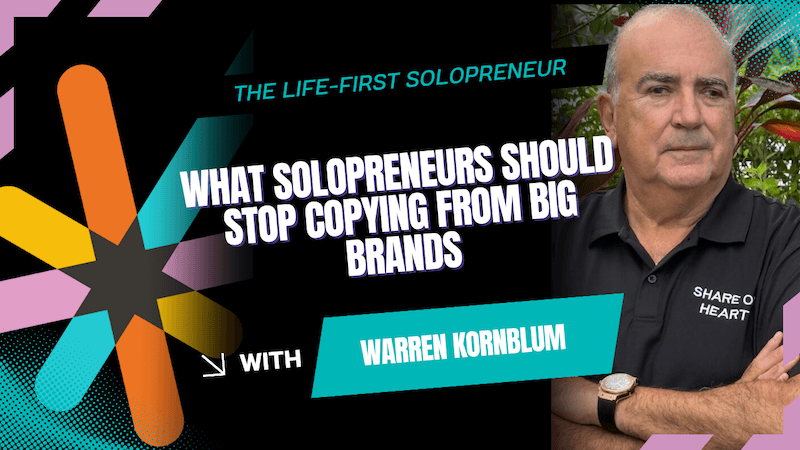
Most solopreneurs think branding requires a big budget, a huge following, and a polished marketing machine. Warren Kornblum, a marketing leader who spent decades inside massive brands including Toys R Us across 27 countries, argues the opposite. In this episode of The Life-First Solopreneur, Warren explains why a business of one actually holds the branding advantage, and how to use it.
What is a brand stand?
A brand stand is what your business stands for, the promise you make and the reason a customer should choose you. Warren explains that it goes beyond a positioning statement. It answers the question, what can I count on from you, and it is grounded in how you treat people at every point of contact.
Why do solopreneurs have a branding advantage?
Solopreneurs can keep an absolute focus on the customer that large organizations struggle to maintain across thousands of employees and multiple markets. When you are the face of the business, every interaction is personal, which makes authentic connection easier to deliver.
What is share of heart?
Warren describes a progression marketers know well, share of mind means people think of you, top of mind means they think of you first, and share of wallet means they buy from you. Share of heart is his addition, and it means people like you, not just remember you. That emotional connection is what drives loyalty, referrals, and repeat business.
Why vanity metrics can hurt solopreneurs
Followers, views, and likes feel like progress, but Warren warns they are vanity measurements. The real measures are customer retention, loyalty, and word of mouth. He cautions solopreneurs not to sell their soul for likes, because awareness is the easy part while trust is far harder to earn.
The risk of using AI to build trust
Warren and Joe discuss a growing problem, solopreneurs outsourcing personal outreach to AI. When a prospect can tell a message was generated and impersonal, the trust you are trying to build disappears fast. The personal work is the work.
One thing solopreneurs can do this week
Be real, be straightforward, be honest, and do what you say you are going to do. For a solopreneur who is the face of the business, authenticity is not optional. If you are genuine, the right business will find you. If you are not, it will catch up with you.
In this episode, Warren Kornblum reminds solopreneurs that branding is not about being everywhere. It is about being trusted by the right people. Listen to the full conversation on your favorite podcast platform, including YouTube.
EpisodeTranscript
Carly Ries: What if the smartest branding advice for a business of one came from a guy who ran toy stores in 27 countries? This week, we sit down with Warren Kornblum, a marketing veteran who spent decades inside massive brands like Toys R Us and somehow walked away convinced that the Solopreneur has the real advantage. We get into why chasing followers might be quietly killing your business, the difference between share of mind and something Warren calls share of heart, and the one thing you can do this week to start earning trust that actually sticks. So go grab your coffee and settle in because this one is packed with wisdom you can start using today. You're listening to the Life First Solopreneur, the podcast for those in pursuit of a life first business.
I'm Carly Ries, and my cohost, Joe Rando, and I spend every episode with solopreneurs who are proving there's a better way to run a one person business and and experts who are helping make it happen. We like to say life first, then business. So let's get right to it. Warren, you and I are both marketers. so I kinda geek out when I know we're gonna have a guest on that's gonna kind of enter the world of marketing. we're going to talk a lot about branding specifically today. So we have icebreaker questions for our guests. And I was like, what is something that I'd be really entertained to know? And I want to know for our icebreaker question, what's a brand you're irrationally loyal to? Maybe you spend too much there, whatever.
I want to see how you interpret this.
Warren Kornblum: Well, I'll answer it two ways. One, to spend too much there is definitely Amazon. I would probably buy about half of what I buy if I had to go to the store and get it myself, which is what drives retailers nuts. But that logistics system and their ability to fulfill purchasing, it sometimes just amazes me how fast. Slight quick story on that one, if you'll allow me.
When the book first came out end of January, a friend of mine in Germany said, where can I get it? And I said, well, if you're in The US, I would say Amazon. But over there, I've been told to say wherever books are sold, So online. And literally the next day, he sent me a picture of him holding up the book. And I said, Michael, where are you?
You're in Germany? He goes, yeah. He says, I ordered it at Amazon. How they do what they do, I have no idea, but they do it. So that would be the first one.
And then the second, I guess, in terms of brand loyalty that I always talk about is I'm a huge Apple user and Steve Jobs fan. So I guess I wish I could come up with something more pithy and not these age old guys, but the reason that their legacy and stay around so long is because they're good at what they do.
Carly Ries: Fair enough. And that's honestly exactly what we're getting in today is how people can become good at what they do and known for something. So I actually think those are perfect answers. so let's actually get into that, speaking of which. So you spent decades inside massive brand machines, including Toys R Us, which I would assume almost all of our listeners, at least in The States, have heard of.
What translates to a business of one from that big corporate world? What should Solopreneurs stop copying from these big brands, and what should they be taking away from these big brands?
Warren Kornblum: Well, I think that in some respects, and I'm really excited about talking to you guys because I think in some respects I really have throughout my career tried to dumb my strategy down. And I don't mean dumb in the traditional sense of it. I mean to me the most important person in marketing, period, whether you're B2B, B2C, anything online, offline, it's about the customer. And the reason I think that the Solopreneur has an advantage is because they are probably whoever their customer is, are in business because they saw a need, a want, a desire, an ability to fulfill it. And I think in a smaller organization or certainly even a single person organization, the ability to have an absolute focus on your consumer is in some respects easier.
I think when I was at Toys R Us and we were in 27 countries and I don't know, I can't remember how many, we had five different brands and all that. Really hard to sort, how do you translate that absolute relentless focus on the consumer down through all those people. The better organizations find a way to do it. But I think as solopreneur, think absolutely the biggest advice I would give is the same advice I would give to a CEO of a multibillion dollar company is it's about the customer. It's not about us.
And the best marketers find a way to get out of the wrong way.
Carly Ries: Yeah. I don't know how many times we as marketers can say that over and over. We actually had an event last week. And somebody was asking about marketing and LinkedIn and everything, and it's the same answer. Just across the board. So I stand behind what you just said.
Joe Rando: And also, one of the biggest challenges that solopreneurs have, and I think some big companies have this too, is when you define a customer, you need to focus on a customer that you can actually communicate with in a coherent way. When you turn around and try to serve too many people, nobody hears
Warren Kornblum: 100%. Yeah.
Joe Rando: And that's something that solopreneurs sometimes struggle with, even though they have that focus on the customer, but the customer is like, I can help anybody.
Warren Kornblum: Yeah. And you know what? That is a problem. And I think that you're absolutely right, Joe. I mean, the focus is a part of it.
It's not just customer being the whole world, because the customer is clearly not the whole world, even for the hugest companies in the world. It's just not. At the end of the day, what you do has a purpose and a promise, it's all got to be focused on the person that you're trying to do business with. It's about the customer, but you're right. It's a select customer.
One of the things I promise you I'm not gonna do book quotes all day long, but, you know, one of the things I say is exactly what you said in different language different words. I say when you try and be all things to all people, you usually wind up being not a lot to a select few. I mean, really that's been a kind of a north star for me throughout my entire career.
Carly Ries: Absolutely. Well and so going back to the focus on the Solopreneurs, when there isn't a company culture to hide behind, you talk about something called a brand stand. I want to know one, what that is. But how does someone build a brand stand that doesn't collapse to just performing their personality online?
Warren Kornblum: Well, brand stand is, yes, I plead guilty. It's kind of a catchy phrase that, you know, play on grand stand obviously, but that's what we're in the marketing business of.
Joe Rando: It's almost like the marketing guy came up with it.
Warren Kornblum: Yeah. Exactly. But the stand word is the important one, right? I mean brand, because it is a brand for sure. But it's the stand.
It's like why are you in business? What are you doing? What can I count on from you? Why should I be with you? I mean, there are probably very, very, very few if any options out there from a business or a brand perspective that are out there by themselves.
So someone has to make a choice. And to me, the importance of helping someone through making that choice is knowing as a solopreneur, what do I stand for? What does my business stand for? Why should that person do business with me? And in essence, that's your stand.
I mean, it's not just the positioning statement, it goes beyond that. It's what's the promise? What's my communication policy? Am I being human with my people? Am I trying to build relationships?
Because I think at the end of the day, the other key thing I would always guide people to is if you focus on a transaction it's important because you're doing business. But if you focus on a transaction versus a relationship, I think that therein in that sentence comes the need for a stand. It's not about the one time fill your tank with gas. It's about this is where I go. This is the people I'm loyal to. I believe in what they stand for. And that, you know, in kind of simple terms, that's what the brand stand is. It's what does the business stand for.
Joe Rando: Can I get a little clarification?
Because the way you just said it, is the stand the solopreneur in this case and kind of what do they stand for? Or are you talking about what the customer that you're serving stands for?
Warren Kornblum: No. No. No. No. It's the business.
It's the solopreneur. The customer, I think you have to identify people who need what you're providing. But at the end of the day, the stand is how you will provide it, why you're right for them. It's what your business stands for. It's the business for sure.
Carly Ries: So let me ask you this. How do you prove that? we have a lot of life first solopreneurs that are just setting out and they don't have case studies. They don't have any actual proof of what their first year actually looks like or anything like that. how do they prove that that's what they stand for?
Warren Kornblum: Well, I think they prove it in action. I mean, we've all gone into waiting rooms, even with a practitioner, podiatrist or something like that. And it's amazing to me, everybody has a mission statement. And the mission statement is great. And I think that to be able to articulate your mission, your stand, your values is really important.
But more important is living them, right? It's making sure you deliver on the promise. Because I think sometimes when you make a promise and you don't keep it, it's almost , it's way worse than actually not making the promise in the first place. So I think for the people that are listening to us today, it's not about technology, it's not about AI, it's not about mass, and it's not about advertising, it's about you and how do you treat people. And I think that when you can control that because you're the person, you're the entrepreneur, I think it's in some respects almost easier.
But you have to understand that every single point of contact you have with your customer, no matter whether it's online, offline, or whatever is, is something that they're gonna remember. And you just have to, do what you say and say what you do, I guess, you know, to quote that old phrase.
Carly Ries: Well, so if people are like, yeah, I know I need to make that connection and an emotional connection at that with a smaller audience. But people think followers are a big deal, or more reach is a big deal, or I have this number of views on my Instagram reel, or whatever. What is your advice for people that want to make that emotional connection but are also pulled to try to have those vanity metrics increase so that they build a reputation?
Warren Kornblum: My advice would be realize exactly what you just said, that they are vanity measurements and that the real measurement is relationships and people who are loyal to you and do business with you and recommend you themselves. It's not to say don't try and go online and promote yourself or don't try and increase your reach. But in my view, awareness is almost the easy part. It's not easy, but it's almost the easy part. Trust is a really much more difficult one.
And I think that particularly for people doing that, like just probably my other key advice would be don't sell your soul for likes. I mean, the measurement that works is customers, customer retention, and positivity. I'll clarify, make sure I don't confuse Joe again. As customers, when we're happy with someone and we're loyal with them, we don't wind up telling everybody at a dinner table how great they were. When we're not, boy, we tell everybody who we can get to listen to us.
And I think that we have to remember that. The most important thing for entrepreneurs is their customer. I know it sounds like I'm repeating it, but I think that's more important than trying to I think, again, exposure, awareness, all important. In the classic words of marketing that I studied, it was like, first of all, you want share of mind, so you want people to think of you. Then you want top of mind, so you want them to think of you first.
And obviously, share of wallet is important because that means you're doing business with them. But as you know, my lifelong belief is this thing I call share of heart. And in simple terms, what is it? I want them to like me, not just think of me. And I think that's really critical for entrepreneurs.
Joe Rando: You know, Warren, I just wanna double down on how much I agree with what you're saying. And just as a counterexample, you see these people on social media, and they're selling something, and they're coming out, they've usually got big personalities and these videos, and they got this thing, and it's programmed, and you pay them money, and then the next thing you know, you don't see them anymore because basically, what they're selling doesn't really work, but they've got some great marketing in the front, and then they're gone. And I don't know if that's on purpose, or if they just go, we're gonna come in here and scam a bunch of people and disappear, or whether it's just that they don't understand what you're saying, that you've gotta kind of give people what they need that they actually come back and trust you and do business with you again. Have you seen this kind of thing?
Warren Kornblum: Yeah, You know, it's funny, I'm a first time author. I don't know if you guys have written books or not, but it's like, it's a whole new world for me.
Joe Rando: Shameless plug.
Warren Kornblum: Oh, there you go. Well, got mine behind me too. But Joe, to your point, I think every morning when I open up my emails, I've got this email that says, and if they're listening, I hope the whole industry will take a lesson from this, this book marketing thing. It's like, oh, Notes From The Brand Stand quoting basically everything on the cover.
It's so good because it connects to emotional connection. We'd love to have you on our this, or we'd love to have you at this fair. And it's from a Gmail address. It's like, no, you wouldn't. You're trying to get me to buy a subscription service to something.
So I think that the kind of crash and burn marketing thing is the antithesis of everything I believe in. And on the other side of it, where I think solopreneurs and business people of all types, but certainly individuals, have to remember that it's like we're building right now. It's a relationship, right? And if I'm kind of just a stick and move in the old boxing term and then you never see me again, well, there's no relationship there. It's transactional, right?
If it's even transactional. I want people to think of me as a brand even when I'm not out there. And that's kind of when you start to get the job beat is when build those and I'm not saying that you have to go on a street corner and shake everybody's hand and give them a hug. but I think strategically that's what you have to do, just not physically.
Carly Ries: Well, I want to circle back to your phrase share of heart. I love that so much. And I'm just curious for, I mean, what is something that Solopreneurs can be doing this week you think they can start earning share of heart? Like the first thing you'd recommend.
Warren Kornblum: Be real. Be straightforward. Be honest. And do what you say you're going to do. I mean I know that wasn't one thing but it kind of is all wrapped up in the same thought.
But be real, especially for a solopreneur I think is just so important. Don't try and be something you're not. There will be a business in there for the right person at the right time. And it's got to be especially since it is you and you're the face of the business, it's got to be real. It's got to be about you.
And if you've thought it through and the business has plausible platform of what you're providing or offering or selling, then it'll look after itself if you're real. If you're not, it'll catch up with you.
Joe Rando: Question. What do you think about solopreneurs that are afraid to look as small as they are? And so their business will be Joe Rando and Associates, and they'll talk in the plural, we this and we that. But in reality, it's just them, but they just don't wanna look that small. what do you think about that?
Warren Kornblum: first, I think, caveat to it would be the, be real part. Like don't let people think you're something you're not because, again, it will catch up with you. It's kind of an interesting one, Joe, because one of the things that I say to my adviser when I'm talking to potential clients is you don't have to worry about me sending, you know, the junior account executive who's been in the business for a week instead. If you meet me and I've siphoned you off to somebody, I don't have anybody to siphon you off to. And I don't think there's anything wrong with that.
I think that if you're building your business on this matters to me and you matter to me and I'm going to look after you, then Okay. I mean, that's fine. There's nothing to be embarrassed about there. On the other side, I think if you cross a line that leads to misleading people, again, I think it'll catch up to you. So I don't think it's a matter of of how you articulate it.
I think it's just how you how you treat people.
Carly Ries: Well, so I loved the share of heart. And so I'm gonna go off of another phrase that you've coined because I think you're really good at this. So let's talk about the promise problem. Where do solo business owners most often over promise do you think? Is it in their marketing, delivered delivery? What do you see them over promising and under delivering on?
Warren Kornblum: I think probably you're right. I think that it's kind of a universal question. But I think that the inherent risks are the broadest one would definitely be in the marketing because that's your outreach, right? And then once, speaking as a customer now, once you've kind of brought me into the fold and I'm saying, Okay, I'm considering you, we're talking, let's do business, then I think that you have to deliver on promises that you made. I always look at it and I say, it's purpose, it's promise, it's trust.
And you have to have all three of those. Or you have to have the first two to get the third one. So purpose back to that mission statement, like what's the business stand for? Then an inherent promise that through either broad stroke marketing or even very specific targeted marketing, you're making a promise that you're going to deliver. And then I think the third part that's the really important one is that you have to deliver on the promise.
And that's where you start to gain loyalty, trust, belief, whatever you want to call it. So I think that the biggest risk would be, again, saying something that you're not. Because as soon as someone you're inviting someone into your house as a business. And as soon as they come in the house, if that's not what they see or feel, they feel misled. Kind of back to the example that Joe had before of people that are just random target marketing people.
The way, particularly I think as a solopreneur, I mean the way I would certainly believe you go about it. And I guess I am one now, right? Because I've gone from those big mega companies to by myself now and enjoying it. But I think that's the most important thing. It's like we are as human beings. Wind up going to people that you feel you can trust that are attractive that I don't mean attractive in a beauty sense, but are compelling. That's where you go to.
And I think businesses are the same. I really do. I think the more you can get it down to the interpersonal level, it's like sorry, I'm rambling a bit here, but it's even like going in before Carvana and everything when buying a car.
You can always tell the sales associate who really is trying to figure you out and what you need. And you can figure the other one out who's got like I got six minutes and I got to close four deals today. And what you want is not relevant to me. What I want is relevant to me. Well, that's the kiss of death for a solopreneur, I think. That just happened. We're in the market for a car for my wife. And went in, the sales guy was like too busy to really pay attention to her. She's like, I'm not buying the car from them. Like, that was it. It was done. It didn't matter if the car was better or worse, she was done. And ended up going to another place.
And I really do believe it's analogous. Take that into a non showroom business environment. It's the same thing. If I'm coming to you and I'm expecting something or I'm asking for something from you, I want to be treated right. I Mean, how many times have we well, I don't think solopreneurs have the issue of call centers and all that.
But it's like, I wish I had a nickel for every time I've been sitting going, representative, representative, representative. Talk to a human being. There's an advantage in being small and being able to have that relationship.
Joe Rando: And what solopreneurs are at risk of is using AI to do work that they should be doing personally. And as you know, some of those emails you're getting were probably AI generated.
Warren Kornblum: Thousand percent of that work.
Joe Rando: There are a lot of people pitching solopreneurs, oh, just use AI to reach out on LinkedIn. And it's like, you know, that's a risk because that trust piece goes away fast. I have a bunch of people contacting me, and I'm like, I know it's written by AI. I know you don't even know who I am.
Warren Kornblum: I think that the way I always look at it, I think we live in an age of AI, and I think it's a fabulous tool. I think every business from large to small has to be in their own way competent in it. However, what it is to me is it's an enabler. I remember in my days in the ad business if we wanted to understand what the customer was thinking we would do focus groups and usage and attitude studies.
And maybe three months later some really smart MBA from the research company would come back to you with the results. Even in those days, we used to say the best results you're going to get are go walk the floor, jump on a call and talk to people and listen to what they're saying, listen to what they're saying, not talk to them. And I think that when it comes to world of AI, which you can do now, example I used on research, I can get that information in real time, through AI. So I think that's a phenomenal enabler. What it doesn't do is it doesn't bring humanity into the mix.
You can't have a relationship with a machine, at least not for now. And I hope not in my life
Carly Ries: There shouldn't.
Warren Kornblum: Some people might argue that, but from a business perspective, you're not going to get the softer side. You're not going to get that caring from a machine. A machine's an algorithm.
Carly Ries: Yeah. It's so true. Well, for a solopreneur listening right now who they I mean, solopreneurs, they are their brand. It's one and the same.
But if they hate self promotion, what could they be doing where if they wanna get their business out there but not themselves personally, how do you recommend they go about that when they don't wanna be visible?
Warren Kornblum: Well, I think that forgive me, but I think the answer is in the question. I think that what they need to get out there is the business and the concept and the stand as opposed to the personality. It doesn't say there's anything wrong with when they're linked together. But for people who want to be kind of in the shadows or not be visible as the celebrity brand and there's merit in those things if you are in fact a celebrity. But I think that at the end of the day, to be thinking about how can I get my platform out there, my brand stand out there?
I'm sorry to repeat that. But I think that that's the difference, think about it as a business, not as a person.
Carly Ries: Well, Warren, can I just say, you are one practicing what you preach, because you are so easy to talk to. You seem so authentic. I just feel like everything you're saying, I'm like, this guy does it himself. I can just tell because you just seem so so real. I have no doubt that what you've been saying today will help a lot of our listeners find success in this realm.
So as we wrap up, which I don't wanna wrap up because I want to keep talking to you, we ask all of our guests , What is your favorite quote about success?
Warren Kornblum: About success? I actually I don't know that it's a quote, but I can tell you how I think about it. I think that when I wrote, for example, the book, people have said to me, is it a textbook? And it's the furthest thing from a textbook.
Someone said to me, you should call it a business memoir. So I'm not highfalutin enough to think I have a memoir anybody's going to want to read. But I do think some of the life's experiences and the things I went through either with clients when I was in the advertising days or as a CMO or now in my third I guess my third stage, I look at it and I say, to me, success is being proud of the shoes you're walking in. I don't think I've ever read that.
So if anybody wants to try it,
Joe Rando: Nice. We'll put your name under it Put a dash next to it. Before we quit, can I ask a question? This could be enlightening, and I'm just personally curious because of our common background in retail. When you were at Toys R Us, who was the target customer? Was it the mom, the dad, or the kid?
Warren Kornblum: That's such a good question. And the classic target market was mom with kids, 100%. And I think that in many ways so I was there from like 2000 to 2005 when it was public before it went to private equity. I left when it went to private equity. No disrespect to those guys. But it was just a different business.
And I think that the challenges Toys R Us wound up facing were that it was not focused on a mom with kids. Things like change rooms. I mean, stuff that's kind of almost silly to talk about in today's life. And also, I remember distinctly the first board meeting I ever had at Toys R Us knowing as the marketing guy, it's about moms with kids.
And I walk into the room and it was all guys with ties. I'm like, okay, well I'm the marketing guy. My whole life I've been taught, as I said earlier, get out of your own skin and think like a customer. And you can be pretty good at that, but unless you live it, I think it's a different thing. And then the other quick one I'd say Joe is, kids obviously were really important.
And we did little things to find a kid's voice, particularly young kids like four, five, six, seven years old, they can't really articulate why they like something and why they don't. But I'll tell you what, you watch them and you know which one they like and which one they don't. And it's usually not the most expensive or the fanciest or the most technical lot. It's just something. So I think getting, part B of it is mom with kids, but then finding a way to hear the kid's voice through action, through, you know, what is the magic that they embrace? Because it's toys, you know.
Joe Rando: It's just interesting, that makes a ton of sense. But also, the same thing when I got involved in retail and I went to the first big conference, tens of thousands of people, and there are all these guys with, unlit cigars walking around in suits. This is going back to the nineties, and it's like, this is retail? And it's all about, all the Target customers were, except for like Home Depot, were women. And it was just all these men.
And I changed over time, you know, but we are way off topic here, Carly. Sorry.
Carly Ries: No. I am the target for Toys R Us. So I'm just like, hello. Put me in the boardroom, you guys.
Warren Kornblum: Yeah. I'd be delighted, but I'm not sure I wanna go back and do that Right now. I'm on this other thing. I don't know that they'd invite me back either but
Carly Ries: Well then let's wrap with this. Warren, where can people learn more about you, your book? Tell us all the links that we can send our listeners your way.
Warren Kornblum: So well, LinkedIn for sure. I am happy. AI don't write me. Real people, feel free. And so it's just Warren Kornblum on LinkedIn.
I'm pretty easy to find. The book, most people always talk to Amazon, so it's on Amazon. YouTube, again Warren Korenblum where we kind of put things like this on. And it's kind of wherever books are sold online. Barnes and Noble has it, all that.
I don't wanna just be a Jeff Bezos shill here. Even though I am amazed by that company.
Carly Ries: Yes. Well, thank you so much for coming today. I Was fascinated
Warren Kornblum: Oh, wait one more thing? And my website , how bad of me. My website is www.shareofheart.com on the website.
Carly Ries: Good. That's an important one. And all of these links will be in our show notes.
Warren Kornblum: Yeah.
Carly Ries: Thank you so much for coming on. It Has been great.
Warren Kornblum: It's been great being with you. And I think what you're doing is really important. And even in some of the preliminaries, which your audience may not know of, sending out a note saying, listen, please focus on our audience because it is that single entrepreneur. And they have a lot of issues. Some of them are the same as an executive may face, but some of them are very unique to being solo.
I think it's a great service that you guys are doing. And I'm sure your listeners appreciate it because it's too easy to focus on the big. And I think it's important to realize that we all started out small.
Carly Ries: Well, thank you. I appreciate you saying that. And Joe, I'm sure you do too. And now I'm just speaking for both of us.
Well, thank you. And listeners, thank you so much for tuning in. As always, please hit that five star review. It helps us build that credibility to spread the word to other Life-First solopreneurs who are in your shoes as well. Share this episode with a friend or a fellow solopreneur who you think could benefit from this conversation, which I think everybody can, from a completely unbiased opinion.
And subscribe to our show on any podcast platform, including YouTube. We'll see you next week on the life first solopreneur. You may be going solo in business, but that doesn't mean you're alone. In fact, millions of people are in your shoes, running a one person business and figuring it out as they go. So why not connect with them and learn from each other's successes and failures?
At LifeStarr, we're creating a one person business community where you can go to meet and get advice from other solopreneurs. Be sure to join in on the conversations at community.lifestarr.com.