








20 min read
The Clarity Problem Killing Solopreneur Search Rankings
 Joe Rando
:
Jun 23, 2026, 11:41:29 PM
Joe Rando
:
Jun 23, 2026, 11:41:29 PM
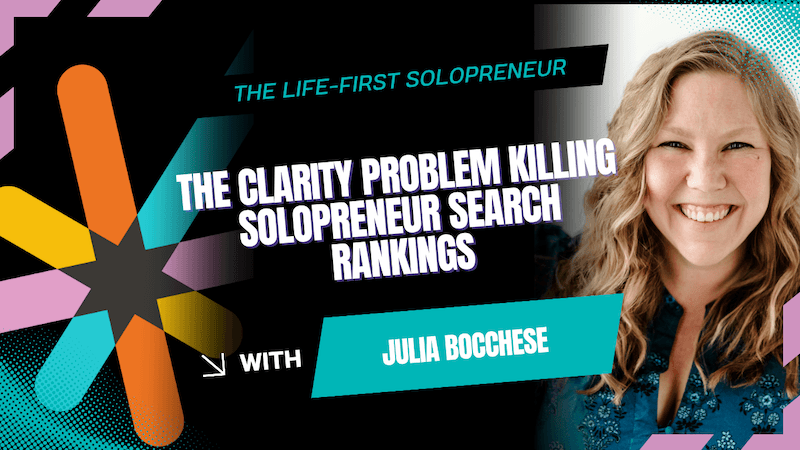
TL;DR: SEO specialist Julia Bocchese explains how service-based solopreneurs can rank in AI search (ChatGPT, Google AI Overviews), traditional SEO, and Pinterest. The key takeaway: most businesses don't have a keyword problem, they have a clarity problem. Use the language your clients actually search, optimize your website first, and let AI connect the dots from your reviews, blog posts, and digital PR.
What is the difference between AI search and Google search?
Google ranks individual pages, so each page on your site can rank on its own for a specific keyword. AI search platforms like ChatGPT look at your entire website as a whole, plus reviews, Reddit, directories, and blog content, then summarize that information to match a searcher's query. Google searches average three to four words, while AI searches often run 20 or more words.
Why does AI search favor small businesses?
Because people search AI platforms with long, specific phrases, AI connects the dots across your whole web presence rather than requiring exact-match keywords on a single page. A brand designer who mentions a luxury client on one portfolio page can get recommended by ChatGPT for "brand designer for luxury brands" because the platform pieces that context together.
What is a keyword?
A keyword is the word or phrase people type into Google or AI platforms to find services and products. Despite the name, it can be a short or long phrase. The goal is to target the language your clients actually use, not internal industry jargon.
What are affordable SEO keyword research tools?
You don't need to spend thousands. Julia recommends Key Search (around $17/month) and Ubersuggest (similar pricing, with a limited free version). These let you compare keyword competitiveness and monthly search volume.
How should you write blog posts for AI search?
AI platforms often only crawl the top third of a page (roughly 44% of the time). Put your most important, clear information—and a summary or TL;DR—near the top, not buried at the bottom. FAQs and key takeaways should appear early, not only after a long post.
How do you optimize Pinterest as a search engine?
Treat Pinterest like SEO, not social media. Write keyword-optimized pin titles and descriptions for a cold audience that doesn't know your brand. Don't auto-copy Instagram captions. Pins, boards, and profiles can also rank on Google, doubling your traffic potential. Pins without faces often outperform pins with faces.
Where does ChatGPT find information about your business?
ChatGPT pulls heavily from Reddit (a top source), Google Business Profile reviews, directories, blog posts, portfolio pages, podcast interviews, guest posts, and online features. Your website matters most, but third-party endorsements carry significant weight.
What is the one thing to do in the next 30 days?
Focus on your website. Target keywords your clients actually search, use clear plain language over jargon, and give search platforms enough copy to understand what to rank you for. Then expand into blog content and digital PR.
Key takeaway: "Clear is kind. Unclear is unkind." — Brené Brown. Clarity on what you do, who you serve, and where you're located is the foundation of getting found.
Guest: Julia Bocchese, founder of Julie Renee Consulting | JulieReneeConsulting.com | Instagram @juliereneeconsulting | LinkedIn Julia Bocchese
Episode Transcript
Carly Ries: In today's episode, we sit down with Julia Bocchese, SEO, AI search, and Pinterest consultant who helps creative and service based businesses get discovered online without paid ads or content burnout. Her big insight, most businesses don't have a keyword problem, they have a clarity problem. In plain English, Julia covers why clarity beats keywords, how AI search favors small specific businesses, how ChattyPT actually finds and recommends you, why Pinterest still matters in 2026 as a search engine, not a social platform, and the one website fix to prioritize in the next thirty days. You're listening to the Life First Solopreneur, the podcast for those in pursuit of a life first business. I'm Carly Ries, and my cohost Joe Rando and I spend every episode with solopreneurs who are proving there's a better way to run a one person business and experts who are helping make it happen.
We like to say life first then business. So let's get right to it. Julia, now that you said your name, Julia Bocchese, I'm like unique New York. Unique New York. Julia Bocchese. I wanna make sure I don't mess that up.
Julia Bocchese: It rhymes with crazy if that helps.
Carly Ries: That actually is really helpful. Well, I'm sure when people search for you online, there isn't a lot of competition. And we are going to get into the world of AI search, SEO, Pinterest randomly, which that threw a curveball my way, and I'm excited to talk about. But before we get into all of this marketing talk and how to get found online these days when everybody's trying to get found online and blah blah blah, let's do an icebreaker question to get to know each other. But it does relate to our topic.
So I wanna ask you, if AI search engines could recommend you for one totally non work skill, what would you want to be the top result for?
Julia Bocchese: Probably for being a Viking history nerd.
Joe Rando: Oh. I did not see that one coming.
Carly Ries: I did not see that one coming either. Okay. Well, when we publish this, it'll be in the transcript and everything. So let's get you to the top.
That's awesome. How did you get into that?
Julia Bocchese: Yeah. So I mean, it goes back to kind of like just being a general interest that I had, growing up. I remember in like third grade, I did a presentation as Eric the Red. We're supposed to be like historical figures. And all the girls did, like, Florence Nightingale, and I was like, yeah. I'm gonna be a Viking.
I was wearing, like, my brother's, brown Jedi outfit for it. But in college, I studied abroad in Denmark to study more about the Viking Age and Just got really interested in it.
I went to Roskilde, and I met my husband in Denmark. He's not Danish, but that's how I ended up in the Philadelphia area, actually. And then when I wanted to quit my job, I wanted to go to grad school to study Viking history, and I wanted to have a flexible schedule, I started freelancing. So it was when I was in grad school studying the Vikings is when I accidentally built my business. And then I was considering going for my PhD, but then I ultimately chose my business instead.
So it does connect to my business.
Carly Ries: Yeah. Okay. So we're going through a rebrand with the show right now. We're rebranding from the aspiring solopreneur to the Life-First Solopreneur. And now after talking to you and other people, I'm like, maybe we should change the show to the most interesting solopreneur and I'll have our guests have a competition of how, interesting and fascinating all of them are.
Joe Rando: I'm seeing that meme of the most interesting men in the world. Most interesting solopreneur in the world.
Carly Ries: Well, we could talk about this. And now I just wanna talk about Viking history for the next forty minutes. But I suppose we should probably dive into what we promised our listeners, and you, we would dive into. So let's get into it. You have said that most service based businesses, which is the vast majority of our audience, don't have a keyword problem, which is that like fun little marketing term we like to throw in there.
They have a clarity problem. So what does that actually look like in practice? And for a solopreneur, like, what are they dealing with these days in 2026?
Joe Rando: And can we define keyword just for people that maybe don't know what that means?
Julia Bocchese: Yeah. So keywords are basically just the word or phrases. I know keyword is misleading because it sounds like it's one word. But it can be a short or a long phrase, that people are searching on Google or on AI platforms in order to find, your services and products and things like that. I definitely think people do have keyword problems, but I think it first starts at the clarity issue where they don't know how their clients are actually speaking and the languages that or language that they're using in order to find their services. I see this a lot with, creative businesses where wedding photographers are like, I'll design your beautiful wedding day or something like that, instead of trying to target that they're a wedding photographer because that's what their clients are actually searching for. So it starts back at what your clients are actually searching for, how they actually phrase things, because it could be different than what you are phrasing things as because you're really in your business, you know all of the industry jargon and things like that, but it could be very different from what your clients are searching for. I run into this myself because, especially with AI search, people don't really know they might be searching AEO or GEO or AI search or AIO, whatever, all the different, acronyms there are now.
Joe Rando: We heard them all at HubSpot's Inbound last year. It's like every session you went to was a different expression
Julia Bocchese: I know.
Joe Rando: artificial intelligence searching.
Julia Bocchese: Yeah. So when people are confused or they're just not aware of the industry jargon, instead of, searching for, you know, AIO specialists or something like that, they're probably searching for how can I get recommended by ChatGPT? So it's like starting at the very basics, like what are your clients actually searching for? And then from there, you can build your keyword strategy.
Carly Ries: Okay. So stop right there. So they have the clarity and all of that. And you just said keyword strategy. And I mean, you've worked with interior designers, photographers, creatives. You just talked about wedding photographers.
We have a lot of people that kinda do that type of work listening to this. And they hear keyword strategy and they get paralyzed. they're like, where do I even start? I know who I am. I know what I do. What is the first thing you would have them do after the clarity phase?
Julia Bocchese: Yeah. So if you don't wanna kind of get into like really, SEO strategies that's overwhelming, just start with again that language that your clients are using. So if it's wedding photographer and then, your location or if you're a destination wedding photographer, just starting with that and then make sure you're actually using it on your website. This is the other issue I see where, someone's like, I wanna rank for Philadelphia interior designer.
I'm like, you don't actually use the word interior designer anywhere on your home page. You say, interior at the top of the page in one paragraph, and then you say, design in another paragraph. You need to actually use those words together, both for, Google and AI search, but then also for your potential clients who are reading your website copy. You wanna make sure it's really clear to them exactly what you do. So you can kind of just start there with using the actual, language that your clients are searching for.
If you do want to kind of dig into more SEO strategies, you can use keyword research tools. And that's just to find, different keywords that you can compare how competitive they are. so, if you're in a really competitive industry or if you're trying to, find a keyword that may be less competitive that better describes your services, that's a good place to start. You can see how many people are searching for that particular keyword each month, so that way you're not targeting a keyword that is so specific that no one is actually searching for it. Or again, back to the clarity issue, you're trying to target keywords that are, you know, industry jargon that your clients aren't searching for it, so no one is really searching for it on Google.
You wanna make sure that you're finding keywords that people are searching for and that aren't too competitive so you actually have a good opportunity to rank for them.
Joe Rando: Question. Some of those SEO tools are the search engine optimization tools are very expensive. One of the ones I've found, Ubersuggest, isn't. Any thoughts on that?
Julia Bocchese: Yeah. So you don't have to pay thousands of dollars. My personal favorite is Keysearch. I think it's, like, $17 a month. I think Ubersuggest is also around that price range.
Joe Rando: 9. $9.15. Something like that. Yeah.
Julia Bocchese: So especially if you're just working on your own website, you don't need to do keyword research for, like, 20 websites a month, which is what I'm doing. So I'm investing in, these, more expensive tools. But just for your own website, if you just need to do, a couple of keyword searches a month, I would do a, lower price tool like Ubersuggest or Keysearch. I think even with Ubersuggest, you might get, like, five free searches per month or something like that. So if you just wanna, test out the free version too, you can, get your feet wet with that.
So yeah, you don't need to pay thousands of dollars for keyword research tools.
Carly Ries: Okay. So speaking of keyword research, let's kinda zone in on AI search really quick because we have a lot of people that have left corporate America. Maybe they took a marketing course ten years ago where they learned all about search engine optimization, and now they're like, wait a second. I have to think of another thing to rank on now with AI. And you say that Google searches average like three to four words when people type it in.
But AI searches, it's like 20 or more on average, which I know from my personal searches through plot and GPT and everything. Those can be big sentences.
Joe Rando: So I gotta be honest. I'm doing that now in Google. I'm searching Google with AI search because it has an AI response. Yeah. It's across the board, at least for me.
Carly Ries: Yeah. So why does that shift actually now favor small specific businesses over big competitors? Because I feel like that's like a big, momentum boost for these small guys. Even for us, we we rank, like across the board in AI. And it took us a while to get there in Google and it was much faster in the age of AI.
So sorry, I'll stop. That was a humble brag.
Julia Bocchese: Yeah. So there are a couple different ways this is, beneficial for smaller businesses. So, one is, I mean, people are searching really specific things. And the way that AI works that's a little bit different from Google is Google will rank, individual pages.
So anytime, I'm sure you've used Google, you've seen whatever you've searched. So if it's, interior designer in Philadelphia, you see 10 results on the first page, and they each link to one page. It's not just linking to the homepage overall. You can get your about page, your services pages, your portfolio pages, things like that to rank on Google, as their own. It's not just your website as a whole ranking on Google.
And then AI search is a little bit different. So they are obviously looking at all of your website pages, but they're also looking at your website as a whole. So when people are searching these really specific phrases, you don't necessarily need to make sure that you're targeting these, like, 23 word phrases on each page. AI will connect the dots a little bit more than Google does. So for example, if someone's searching, interior designer in Philadelphia, you'll see the page ranking for that.
But then someone on, like, ChatGPT might be searching, I'm looking for a female interior designer in the Philadelphia area who works with families that have young kids but still wanna have, a luxury look, you know, something like that, then ChatGPT is looking on your website, but then also, any reviews that you've gotten on, Google Business Profile or on directories, on your blog post content, on your portfolio pages to kind of, piece together that information. So even if you don't say, on your homepage, I'm a female interior designer who, works with families that have young kids or something like that. But if you mention, on your about page that you're a female interior designer in Philadelphia, and then someone has written a review on how much they love how you're able to make their house look luxury even though they are living with, you know, young kids, ChatGPT is looking at all of that information, and then they'll bring together a summary. So if you ever use ChatGPT , they're not just listing out websites. They're giving you, a summary that best matches what you've searched for, and then adding the link to whatever is the most relevant link for that search.
So they're summarizing all that information and then giving it to the searcher. So that's where small businesses, they don't have to try to target all these 23 word phrases on every single page. Like, if you have that information that people are searching for in different places, AI can kind of, piece that together. actually, someone I was working with was a brand designer, and she is really targeting, brand designer on her pages. But then she, mentioned on a portfolio page that the client that she had worked with was a luxury brand.
So now she gets a lot of inquiries from ChatGPT for people looking for brand designer for luxury brands because ChatGPT has put together that she's a brand designer, and she has experience working with luxury brands. So they are also looking for, kind of that experience or that proof that you are who you are and what your services are essentially. That is a long answer. I hope I answered you.
Joe Rando: this is great. But you're saying that proof is the idea that it's coming from someplace else. Not I'm not saying it on my website. I work with luxury brands. Somebody else is saying it about me is giving more respect?
Julia Bocchese: Both are definitely important. So if you have any sort of, credentials that are important for your industry Or, like, on my website, I say, how long I've had my business, how many clients I've worked with over the years, things like that. That definitely carries weight for ChatGPT . But, yeah, anytime someone else is talking about you or essentially, they're endorsing your business in different ways, that is also gonna carry a lot of weight. Because the number one website that ChatGPT looks at when they're, trying to find answers for people is Reddit.
Because it's people talking about, other people or, brands, products, services, things like that. So it's not just you talking about yourself. It's, these other people talking about, their experience with you and things like that. I mean, even any sort of digital PR is helpful.
So, you know, doing podcast interviews or guest blog posting, being featured in online magazines or doing TED talks, things like that. That is all going to be kind of added up and carry weight for you. So your website is definitely really important, but yeah, should not be the only place where, you're talking about your experiences and your services and things like that.
Carly Ries: these are all such helpful tips. But I feel like some other people, they try to gain the system and use hacks, like, put really small paragraphs on your website. Write everything on your website in the form of a question so that it matches the question perfectly. There are all these different, like the formatting, all these things. But you argue again that clarity is much more important than these hacks.
So what does writing and you kinda just talked about a lot of this, but is there anything else you wanna add about writing for clarity instead of making sure you have enough bullet points or call outs or stuff to get found?
Julia Bocchese: Yeah. So one thing that's really helpful with Clarity and AI search is, I think it's like 44% of the time, AI platforms are only looking at the top third of a page because they are crawling all of these different places and across your whole website when they're searching for an answer. They don't have time to crawl, a, 2,000 word blog post all the way to the end sometimes. So a lot of times they're only looking at the first third of the page. So you do need to be very clear from the beginning.
So it's maybe not hard to game the AI search system, but it isn't beneficial if you're, hiding a bunch of paragraphs and white text at the bottom of the page, because AI might not even actually look at that. So being clear for both your potential clients, but then also for, AI search at the top of the page, rather than having a lot of, fluffy text that's really poetic, but means nothing, and then actually talking about your services the second half of the page.
Joe Rando: that's really interesting. So one of the things I've heard people saying is you should include FAQs even on blog posts and on your pages because that is something that AI really likes because it's a question and an answer to a question. But I've been doing that on our blog posts, but I've been putting them at the bottom of the page, half to the blog. So you're saying that might not actually be doing me any good.
Julia Bocchese: Yeah. I mean, yes and no. So it's hard to say since like, half of the time that they might not be crawling the whole blog post. So it really depends on the search.
For BlogGhost specifically, I would recommend adding, towards the top, in the introduction or something like that, a summary of the blog post or you know, TLDR section.
Something like that. So they get like the gist of what is going to be included in the blog post if they're not crawling to the entire blog post.
Joe Rando: Cool idea.
Carly Ries: That's a great point. Really good point. Okay.
Joe Rando: Next blog.
Carly Ries: Yeah. Right? so Julia,You're not gonna like what I'm about to say. But doing my background research, I knew we were gonna talk about Pinterest today. So I went to look at my Pinterest, which I have a wedding board from 2015 with all my inspo, and then just a bunch of recipes.
And that's how I've used it. And I was like, oh no. I am gonna get big red x across from me saying this. Because I think it often gets lumped in with social media. But you are a big advocate to treat Pinterest as a search engine.
So tell my 2015 self, why does Pinterest still matter in 2026? And who should and shouldn't be there right now?
Julia Bocchese: Yeah. So I mean, what you described is like your personal kind of account on Pinterest. So you can definitely have a personal account and a business account if you kinda wanna keep them separate and have a business strategy. But, Pinterest is a search engine, and this is where it kinda trips people up with the, strategy. Because I see a lot of times they're just trying to replicate what they're doing on Instagram.
They're just automatically posting whatever they're doing on Instagram over to Pinterest. But Pinterest really does need, those keywords, making sure, the pin title and the pin description are well optimized. And especially thinking about the audience on Pinterest as being a cold audience who has no idea who you are. They don't really care who you are. They just care about the information.
So I saw this recently with an interior designer where she was just, automatically, again, posting the Instagram post over to Pinterest. But when that happens, it's just copying the Instagram caption over. So it's like, oh, look at this, cool paint color my client picked out today. And it's a really pretty, you know, room that she designed, but there's no context behind, the work that she did or what the, room is or, the different style that she added to the room. There's also no pin title when you just, automatically pin whatever you're doing on Pinterest or Instagram over to Pinterest.
So you're missing an opportunity to add, a well optimized title that incorporates keywords for Pinterest. So people on Pinterest, they don't know who you are. You really need to, approach it as SEO as if no these people aren't familiar with your brand, with your services, with your content. They're really looking for information, and they don't necessarily care who they're getting the information from. Whereas, on Instagram, people like to follow people.
They like to see your face in posts and things like that. But typically, pins that don't show faces perform better than pins that do show faces. So it's a very different approach, and I think that's where people kind of get tripped up with Pinterest.
Joe Rando: Now does this only help in Pinterest if people are using Pinterest as a search engine, or does this also help with overall AEO or SEO?
Julia Bocchese: Yeah. So pin pins, boards, profiles, all of that can actually rank on Google. I do see this sometimes when I'm doing, keyword research for an SEO client. I'll see, like, the top ranking websites, and some of them are, Pinterest boards or actual pins.
So if you have a well optimized pin or board or profile, you're using keywords, Google's seeing those keywords and they can actually rank well on Google. So you can kind of get like double the traffic for some of your pins if you're able to get them to rank well on Google.
Carly Ries: Okay. So somebody's listening and like, woah. Woah. Woah. I need to now factor in SEO, AEO, Pinterest, Reddit, my reviews, everything people are saying about me, this seems like a full time job.
And I'm trying to live a life first business where I work hard but also have that work life harmony. How do you tell your clients to manage all this without burning out on keeping track of everything?
Julia Bocchese: Yeah. So first, I would focus on where your clients are. So if they aren't listening to podcasts, don't do podcast interviews. If Reddit doesn't make sense, like, Reddit really doesn't make sense for my business to try to, like I don't even know how I would, get people to talk about my SEO services on there naturally. So something doesn't make sense for where your clients are searching or, whatever activities they're doing, then I wouldn't worry about that platform.
You can also take things, one step at a time. You don't have to do 50 podcast interviews tomorrow or anything like that. I would first focus on your website because no matter if someone's coming from Instagram or Facebook, it all leads back to your website. So you do wanna make sure that your website is not only well optimized for SEO and AI search, but also for anyone who lands on your website in order to be able to easily convert them into, clients or customers. So make sure everything is set up for your clients, and then you can, start to do things one step at a time.
With Pinterest, one reason I love Pinterest is you can schedule out pins for, a month or two and then not even log in to Pinterest. Like, you don't have to show up on Pinterest every day. You don't have to, interact with other pinners. So if Instagram, you're really getting burned out, I would recommend trying Pinterest as long as you do have content on your website because you do need to have something to pin. So if you, don't have any blog posts, don't have any, portfolio pages or anything like that yet, I would, again, start working on that.
So focus on your website first before starting to integrate Pinterest. But Pinterest, it can be a bit to kind of set up at the beginning. But then once it's set up, it can kind of run on its own, and you just need to create pins and schedule them out for like a month or two, and then you don't have to touch it again. So it's not something where you do have to be active every day.
Carly Ries: Yeah. That makes sense. Well, okay. So Pinterest to me is like a hidden gem. And you've mentioned that there's one simple visibility fix most founders, solopreneurs avoid even though they need it. So what is that? And why do you think people resist it?
Julia Bocchese: With Pinterest specifically?
Carly Ries: No. Just in general. I thought I saw when I was doing my research that there's a simple visibility fix. Do you have one or did I make that up?
Julia Bocchese: I don't think I have anything new. It'd probably be more related to keywords.
Carly Ries: Well then maybe I made it up.
Julia Bocchese: That's okay.
Carly Ries: if a solopreneur could only do one thing in the next thirty days to improve how they show up in search, traditional AI, whatever. What should it be?
Julia Bocchese: Definitely the website. I would first make sure that you're targeting keywords that people are actually searching for and using the language that they're actually using. Don't use a lot of industry jargon if that's gonna be confusing. So my website, you'll see I don't use AEO, GEO, AIO a lot. Maybe a couple times, but I'm really not using it a lot.
So first focus on that. And then once you have your website in a good place and you have a good amount of website copy for, search platforms to be able to crawl and understand what to rank and recommend you for, then I would focus on, depending on how much time you have, either your, blog post strategy or kind of that digital PR, doing guest blogging, doing podcast interviews, getting featured on, directories that are related to your industry. It kinda depends on, the business and then also where your clients are. But I would definitely try to increase your visibility in at least one of those places.
Carly Ries: Yeah. Well, Julia, this has been so helpful. I'm a marketer, and this really opened my eyes to a lot of things today. So thank you so so much. I think it'll help so many of our listeners find success in this area.
So I have to ask a question that we ask all of our guests. What is your favorite quote about success?
Julia Bocchese: I would say my favorite quote is more about how to be successful or get success. And it's Brene Brown, Clear is kind. Unclear is unkind. Because, again, going back to, the clarity with your website and everything like that, if you are unclear about, what you do, who you serve, where you're located, It's not going to be helpful for reaching potential clients or converting them. So you're not gonna have as much success if you're very unclear about what you do and what you offer.
Carly Ries: It's a great quote. And a first. sometimes we have repeat quotes, and I haven't heard that one yet.
Joe Rando: Which is cool.
Carly Ries: Yeah. Which is great. Well, Julia, this has been so helpful. Where can people find you if they want to learn more? Send us all the links.
Julia Bocchese: Yeah. So you can find me at juliareneconsulting.com. I, of course, have lots of blog posts there. You can also find me on Instagram at juliareneconsulting, and on LinkedIn, juliareneconsulting.
Carly Ries: Bocchese. See, did I try it? Did I do it right?
Joe Rando: You did well.
Julia Bocchese: It was great.
Carly Ries: Yeah. It was good. I tried to do the East Coast accent.
Julia Bocchese: Do The fingers. Bocchese.
Carly Ries: Well, thank you so so much for coming on the show today.
Julia Bocchese: Yeah. Thanks for having me.
Carly Ries: And listeners, thank you so much for tuning in. As always, leave that five star review. It helps us share information like this with other Life-First Solopreneurs in your shoes. Subscribe to the show on your favorite podcast platform including YouTube, and share this episode with a fellow solopreneur. And we'll see you next week on the Life-First Solopreneur.
You may be going solo in business, but that doesn't mean you're alone. In fact, millions of people are in your shoes, running a one person business and figuring it out as they go. So why not connect with them and learn from each other's successes and failures? At LifeStarr, we're creating a one person business community where you can go to meet and get advice from other solopreneurs. Be sure to join in on the conversations at community.lifestarr.com.