









23 min read
The Dating App Psychology Every Solopreneur Should Steal
 Carly Ries
:
Aug 4, 2026, 6:08:38 PM
Carly Ries
:
Aug 4, 2026, 6:08:38 PM
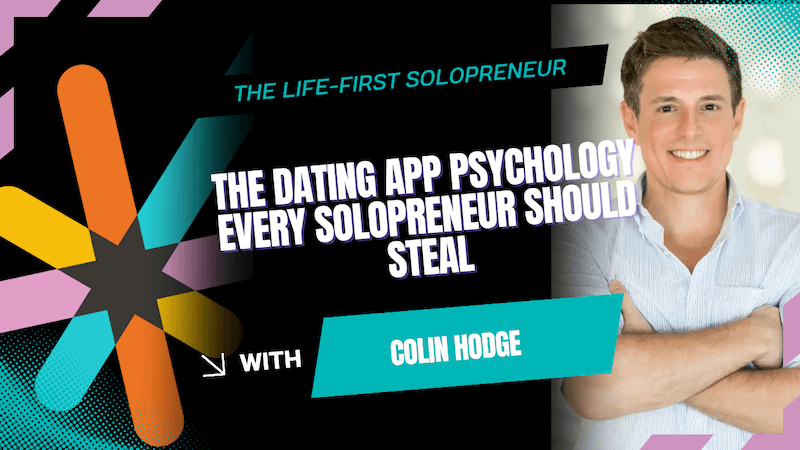
Can dating app psychology really help you grow a business? According to Colin Hodge, national bestselling author of Outrageous Startup Growth and founder of one of the most talked-about dating apps of the last decade, the answer is yes. The same triggers that make people swipe, match, and return day after day are the same principles solopreneurs can use to attract customers, build loyalty, and grow without a large marketing budget.
In this episode of The Life First Solopreneur, Colin joins Carly and Joe to break down the user psychology behind successful products and how any solopreneur can apply it starting today.
Why understanding your user matters more than your product
Many solopreneurs fall into the build it and they will come trap. Colin explains that real growth starts with understanding your target user, how they think, what is happening in their lives, and what they are searching for when they encounter your product for the first time. That understanding unlocks new user acquisition you cannot get any other way.
How to turn rejection into resilience
Rejection is unavoidable in both dating and business. Colin shares how exposure builds a resilience muscle, so a no stops feeling like a disaster and starts becoming a lesson. He also opens up about being rejected from Microsoft's product team and why it was the best thing that ever happened to his career.
The unfinished task principle
Ever get stuck on a cliffhanger you cannot stop thinking about? That is the unfinished task principle, also known as the Zeigarnik effect. Colin explains how progress bars, cliffhangers, and held-back content keep users coming back, and how solopreneurs can use it ethically to build habits that lead customers to success.
Persuasion tactics solopreneurs can use today
Colin walks through Cialdini's persuasion tactics, including liking and social proof. His key insight is that you do not need thousands of customers to build social proof. You need one or two of the exact right people and a compelling story built around them.
The scarcity mindset, a double-edged sword
Growing up resource constrained can make founders scrappy and resourceful in the early days. But Colin explains how that same scarcity mindset can later hold you back from smart spending that scales your business faster.
Why curiosity is a competitive advantage
Colin shares how a single curious question about an unexpected spike in downloads led him to discover app store optimization, which went on to drive much of his app's organic growth.
The TRUTH framework for authentic branding
Colin created the TRUTH framework to define what makes a brand feel real. It stands for transparency, relatability, uniqueness, trustworthiness, and honesty. He explains how these elements combine to signal authenticity, and why that matters more than ever.
Standing out in the age of AI
As AI floods the market with content, Colin argues that sounding like a real human is a solopreneur's biggest edge. He shares how the contrast effect can help your brand stand out through voice, visuals, and genuine customer connection.
Colin's favorite quote about success
The best time to start was yesterday, and the second best time to start is today. Colin explains how this why not now mindset helps him push past hesitation and take the first step.
About Colin Hodge
Colin Hodge is the national bestselling author of Outrageous Startup Growth and the founder behind one of the most successful dating apps of the last decade. You can find his book anywhere books are sold and learn more at ColinHodge.com.
Listen and subscribe
Subscribe to The Life-First Solopreneur on your favorite podcast platform, including YouTube. If you enjoyed this episode, leave a five-star review and share it with a fellow solopreneur.
EpisodeTranscript
Carly Ries: What if the same psychology that makes you swipe right on a dating app is the exact same thing that makes someone buy your product? On today's episode, Joe and I sit down with Colin Hodge, national best selling author and dating app founder, who turned user psychology into a growth machine. We get into why getting rejected from Microsoft was the best thing that ever happened to him, the sneaky reason you can't stop thinking about that TV cliffhanger, and why sounding like an actual human might be your biggest edge in the age of AI. So grab a notebook because you are gonna wanna take a lot of notes. You're listening to the Life-First Solopreneur, the podcast for those in pursuit of a life first business.
I'm Carly Ries, and my cohost Joe Rando and I spend every episode with Solopreneurs who are proving there's a better way to run a one person business and experts who are helping make it happen. We like to say life first, then business. So let's get right to it. Okay. So listeners, it is not every day you see a subject line in your inbox that says, how would dating apps user psychology also applies to business and startups?
And I was like, what? That is unlike anything I've ever seen before. I'm so intrigued. And so, of course, we had to get Colin Hodge on the show today to talk about this and so many other things. Colin, welcome to the show.
Colin Hodge: Thanks so much for having me and apologies for the crazy email subject.
Carly Ries: No. It's the best. It was the best. I was like, oh, that's cool. Let's chat. So before we get into everything I want to talk to you about today, we have an icebreaker question and it kinda ties in to what I just told the audience that I read about in the subject line. So I have to ask you, what is a product or app on your phone right now that you can't stop using, and do you know exactly which psychological trick it's playing on you?
Colin Hodge: Oh yes, okay, so like a lot of people, I am currently addicted to social media, and I am trying my best to fight it, but it's super hard because they employ all of these psychological tactics to give us the dopamine hits that keep us coming back, to guess when we're about to lose interest and our attention is waning, give us that jolt of something that they know works very well versus something more experimental. And so I am trying really hard to cut that, but in my book I write about another one that I think is very cool, and this one is actually a bit more useful. It's Duolingo, and in Duolingo, they use all sorts of gamification elements, everything down to their mascot. That little owl is the most motivational, but frankly manipulative little character that any of us might have on our phones.
Carly Ries: Yeah. Well, I wanna talk about Duolingo a little bit more with you later in the episode, because I think there are a few more things we can dive into. But we're talking about the psychology behind these apps and everything. And you discovered that the psychology behind swiping right on all these dating apps the same psychology that drives someone to download an app or even buy a product. So for a solopreneur with no marketing budget or anything, what do you think is the single most useful piece of that psychology to understand first to apply it to your audience?
Colin Hodge: Yeah, so many of us, when we're thinking about marketing or we're an entrepreneur , we're a solopreneur, we're trying to get our work out there, we put ourselves in this situation where we think if we build it, then the users will come, but that's just not the case, and if you have been running at this game for a while, you've been trying to build your audience, you know this. so the first piece of advice that I give to people is to succeed, you need to understand your target user, and that means understanding how they think, understanding what type of person they are, and what's going on in their lives as they encounter your marketing, your advertising, or your product for the first time. Because when you do, that unlocks a whole world of new user acquisition and success with your products. You can help them get from whatever starting point it is, all the way to that successful point that they're really hoping to get when they're searching for a solution like yours.
Carly Ries: I want to go back to the dating thing really quick, because I just had this idea. In our book, and we're not the only people to allude to dating and marriage as the buyer's journey, but in our book, Solopreneur Business for Dummies, had to throw in a little shameless plug, we use the dating analogy to marriage and all of that. I think it's fascinating that you name like resilience to failure, displaying confidence before you feel it, and standing out as three dating insights essential for business survival. There's so much you can apply from the relationship world to the business world. But some solopreneurs face rejection constantly, and they're alone, and it's hard to bounce back when you're flying solo.
So how do you think someone builds resilience through this repeated exposure without burning out based off of what you found with these dating apps?
Colin Hodge: Yeah, so even a lot of therapists are using this technique of exposure therapy, and it's taking whatever you fear. In this case, as entrepreneurs, I mean, as humans, we all just fear rejection, right? And so how do we help people build that muscle? I mean, I was writing my book, this is my first book that I wrote, I feared rejection from people when I reached out to them, I feared failure when the book came out, and teaching people to overcome this fear by building that muscle, building that repetition is one of the most powerful things we can do. And as you start to take small baby steps and you notice oh, actually, it's not a disaster when I heard no, and that no led to a maybe somewhere else that turned into a yes on the third connection.
So you start to see that putting yourself out there and facing possibility of rejection, but also the beautiful lessons that come from rejection, that is a huge step and a huge element for obviously dating because you have to kiss a lot of frogs to meet your prince or princess, right, and for running a business because you can't run a business alone, you can't run it without customers, or you can't run it without teammates, building a staff, etcetera. So it's gonna take putting yourself out there and risking rejection so that you can learn from it, and you can also build that muscle and become more resilient to that rejection.
Carly Ries: and Colin, not to put you on the spot here, but you were rejected from Microsoft, correct, from their product team? But you say it was the best thing that ever happened to you. So for someone still in corporate who's daydreaming of going solo, what is that hidden cost of fitting in that they may not see until they leave that you luckily saw after that rejection?
Colin Hodge: Yeah. So I guess over fifteen years ago, I was working at Microsoft, and I was in an engineering and test position, so very much a lot of coding, a lot of engineering work. Working on Windows Phone, you remember that relic. It was one of the original smartphones.
Joe Rando: I do. Not fondly though, sorry.
Colin Hodge: Not fondly. Well, I like to tell people, I was part of the battery life team for a while, so I like to tell people if your phone lasted more than a few hours, you're welcome. If you're mad about the phone
Joe Rando: Never minded the battery life,
Colin Hodge: I'll take that small win. So as I was working on that, I realized that I didn't want to just do coding or testing for the rest of my life, my career, and I wanted to start to define the product, start to define what are the cool features we're going to work on next? What does the user feel like during that experience? And I started to ask around and interview around, and I realized that I was not very good at interviewing for this new role, and a lot of the feedback I was getting was either of two types. One was, this is not for you, this is not a good fit, you need to start much lower on the totem pole here, or you're so smart, why are you even bothering with this?
Go out and start your own thing. And so felt conflicting because at one point I felt like I'm not good enough and at another point people were telling me you're good enough to start your own thing. And so the hidden cost that I was missing at the time, and it hurt to be rejected, so I didn't see it right away, was I was holding on to this dream or this idea of like what it meant to have more impact within this big company within the corporate world. And I was missing that by chasing that and trying to fit something that wasn't a good fit, I was paying the cost of the freedom, the realization that I would find once I finally took that leap and I went out and became a solopreneur. Once I did that, it really unlocked a whole world of possibilities for me, and then the shades fell from my eyes, and I finally realized like, I thought that these were my only choices, but the whole world is my oyster, and I shouldn't just settle for the corporate life as somebody else higher up to find it for me.
Joe Rando: Says the guy calling in from Athens, you know, the world is your oyster because you're you're kinda living wherever you want. Right?
Colin Hodge: I am. We have a team trip here. We're doing a week retreat and we flew in half the team, so absolutely taking advantage of this freedom that I have now.
Joe Rando: That's great.
Carly Ries: So cool. Well, I want to go back because I do wanna talk a little bit about about your stories because I think it's relatable to people. But what you've done since being in corporate is really cool. And I really like talking about psychological principles, tactics, and all that. So we're gonna dive into a few.
You
Colin Hodge: Let's do it.
Carly Ries: The unfinished task principle, which I actually have never heard of. So how can a solopreneur well, one, I want you to define it. But also, how can a solopreneur with one product and limited resources, which many people have, how does that unfinished task principle keep customers coming back? can you show us some examples us just how that works?
Colin Hodge: Yeah. So the unfinished task principle is this, it goes by many names, Zeigarnik or Zeignerik was the psychologist who defined it and had it named after her, but the idea is that our brains, when we have a task that feels unfinished or we can visibly see it's unfinished, we remember it a lot more strongly than a task or an element that is not like that. So if you complete an entire puzzle and it's done, finished, your brain kind of wipes the slate clean and doesn't hold on to that as something that it's working on. But if you leave a few pieces undone in that puzzle, then your brain is still holding on to that, and it leaves like a little bookmark, a little reminder, and you're gonna remember much more, not only about, oh, I have this puzzle to finish, but also which pieces they are and where are the holes and where they might fit.
And so we see this everywhere, and if you're using any sort of technology, you've seen this because the progress bar takes advantage of this phenomenon. The progress bar is this mental need we have deep in our brains, something is triggered that says, This feels unfinished, I'm working on a task, and I need to remember, I need to close that. It's a drive we have to try to finish things, and it also helps us remember things more. And so we use it obviously in progress bars and other places, but in a dating app per se, you might think about this as, okay, we want users to come back the next day and keep meeting new people, so how do we implement that? We run experiments and try to bring people, try to not give them the complete puzzle from the start.
So maybe there are a few more new profiles that we're gonna hold back from you, and we're gonna say, hey, you can come back tomorrow and see the best profiles for you, and if you don't pay, then you can't see them right away. So that's an example of how you can use this, but you want to make sure you're doing this in a way that helps the user in their overall long term progress. So it's not just randomly breaking down things and saying, Oh, you can't complete this right now because we want to frustrate you or we wanna make you pay. It's building these habits that can lead them to success. So when I use any sort of thing, it's kind of a related principle, it's like cliffhangers in Netflix, right? if I'm watching a movie or I'm listening to a podcast or an audiobook and there's a cliffhanger, I am much more likely to want to return to that and stick around, and my brain is logged so much about what happened because it's anticipating that it feels unfinished. And so we can use that in our user experience design, and also in our communications.
Carly Ries: So funny, I'm watching a show right now, and I found myself over the weekend thinking about it a lot, And I was like, this is so ridiculous. I have so many things I need to be getting done, but there was a cliff hanger and I was like, I can't stop thinking about it until I watch the next episode. This is driving me crazy. So I'm glad there's an actual persuasion or a principle behind it because it makes me feel like I'm not alone. And that other people experience what I am. okay. So going back to speaking of this need to like continue watching. You're talking about your social media addiction earlier that so many people have.
Colin Hodge: Mhmm.
Carly Ries: So let's bring up Facebook. They built Facebook like an empire on four psychological triggers that a lot of startups don't use. What persuasion principles do you think are most accessible to solopreneurs, and how can they use it on a on a limited budget?
Colin Hodge: Yeah. So these are called Cialdini's persuasion tactics, and these are basically, you're gonna recognize them in the wild all the time, as I describe a few of them. So the first one that you can all start with, whether you have a social media account that you're just trying to build some traction with, trying to get people to like you, is called the liking persuasion tactic. And this is being authentic and creating this persona, creating this brand that people actually like and want to do business with. you can do that as an individual, you can do it as a company, or like Duolingo, you can create a mascot that people create a connection with, and they see it's a personification, it has emotions, it reacts to things, it encourages you, that creates a likeness, so everybody really enjoys or sometimes enjoys that bird, and therefore is going to be higher retained and spend more money and all that good stuff. So the first one you can do is just think about how are you coming across to your target customers? Is it coming out in a way that is authentic, is it something, is it a type of person or persona that they would like, and are you making sure that it feels like there are humans behind it that actually are designing this emotional experience for them? So liking is the first one. The second one is social proof.
Now you might be thinking, Oh, I'm just starting out, I don't have social proof. But social proof can be the smallest sorts of things. So if you're just starting out and you think of your target audience, your target customer, there's probably a very narrow definition that you can really drill down into, and when you do, you're going to realize that you can create some social proof that matches that type of person's interests and personality. So let's say that you have users and they're super into sports, they're super into mountain climbing, and you don't need a thousand people who mountain climb and say they love this product, you just need one or two, and they could be your friends, or they could be people that you approach that are in the industry and trying new products, and you could say, okay, I'm going to give them a free product, or I'm going to pay them even to try my product, and then build a case study of social proof of why this is great for a mountain climber like them. So that's social proof, and then as you display it, you explain, Joe is a mountain climber, he climbed these mountains, here's his home gym that he does, you want to build this whole story around them, and then you present it to the user as a testimonial.
That is a great form of social proof that is very on the nose for your target customer, but it doesn't require that you already have thousands or even millions of customers, it just requires that you think very deeply about the type of person that you want to reach, and create that social proof for them so they feel like they see themselves in the testimonial or in the product.
Carly Ries: These are all so fascinating. I'm like jotting down all these notes. Another thing I wanna bring up, are you familiar with Nancy Harhut? She does behaviors
Colin Hodge: Yeah, I am. I think we're connected.
Carly Ries: Okay. Yay. So I follow her stuff. I now follow your stuff. But she talks about scarcity a lot. And since my kids are in the other room and they could walk in at any moment during this interview, Made me think of this. We always hear celebrities say, oh, I came from nothing and I built this or I started with such low means and now look look at me today. And you make the case that kids who grow up resource constrained often make better solopreneurs or entrepreneurs. What specific psychological edge do things and I bring up Nancy Harhut, but she's she talks about scarcity quite a bit. What psychological edge does scarcity create?
And if somebody does grow up with privilege, can they deliberately overcome this and still have great odds? these people that had scarcity?
Colin Hodge: Yeah, so in my book I talk about this scarcity mindset, I put it in the book as something that's a bit of a double edged sword, because as a beginning entrepreneur, when you're first starting out, it can be incredibly helpful to help you be scrappy, to survive those earliest years until you get traction, and then you can actually start to delegate, usually with money, delegate to other people and help spread your business, but in the process of growing it becomes also kind of a weight around your neck because what you realize is it's holding you back from seeing the smart moves with your money and doing things that can actually scale you faster and scale you to success better. So a lot of the times, I find that entrepreneurs from zero to one when they're first starting out, that scarcity mindset is super helpful, because you do things like, you find the scrappiest way to make the business survive, to find all the free credits you can, to make partnerships out of nothing without actually having to pay the partner, just designing a win win, to just being relentlessly persistent and growing your business. These are all the things that I think growing up with that mindset teaches you.
It's like making something out of nothing, but then what I've had to grow through, and I think maybe some others who grew up similar to me might have to evolve if they want to level up as well, is be willing to examine where those same superpowers are holding you back in maybe other stages. And my business partner pointed this out to me and I've worked on it a lot where now I'm okay spending a bit more money and not penny pitching, not looking after every cent, not trying to do everything ourselves and do it, you know, organically, but say, hey. You know, some things, they're just better to pay for because it lets you focus on where you can scale better or where you wanna spend your time more.
Joe Rando: Absolutely. just a little bit on that. I've seen it over and over again, what you said. You know, there are the people that kinda come from some money, and they get the idea of investing money, but it's hard to get going. And then the other side of it, the people that are scrappy and don't ever think through going to that next level.
What is the the thinking that brought you from that scrappy, you know, guard every cent thinking to the investing? I mean, what was that transition built upon? what would a solopreneur that's dealing with this want to do or think about in order to make that transition?
Colin Hodge: Yeah, I think a big part of it for me was having a business partner or a co founder to hold up that mirror to me and push me out of my comfort zone, challenge me a bit on those. But even if you're a solopreneur, you can do this as well by looking at the competition and looking at what are the patterns you're seeing with them. For instance, in the dating app industry, we've seen some competitors that have grown much, much faster, and most of the time I would dismiss a lot of that growth to say they're doing it unsustainably, they're chasing just growth at all costs, but they're not going to last, and a lot of times that has proven right, but a few of them have actually been able to grow more aggressively because they're able and they're willing to spend that money. And so when I took that hard look, and it's not every day I do it, maybe once a year or so, do that exercise and look at what the competition has done, and what possibly unlocked that growth for them, that can really open your eyes and challenge your beliefs or challenge, frankly, just your habits about how to do this, because once you do that, then you can start to work on it.
I'm still not just throwing money around everywhere, but I do want to spend it where it saves me time or gets us there faster to a tangible result.
Carly Ries: Well, so we've talked about Cialdini's persuasion principles, talked about scarcity, but you also say that curiosity is a big competitive advantage that often goes overlooked. What do you think curiosity looks like in practice for a solopreneur? And is there a way to help them keep everything alive when they're buried in day to day operations?
Colin Hodge: Yeah, I've got to say that this is something I only realized in the last few years. I'm a naturally curious person, and I think most entrepreneurs are because we look at the world and we see it a little differently. We see it as something that we can make a dent in, that we can have an impact, or we can carve out our own new creation that can create value from seemingly nothing. And so this curiosity is something that I really encourage other entrepreneurs to lean into when you just look at the world as why is something happening? Why, for instance, going back to my book, launched our app in 2013, and we had a big spike of users and lots of worldwide attention, and then things started to fall, and it was about a year later that I started to look at the numbers more closely, and I noticed there was a small spark of growth in a country that I wasn't even paying attention to. But because I was curious, I wondered what drove that, I started to dig into it, and when I did I realized it wasn't the typical driver of growth that I had a finger on, it wasn't press, it wasn't something obvious like ad spend or anything like that, it was organic downloads coming from the App Store on a particular keyword, and users were just searching for that, and we happened to rank highly for it during that day.
And that spark led me to just keep digging into it, like how does this work, how do we rank for more keywords, and that began my journey of app store optimization, which has driven so much of our app's organic growth. So when I talk to other entrepreneurs, I tell them, be curious about the world, be curious about what's going on with all of your metrics, with the patterns you're seeing in the industry, because that curiosity can drive you to new places that you wouldn't get on your own just by your normal brainstorming or normal discussions. It's looking for those little sparks of growth and really double clicking on them or digging deeper on them.
Carly Ries: So speaking of curiosity, I came across your truth authenticity framework. Can you tell us a little bit about that? What is that?
Colin Hodge: Yeah, so my book is called Outrageous Startup Growth, and one thing that I was trying to figure out is what made my brand so outrageous? What made us successful with that? And our original brand was called Bang with Friends. So it was a very curiosity driving name, and as part of that, I realized that it wasn't just the name, it was how we showed ourselves to the world. It was how we talked about the brand, how the app felt to users, and how the marketing came across.
It was all very just real and didn't hold back anything. It wasn't a bunch of corporate PR speak, didn't have a bunch of buzzwords, it was just real. And so I started to think about, okay, well how do you make a brand feel authentic or real to people? And that's when I came up with this truth framework. The idea is, it's the truth acronym, and it stands for transparency, relatability, uniqueness, trustworthiness, and honesty.
And so all of these elements come together and they help us feel like it sends a signal to our brain that something is more authentic, especially a brand. So if a brand is transparent, it's more direct and open about the product's real uses, company's values and mission. It's relatable, obviously the audience sees it in a more genuine, kind of no BS manner, and it's just refreshing to be able to relate to something you feel is real and relatable rather than something that feels like there's a wall between you. If it's unique, then it stands out from the crowd because you can't really feel authentic if you're copying everybody else. And then if it's trustworthy, it's consistent in its messaging and delivers on its promises.
So that even means standing up and holding some integrity if your company or your product falls short of something. Lastly, if it's honest, that one is communicating sincerely, directly, and naturally. So all of these together build a lot of authenticity for brands, and I walk through in my book how my original brand, before the one that took off and got a lot of attention, really missed on a lot of these elements, and how the new one, even though it was controversial, it had all these other elements as well.
Carly Ries: Okay, so I have to address the elephant in the room with authenticity. AI.
Colin Hodge: Please do.
Carly Ries: Good old AI. Everybody thinks now, even with AI, they can make themselves sound authentic, and they can train their GPT or claude or whatever they're using to sound just like them, and it's great. But you still argue that authentic human voices are more and more valuable because of this whole wave of AI. So for a solopreneur competing against companies with AI that still may match their personalities, where do you think these solopreneurs should put their focus on?
Colin Hodge: So I am a proponent of using AI, where it saves you time and it helps automate processes. Where I'm suggesting the edge might be for solopreneurs is maintaining and showing that there's a human behind your company, that there's a human standing behind your product, and keeping that emotional element there. What the AI cannot do is talk like a real human, it can emulate you, but users soon enough figure it out, and especially if you don't carefully tune it, then there are telltale markers that even the average user is starting to spot, things like using a lot of em dashes in text, things like if not, then this, sort of structures in text.
Joe Rando: Yes.
Colin Hodge: And they can be annoying, and they can make us roll our eyes or cringe, right? So the more you can maintain some human elements to things, think about your customer service, right? Talk to people like you're in front of them, you're face to face instead of behind a computer or definitely a robot talking to them. You want to customize these things and make it feel like there's a human building your product and standing behind it, because when you do, then you stand out from the crowd, and one of the most persistent principles that I tell people is you want to use the contrast effect. Contrast effect is thinking about all the aspects of how you show up in the world, your brand shows up in the world, and how you can contrast with whatever competitor or whatever other brands the user is encountering when it comes to that area.
So we look at colors and vibe on icons and screenshots, we look at the copy and language we use, and make sure that it feels very real and direct, we look at the types of photos we use for the people in it, and of course, if there's anything spoken, anything coming from me, I try to just talk to people like they're on my team or they're a friend, because at the end of the day, we are being overwhelmed with AI and overwhelmed with AI content and slop, And so this is, I think, a good way for companies and especially smaller companies to stand out.
Carly Ries: everything you're saying, I just think is so cool. I could pick your brain all day to dive into even more principles, tactics. I think the psychology behind all of this is fascinating.
And Joe, while I love my job, I feel like I could do what you do like all day every day because I just think it's so cool. I couldn't do what you do. I think I'd be interested in doing what you do because it's just awesome. It's fun to listen to and it's fun to absorb all this information. So at the risk of keeping you all day to just ask all the questions I wanna know about, we'll start ending the episode.
But before we do, we ask all of our guests this question, and that is what is your favorite quote about success?
Colin Hodge: My favorite quote about success, you know, the one that comes to mind right now is the best time to start was yesterday, and the second best time to start is today. And I have to remind myself of this all the time, I feel like, you know, especially as entrepreneurs, we have all these tasks and projects and things we wanted to try and get out there, and it can often feel like, Ugh, this is too late, I've waited too long, or something like that, but if you realize that you're gonna be thankful to yourself tomorrow if you had started it today, that really changes the framing of things, and it flips it to basically a why not now sort of mindset, and that really helps me to make that first step and make progress on those things that are holding me back.
Carly Ries: Such a great quote, and I totally agree. Yeah. Well, Colin, where can people find you if they wanna learn more, learn more about your book, your company, everything?
Colin Hodge: Yep. So my book is Outrageous Startup Growth. It's a national bestseller. You can find it anywhere you buy books, support your local bookseller or go to Amazon, and you can find me at colinhodge.com, and feel free to reach out if you have any questions or if you wanna talk about the book.
Carly Ries: Loving it. Well, thank you so much for coming on the show today. We so appreciate it.
Colin Hodge: Thanks so much for having me. This was a fun chat, and Carly, if you wanna talk more about psychology, let me know.
Carly Ries: Oh, don't tempt me. Now I'm gonna flood your inbox. And listeners, thank you so much for tuning in. As always, please leave that five star review. It helps us spread the word to other solopreneurs looking to live a life for its business and learn about the psychology behind all of our actions, basically.
Share this episode with a friend and subscribe to our show on your favorite podcast platform, including YouTube. And we will see you next time on the Life-First Solopreneur. You may be going solo in business, but that doesn't mean you're alone. In fact, millions of people are in your shoes, running a one person business and figuring it out as they go. So why not connect with them and learn from each other's successes and failures?
At LifeStarr, we're creating a one person business community where you can go to meet and get advice from other solopreneurs. Be sure to join in on the conversations at community.lifestarr.com.