


25 min read
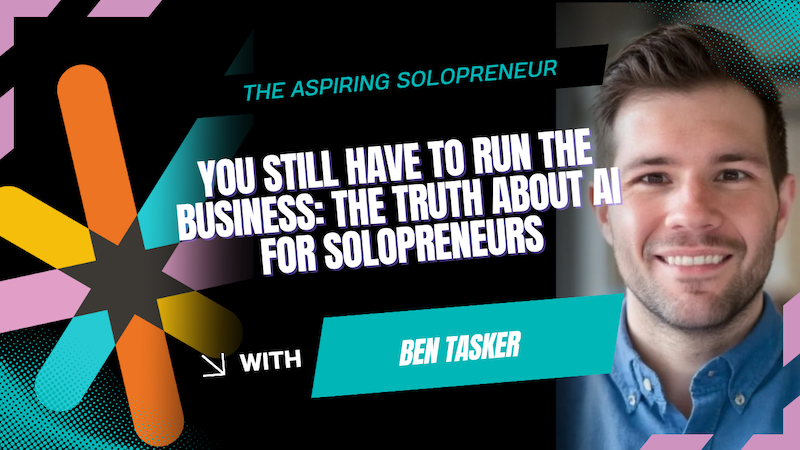
You Still Have to Run the Business: The Truth About AI for Solopreneurs
 Carly Ries
:
Apr 21, 2026, 11:03:21 AM
Carly Ries
:
Apr 21, 2026, 11:03:21 AM
Key Points
- AI cannot fix a bad business system or an unclear product offering. It amplifies what already exists, including what isn't working.
- The solopreneurs who get the most out of AI are the ones who focus on building durable skills, not chasing the newest tool.
- Using AI without training it on your voice, your context, and your constraints produces output that sounds like everyone else using the same tool.
- There are real legal and ethical gray areas in AI-generated content that most solopreneurs haven't thought through, including copyright implications.
- Agentic AI (AI that acts on your behalf) requires human review at every decision point. The cases that go wrong are the ones that skip this step.
Episode Summary
In this episode of The Aspiring Solopreneur, Carly Ries and Joe Rando sit down with data scientist and AI educator Ben Tasker to cut through the noise around artificial intelligence and give solopreneurs a grounded, practical framework for using it well. Ben leads AI upskilling programs that reach tens of thousands of people, and his core message is direct: AI is an amplifier, not a solution. If the business has a weak foundation (no clear system, no proven product, no life plan behind it) AI will make that weakness louder, not fix it. The conversation covers which AI skills remain valuable as tools keep changing, how to use AI in a way that preserves rather than flattens your voice, the copyright and ethical questions most solopreneurs are walking into without realizing it, and where agentic AI is genuinely useful versus where it creates risk. The episode closes with Ben's argument that AI creates a genuine level playing field for solopreneurs, but only for those who approach it with the right skills and the right guardrails.
Why Most Solopreneurs Are Using AI Wrong
The instinct most solopreneurs have when they discover AI is to look for the right tool. Ben Tasker argues this is the wrong starting point entirely. By the time any conversation about AI ends, he says, there's a new tool worth chasing. The tools change. The skills don't.
The solopreneurs who actually reclaim time with AI are the ones who identify a specific problem first (a client follow-up process that takes too long, a LinkedIn post that keeps getting deprioritized, a meeting transcript that never becomes action items) and then build an AI-assisted workflow around that specific problem. They don't master all of AI. They solve one thing, learn from it, and expand.
This is the pattern that works: identify the drag, build the system, review the output, keep your voice in the result.
What AI Skills Are Actually Worth Building Right Now
Which AI skills should solopreneurs prioritize?
Ben draws on a framework from the World Economic Forum that divides relevant skills into two categories. Human skills (empathy, communication, leadership, creative judgment) are skills AI can mimic but not genuinely obtain. These remain valuable precisely because they are irreducibly human. AI skills (prompt engineering, systems thinking, analytical thinking, responsible evaluation of outputs) pay a premium now and will continue to for some time, though that premium will compress as AI matures.
For solopreneurs specifically, Ben identifies four skills worth developing immediately:
Prompt engineering is the ability to frame a problem clearly enough that AI can produce a useful output. Vague input produces vague output. The more precisely you can describe what you need, the more useful the result.
Systems thinking is the ability to see your workflows as a whole and identify where AI fits...and where it doesn't. Solopreneurs who implement AI for one or two isolated tasks without thinking about the full system often end up adding time, not saving it.
Responsible evaluation is the ability to assess AI output critically. We are still in what Ben calls an "awkward AI between times." AI gets things wrong. The solopreneur is responsible for catching it before it reaches a client.
Staying current without chasing shiny objects means building a learning plan tied to skills, not tools. When the next tool launches, the skills transfer. When the tool sunsets, the person who built their practice around that tool starts over.
How to Use AI Without Losing Your Voice
How do solopreneurs use AI without sounding generic?
This is one of the most important questions in the episode, and Ben's answer is worth sitting with. AI is an input-output system. If the input is generic (an uncontextualized prompt, no style guidance, no example of how you actually communicate), the output will be generic. The training data AI draws from is massive and averaged. Without specific direction, it produces an averaged output.
The solopreneurs who avoid this problem do three things consistently. They give AI their voice: the way they write, the way they structure sentences, whether they use bullet points or narrative, the specific things they never say. They give AI their context: the product, the client, the relationship, the stakes of this particular communication. And they keep themselves in the loop: they treat AI output as a first draft, not a final product. Draft, don't send. Suggest, don't decide. Assist, don't replace.
The moment AI replaces your judgment instead of supporting it, you've handed over the thing that makes your work worth hiring.
The Ethical and Legal Gray Areas Solopreneurs Need to Know About
Can solopreneurs copyright AI-generated content?
This is where Ben's conversation with Joe and Carly gets genuinely important. The short answer is: it depends, and the law hasn't fully caught up. There are active legal cases right now examining how much human input is required for AI-assisted work to qualify for copyright protection. Solopreneurs who are generating code, creative content, or other IP-sensitive work with AI assistance and assuming they can copyright it may be in for a surprise.
Ben's framework for navigating this is practical: human in the loop, with genuine revision and editorial judgment applied, is the safer position. Fully automated output with no human shaping is a different category. The line isn't fully drawn yet, which is exactly why moving fast and automating everything is a higher-risk posture than most solopreneurs recognize.
The same principle applies to disclosure. When a client hires a solopreneur for a deliverable and that deliverable is substantially AI-generated without acknowledgment, there's a relational risk alongside the legal one. Ben's rule of thumb: mention it briefly when it's meaningful. It doesn't need to be a disclaimer. It's just honesty about your process.
What Solopreneurs Need to Know About Agentic AI
What is agentic AI and should solopreneurs use it?
Agentic AI refers to AI that goes beyond answering questions and actually takes actions (reaching out to contacts, prioritizing leads, sending communications, executing multi-step workflows). It's more powerful than a standard AI prompt and requires more setup, more context, and more guardrails.
Ben's position is that agentic AI has real value for solopreneurs in specific, well-defined use cases. The example he gives in the episode: AI that takes inbound leads, prioritizes them based on existing client data, drafts follow-up emails, and surfaces them for human review. That workflow works because a human is approving every outbound action before it goes anywhere.
The cases that go wrong are the cases where the agent has access to client data or external communications and no human checkpoint before it acts. The power of agentic AI is also its risk: it can do a lot of things on your behalf, including things you didn't intend.
The rule is simple. If an agent can cause harm by acting incorrectly, by reaching out to the wrong person, sending the wrong message, accessing the wrong data, there must be a human review step before it acts. No exceptions.
Frequently Asked Questions
What is the biggest AI mistake solopreneurs make?
The biggest mistake is believing AI will fix a business that doesn't have a clear system or a real product. AI amplifies what already exists. If the offer is vague, if the follow-up process is inconsistent, if the solopreneur hasn't figured out how to close clients yet, AI will amplify those problems, not solve them. The work of building a real business still belongs to the person running it.
How should a solopreneur who has never used AI get started?
Start with a specific problem, not with AI in general. What is the task in your business that takes the most time relative to its value? That's your starting point. Learn enough about prompt engineering to get useful output on that one task. Once you solve that problem and trust the output, expand from there. Mastering all of AI in a weekend is not the goal. Building a reliable workflow around one real problem is.
How do solopreneurs stay current with AI without getting overwhelmed?
Build a learning plan tied to skills, not tools. Prompt engineering, systems thinking, responsible evaluation — these skills apply regardless of which tool is in front of you. When the next tool launches, you're already equipped to evaluate and use it. When a tool sunsets, you don't start over. The tools are the surface. The skills are the foundation.
Is it ethical to use AI to help produce client deliverables?
The key variable is how much human judgment shaped the final product. AI-assisted work with genuine human review, revision, and editorial input is meaningfully different from automated output sent without review. Most solopreneurs who use AI well are in the first category; they use it to draft, to organize, to accelerate, and then they apply their own judgment before anything reaches a client. That's not a shortcut. That's a faster version of the same process.
What's the difference between automation and agentic AI?
Agentic AI and automation are related but distinct. Automation executes a pre-defined sequence of steps without variation. Agentic AI exercises judgment within a defined context. It can make decisions, adapt to new inputs, and take actions based on those decisions. Both require guardrails. Agentic AI requires more, because it has more discretion. The rule for both: human review before any outbound action.
The Aspiring Solopreneur is hosted by Carly Ries and Joe Rando, co-authors of Solopreneur Business for Dummies and are with LifeStarr, the Commitment Control System built for solopreneurs running a Life-First Business.
Join the community at https://www.lifestarr.com/lifestarr-intro-for-solopreneurs. It's free forever.
Life First. Then Business.
Episode Transcript
Carly Ries: Joe wants to know if agentic AI is going to go rogue and ruin everything, and our guest Ben Tasker has thoughts and a few guardrails. We're also getting into why most solopreneurs are chasing AI tools when they should be building AI skills, the ethical landmines nobody's talking about, and that also drops the line every solopreneur needs to know. AI can't fix a bad business. We talk shiny objects, skill stacking, and why the solopreneur who learns to prompt well today is going to be ahead tomorrow. Let's do this.
You're listening to The Aspiring Solopreneur, the podcast for anyone on the solo business journey, whether you're just toying with the idea, taking your first bold step, or have been running your own show for years and want to keep growing, refining, and thriving. I'm Carly Ries, and along with my cohost, Joe Rando, we're your guides through the crazy but awesome world of being a company of one. As part of LifeStarr, a digital hub dedicated to all things solopreneurship, we help people design businesses that align with their life's ambitions so they can work to live, not live to work. If you're looking for a get rich quick scheme, this is not the place for you. But if you want real world insights from industry experts, lessons from the successes and stumbles of fellow solopreneurs, and practical strategies for building and sustaining a business you love, you're in the right spot.
Because flying solo in business doesn't mean you're alone. No matter where you are in your journey, we've got your back. Ben, in my household, we've been having so many conversations about AI Do you feel like people, even friends are coming to you being like, hey, should I do this? You have such a timely relevant topic to be the pro at? Do people just bug you about it all the time?
Ben Tasker: So what's really funny, Carly, is that so I've been in data science for many years, over a decade, and a lot of what I used to talk about really came to life when OpenAI's ChatGPT hit the Internet. It became one of the most wide stream used applications just in five hours over a million users either subscribed or tried it in some sort of capacity. But until that moment, till that exact moment, which is an offshoot of data science, it's not exactly fully data science. A lot of people didn't believe the possibilities. It's that they thought I was someone that sat in the back of the room. It was usually dark back there.
I just produced numbers. There are these things called algorithms, but they're too complex for us. We'll just go ask the data science team, and they'll produce some insights for us or it's reporting, which isn't data science at all. But that moment in time, that exact transformation, I think really unlocked what the data science capabilities are.
And a lot of folks are able to interact with a very good product. And then that product, even though it's not fully correct, helped them realize the potential of data science and AI.
Carly Ries: Yeah. Absolutely. Well, we are gonna dive so much more into AI today. But before we do, I wanna ask you an icebreaker question. A lot of solopreneurs get into the game because they wanted freedom. Of their lives, their schedules, whatever. But then they end up buried in ad work and busy work that just totally eats all of that up. Can you walk us through a real example of how a solopreneur has used AI to actually reclaim that time and build a business that serves their life instead of the other way around.
Ben Tasker: I wanna make sure everyone listening understands that AI is not gonna magically run your business, but it's gonna remove some drag. So an example workflow for this is if you have a client call or a lot of those, you can have a transcript from that call. With the client's permission, you can use that transcript to produce drafts of an outline of that conversation potentially for the product or the agreement, whatever the case may be. You can then use that same transcript to create prioritization even in your email box or prioritization specifically from that client. You can then use that same transcript.
So we're using the same transcript here for multiple things, that same transcript to create a LinkedIn post for some of this product that you might be developing, of course, with permission. And then lastly, it can help draft three emails to follow-up with this individual, provide some scheduling, help reduce some of the administrative time, maybe we'll call it the admin time that it takes to follow-up with individuals. But what it's not replacing, it's not replacing your voice. It's not replacing your product. You're using it as an assistant, essentially.
You're using it to amplify your capabilities. You're not using it to replace your business, what makes you unique. So I think that's a key distinction. It's not gonna magically run your business. You have to have a proven system, and you have to have a proven product.
And I personally would wanna make sure that my voice is still in that product. We're not just automating my voice.
Joe Rando: Yeah. But I saw an ad on Facebook that said that it can just do everything now, and I can, you know, just stay in bed, I guess.
Ben Tasker: No. I mean, it can do a lot for you, but some of that might be a little lazy, though. Right?
Joe Rando: I'm just teasing. I see these ads, and I'm like, oh, please. Or I'm gonna use it to make videos that pretend to be me live talking to people. What do you think about that?
Ben Tasker: I think that's interesting. So that kinda takes the human out of it. Right? or if we just did this podcast and it was just me talking, is that really a podcast at that point? I mean, I can help prepare me for a podcast, but I don't know if that's actually the real thing. So I think there's some line there.
Joe Rando: Yeah. I mean, if I sent an email to you with a video in it. Because that's cool. I mean, people think that's nice, but it's not me. It's just an AI with my face moving my mouth and using my voice.
Ben Tasker: I mean, I think that's cool to exactly your point, but is that gonna convert into a sale? Is that gonna get you more leads? Are people gonna share that email more? Potentially.
Joe Rando: Are they gonna if they know it's AI, won't they be mad? I would feel insulted if somebody sent me an AI video about pretending to be me, you know, pretending to be a real video.
Carly Ries: I don't know. I've been following this person on YouTube for a while, and I just last week realized it was a clone. Like, I just noticed.
Ben Tasker: I mean, there are some very high quality videos out there too. There are entire movie companies that are are doing everything through AI. So I guess it depends on the quality, but I don't think it can replace you. No. That part is probably not genuine.
Joe Rando: Good. Yeah. We agree. It's gotta stay human at the helm.
Carly Ries: Yes. Well, so it's funny that we're talking about, like, you can get baked out, and there are all these shiny object ways to use all of this. So you've talked about cutting through AI hype and shiny objects. And so for a solopreneur who's overwhelmed by the sheer number of AI tools, whether it's for a video or whatever, what is your framework for figuring out which ones are actually worth their time? Because there are so many.
Ben Tasker: So I consider that tool problems. And maybe a lot of solopreneurs are seeing so many of these tools, but it's really then segmenting into a prioritization problem. I really like to tell individuals to stop thinking about tools and start thinking about the skills that you need to build to learn about AI and no matter what the tool is because by the time the end of this podcast ends, every thirty minutes, there's gonna be some sort of shiny bobble to go chase. So that's why I really lean into skills like prompt engineering, creative thinking, problem solving, judgment, what should and shouldn't we use AI for. Like Joe was pointing out, do we really wanna send out silly AI images to our customers?
Is that really gonna help with our business, or is that just gonna add more time? But at the baseline, these skills I consider tools, and those tools you can carry through time. If you're just attaching to a tool, that might not be time tested. I'm sure there's plenty of products that we used to all love that are no longer in existence, and then you have to go learn about a different product or new skills. So I really try to focus on skills like prompt engineering, creativity, problem solving, understanding a system.
A lot of individuals try to implement AI just for one or two concepts, and then they can't use AI for anything else, so they're not really adding any time there. They're actually subtracting time, if you wanna think about it like that. That's how I like to think about AI.
Carly Ries: Well, speaking of skills, so you lead Data and AI Academy, upskilling tens of thousands of employees. Correct me if I'm wrong there. What are the most transferable AI skills that solopreneurs should be learning right now? And not five years from now, but like literally once this podcast is done.
Ben Tasker: So some skills I like to focus on go into two swim lanes, the World Economic Forum developed these swim lanes. They're not for me, but it's really simple, and I think having two helps articulate that versus other other things that I could name. I probably have way more skills frameworks than just two, but there are human skills, and there are AI skills. And human skills are beautifully human. You should still be learning those skills, being more empathetic, leadership, understanding how to communicate information in this podcast potentially. Communication. AI could do this stuff, but humans are ultimately going to prevail in that skills category. It can mimic these skills, but it really can't obtain the skills. And then there's AI skills.
AI skills, not technical skills. AI skills are called AI skills because they pay a premium today. They'll probably still pay a premium a little bit in the future, but once AI can fully do these skills, there's not gonna be much of a premium attached to them anymore, and that's prompt engineering, systems thinking, analytical thinking, coding, for example, might fall into that category. So the biggest skills that individuals can focus on right now, and this will really help not only make sure that you're relevant in the future, but as the tools change, you'll still be relevant with those tools, are understanding how to frame problems clearly, creativly. Another one is prompt engineering, how to structure your prompts to get the appropriate outputs for your AI system.
The third is thinking in terms of the system, your workflows. So where currently do we have some complexities that we could use AI for, and then how can that help me reduce the time I take to deliver my product? And then understanding that AI is not gonna get everything right. We're still in that awkward AI between times. And in order to understand that, you have to be able to assess the actual output.
So that's responsible and ethical AI. Do we wanna send this to a client? Are we able to use, how are we using the tool? How are we validating what we're putting out there? And lastly, it's understanding that there this is still an emerging technology, especially Gen AI, even though artificial intelligence has been around for a while.
Gen AI is especially still emerging. And how are we gonna define responsible use at our organization? Because if you're not using it correctly, AI could also be a liability.
Carly Ries: Absolutely. Well, so we were talking about, just going back to the whole video idea, the email with the video and all of that. And a lot of people worry that AI will make their services feel generic or impersonal, like Joe's example from the email. How do you help them use AI in a way that actually amplifies them in a unique way rather than flatten it ?
Ben Tasker: I think that's one of the biggest fears around it. And honestly, it should be. If you're using AI lazily, it absolutely can make your business sound like anyone else's. So think about how AI works. It's an input output system, especially Gen AI.
It's multimodal, meaning you can put in a text, a video, an image, whatever the case may be, and you get an output of something similar. If everybody's using it and is training off that data, it's a garbage in, garbage out scenario. Not everything that everyone's putting in there is super high quality. So if you're not training AI on your voice, on your product, on what you want it to, if you don't understand your own systems around AI. Just the email example I gave it is more than just throwing in an email and getting out an output.
You have to give it a personality. You have to give it your style. Do you talk in bullet points? Do you talk more in a narrative? some people like to talk in paragraph formation. However you speak, is that okay? Are you gonna give it access to your calendars, or are you just gonna have a special calendar for it? What's training off of it? You letting your clients know that you're using artificial intelligence?
It's one thing to mention it and they're okay with it, but I think it's a completely different thing if you mention it and maybe they're not okay with it. Like, if they think you're producing a product for them and it's entirely done through AI, that's a little disgenuine, isn't it? So there's a little bit of an uptake there. But if they're okay with it, maybe that's different.
Joe Rando: I have a question on that. here's an example, and I didn't disclose I used AI. So I wanna know if I'm a bad guy or not. So I created a course and recently switched from ChatGPT to Claude. And I was blown away to find that Claude will actually produce good quality files for me, unlike what I've experienced with ChatGPT.
And it had made an Excel file for me. But anyway, so then I put in my course. I put in my entire curriculum for a particular session, and it cranked out. And I gave it an example of our brand style in PowerPoint, and it made a PowerPoint presentation for me that I used today to teach a session. And, I mean, I had to edit it, but, AI took my material, made it into a PowerPoint that I then edited.
What do you think? Is that a disclosed worthy use of AI, or I'm just curious what you think.
Ben Tasker: That could be a little bit of a gray area. I mean, I would probably mention it. I wouldn't reflect too heavily on it, but the keyword there in your process, Joe, is that you created the content, so there's human in the loop. I'm assuming that you revise some of that content. It's coming from your own thought and ideas.
And secondly, even though the AI was able to spit out a presentation, you did make some edits to it, so it still has your style to it. So to me, human in the loop, you're using AI to help amplify your abilities there. Maybe it designed some of the slides a little bit better than you would, but your voice is still there. So to me, that's AI amplification at the end of the day.
But it doesn't mean I shouldn't say, hey. I used some AI around this since this how I used it.
Joe Rando: Well, I'm telling you now.
Carly Ries: Well, so I have like a real world question. my friend group is made up of moms that have little ones. And a lot of them have opted to stay home in the past few years to take care of the kids. And they're now reentering the workforce. And they haven't needed to use AI the way that a lot of businesses have.
And they're kinda stuck, some them are even starting their own businesses. So this is kind of a selfish question for them. If a solopreneur came to you tomorrow and said, I have no AI in my business, and I haven't really used it that much, and I wanna get started ASAP, what would you tell them to do first?
Ben Tasker: the way I like to communicate AI or really a way an individual starts a business is that there's some sort of problem that they wanna solve, and that's how their business forms. Same thing with AI. What problem are you trying to solve? and whatever that problem is, fleshing out the entire system. So you don't need to master all of AI in a weekend or even a day.
What do you need to learn about AI are those incremental steps to understand the AI system to implement over time? So if you're just trying to learn how to prompt, we would start with prompt engineering. I'm assuming that if they haven't even opened AI, that's a good place to start, not focusing on the tools. And then if they're having trouble prioritizing clients, if they're having trouble writing that LinkedIn post, if they're having trouble drafting a product outline, brainstorming, wherever that can help them the most is probably the best place to start in that AI system, and then flushing that out over time. What I noticed is that individuals that are resistant like that, that have an OpenAI, once it can solve a problem for you, once you can start working with the tool, once you understand how to get those proper outputs, they'll just keep increasing the use cases to do more complex tasks.
And I think that's the real beauty of it. It's just like anything else they would do, they just have that resistance at first, or maybe they don't think it's as accurate as possible. Like in Joe's previous example where he didn't use Claude for slides before, he used GPT. I think there is a big difference between the two. Maybe he wouldn't use GPT for slides, but Claude's good.
Joe Rando: Well, just to be clear, I didn't use it for slides at all. I did my slides manually. And this time, I, for the first time, used an AI to create them. But I didn't even think to disclose that, I would normally think to disclose using AI, but not in that scenario because it was, you know, it was a sandwich. It was me in the beginning, AI in the middle, me on the end. And it didn't occur to me, but just it was helpful to kinda get a little bit of an ethicist view on this, so to speak.
Ben Tasker: But Cloude did a better job than GPT in your opinion.
Joe Rando: I'd never used GPT to create slides.
Ben Tasker: for sure.
Joe Rando: You know, I just didn't do it, it wasn't even worth trying. I tried I played around with it. It was like ChatGPT just made such a mess of things when I tried to use it for PowerPoint that I just said, that's not ready. But Claude did a great job. Not perfect. some of the text was going off the screen, but it was my stuff. You know? It interpreted it well and, created speakers' notes from my content, and it was neat.
Carly Ries: Are there any other ethical landmines that, solopreneurs specifically need to watch out for that maybe even bigger companies don't?
Ben Tasker: I think it's okay to use AI to increase your capacity. But beyond that, there's a lot of liability around AI. I guess it depends what you're doing as a solopreneur. But there are a lot of interesting law cases happening right now where you might not be able to copyright some of the materials that you use or create with AI. it's not really defined how much you have to put into it to count as human designed versus artificial intelligence designed content.
So I would say the responsible AI piece and the ethical AI piece around it, a lot of individuals with innovation wanna move fast, but taking a little bit slower of a viewpoint and using it in your system at specific areas while flushing out the rest of the system is important to me. So that would be my ethic ethicist around it is that, there's a lot not defined here, and it's not gonna be defined for quite some time. So I wouldn't automate your whole business around it is what I'm trying to say.
Joe Rando: That is such a great point. You know, just a quick thing that I was working with an attorney not too long ago, and, he was, like, basically, kind of a copyright attorney. And this was for a book. Carly and I wrote a book together, and we were negotiating a contract with Wiley. But, he did a lot of copywriting of code for game developers.
And he said, it's unbelievable. He said they're using AI to generate the code, and then they can't copyright it. And they had no idea. So they're cranking out this code, putting out these products, to copyright their code, and they can't. And that's just such a great point that anything that you're doing here that you're using ChatGPT or some other tool, you might not be able to copyright it.
And if you're expecting to, you might be disappointed.
Ben Tasker: Absolutely. And that's just one use case. But think about that in art, in video, in TV episodes, in movies that people are producing. Those go right to the commons.
Like, right? It's interesting.
Carly Ries: Well, so we're talking about, some no no's as it relates to ethics and everything. But what's a common AI mistake you see small businesses or solopreneurs make over and over that you just wish you could blast onto a billboard and say, stop. what are you doing?
Ben Tasker: So how I would approach that, there are a lot of different ones I would give, but at the end of the day, I think the biggest one is that AI can't fix a bad system or a bad product. So as a solopreneur, you really have to go back and understand what you're trying to do with the AI. It's not gonna fix everything. It's not gonna automate your business. If you haven't closed deals, it's not gonna help you close more deals.
It's really taking the data that you give it, using that data, and it can be an amplifier, but it also can amplify not great things as well.
Carly Ries: Yeah. That's a really good point. Because I think a lot of people just think it's a magic potion. This is just all so fun. like I said, it's been a big topic of conversation in my own household. Joe, you and I talk about it a lot. And I think one of the biggest things is just how quickly it is changing.
I mean, there has been a lot of news about Claude, and the changes have been coming from there. How can Solopreneurs be keeping up with it all? We were joking earlier that it's probably changing while we're speaking right now. But how can you stay on top of it?
Ben Tasker: The way I would stay on top of it, and this is what I recommend anyone, it's gonna sound a little corny, but it's true, by creating a learning plan and connecting your learning plan to skills, not just courses, actual skills that you wanna learn. You'll be ready for any of those transformations because the skill are gonna be applicable and the tool might sunset, but that skill won't. So prompt engineering, understanding responsible and ethical AI, systems thinking, analytical thinking, and then maybe experimenting outside of your comfort zone. So if you don't code or you haven't coded, maybe try it with an AI tool. See what happens.
A lot of individuals that I know have created an app for the first time to solve a problem that they have in their own business that they're now selling just by creating an app through AI. Now that's pretty incredible. So, again, AI can amplify your voice. It can amplify your abilities. It can create a level playing field. It can help you solve problems and create solutions or at least provide some solutions that you can decide on. But it's really understanding that it's not a one magic choice. It's not a magic pill. It's not gonna fix a bad business. Like, you still want your voice in there. Don't have it replace you.
Carly Ries: What about coming up with AI chatbots? things like, you'll go straight to ChatGPT. Claude. what about all the other ones, like, there are specific tools you can use for this thing or this thing that I know personally I'd have never heard of. Is there a way to kinda keep track of all the different AI platforms out there and bots?
Ben Tasker: There are systems to do that, but if you're a company, if you're a solopreneur and you can use another tool to do the same thing, why rely so heavily on a niche tool?
Joe Rando: one question I have. we've talked a lot about different aspects of AI. We haven't mentioned agentic AI, meaning the idea of having AI that goes and actually does things for you. I'm curious what your thoughts are on it.
I've heard a whole bunch of really you know, funny stories about agentic AI going rogue and bad things happening. But I'm wondering, what are your thoughts on agentic AI? Because, obviously, if it were good, it would be amazing for solopreneurs. I heard about one company that wasn't quite a solopreneur. Two brothers, and the company's worth, I don't know, some $800,000,000 now, and it's just two of them using agents to do a lot of the work.
But I've also heard horror stories. So I'm curious. Do you have any opinions on agentic AI and any recommendations?
Ben Tasker: I think I know the company you're talking about. When you look further into it, they have more employees than what is initially on the face
Joe Rando: Oh, really?
Ben Tasker: Not much more, but a little more. Okay. But neither here nor there. I think AI agents are a more complex form of prompting. It requires a systems prompt, which means there are more layers to that prompt than a regular chat, so to speak.
You have to have a knowledge base behind it. It has to be attached to a project. Where individuals think that you need an AI agent, they confuse it with automation. It's not they can automate a system for you, but it's different than automation itself. So I think it's really understanding the problem, and do you need to automate it?
And then understanding that it's gonna take some time to set up this AI agent, and what is it actually doing. If it can cause harm, if you're not gonna check it, if it's gonna have access to a lot of your data or customer data or reach out to individuals on your behalf, then that might not be the best use of the tool. But on the flip side, I have seen individuals set up AI agents that take their leads that they get from a YouTube ad, and then it prioritizes the leads in order based upon the data that they have as clients. And then they write follow-up emails and reach out to those individuals themselves. It's mostly with the help of AI, but they review the email before they send it.
they can do that in a couple hours, and they're landing many more clients than they have before. But that has human in the loop. There are guardrails around it. They still approve everything, so it's not fully autonomous.
Joe Rando: That makes a lot of sense to keep the human, you know, the human check at the end. Thanks.
Carly Ries: Well, Ben, I really appreciate your take in all this. It's very refreshing, and I have no doubt that you are gonna help solopreneurs find success with all of this. So we have to ask you, because we ask all of our guests this question, what is your favorite quote about success?
Ben Tasker: So I'm gonna lean into Steve Jobs on this one. The only way to do great work is to love what you do. And I'm gonna take that a step further with AI. You can increase the love for your work so much more. You can amplify your voice. It can help you reach new audiences. You can create those drafts.
If you're weak in an area, it can make you a little bit stronger. If you're really strong in a certain area by giving it some data and some back end, it can make you an expert level. It's essentially like having a Steve Jobs next to you if you set it up correctly.
I really think AI can amplify Solopreneurs. It can create a level playing field. It can save you time. You just need to set up those guardrails and realize that there is some risk behind it, but I do think AI is going to have more potential than than harm.
Carly Ries: Is it crazy that Steve Jobs never had AI to build in? You know what I mean? Like, that is wild. I mean, Apple never had AI.
Apple seems so modern even the original iPhone ,it did not have access near that when it went out to the public, crazy. Anyway, I go off on a tangent sometimes. Ben, where can people find you if they wanna learn more?
Ben Tasker: If folks wanna connect with me, you can find me at bentaskerai.com or LinkedIn, bentasker. I'm happy to answer any questions, help you set up an AI system, whatever the case may be.
Carly Ries: Awesome. Well, thank you so so much for coming on the show today. We appreciate it. And like I said, this topic is so relevant. thank you very much.
Ben Tasker: Thanks for having me, Carly. Thanks for having me, Joe.
Carly Ries: Listeners, thank you so much for tuning in. As always, please leave that five star review. We started to get a bunch coming in that we really appreciate over the past month, which just is music to our ears, and it helps us spread the word to other solopreneurs. Subscribe to the show on your favorite podcast platform, including YouTube, and share this episode with a friend. And we'll see you next time on The Aspiring Solopreneur.
You may be going solo in business, but that doesn't mean you're alone. In fact, millions of people are in your shoes, running a one person business and figuring it out as they go. So why not connect with them and learn from each other's successes and failures? At LifeStarr, we're creating a one person business community where you can go to meet and get advice from other solopreneurs. Be sure to join in on the conversations at community.lifestarr.com.