


 Joe Rando
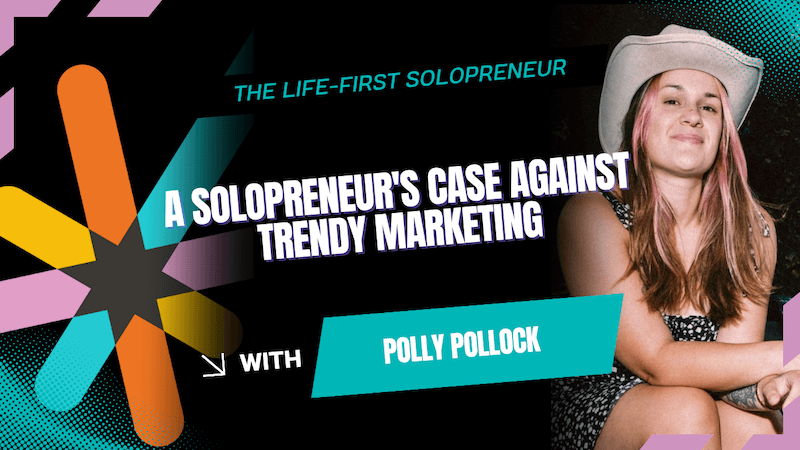
Can you grow a business without social media? According to Polly Pollock, creator of capacity conscious marketing, the answer is a confident yes. In this episode of The Life-First Solopreneur, Polly explains how solopreneurs can build visibility, grow an email community, and attract ideal clients without posting every day or chasing the algorithm.
What is capacity conscious marketing?
Capacity conscious marketing is a trademarked approach Polly developed as an alternative to trendy, burnout heavy marketing. Instead of relying on daily social media posting, it focuses on a compounding marketing ecosystem that moves from visibility to email community to trust and relationships, and finally to your offer. The goal is marketing that does not fall apart if you take a couple of weeks off.
Why traditional social media advice fails many solopreneurs
Polly explains that much of today's popular marketing advice pushes business owners to behave like influencers, posting multiple times a day and obsessing over stats. For many solopreneurs, especially those with ADHD or simply busy lives, this leads to burnout and inconsistency. She argues that you are a business owner, not an influencer, and your marketing should reflect that.
How ADHD shaped Polly's business
After a late ADHD diagnosis in her early twenties, Polly realized that traditional and trendy business advice was not built for the way her brain works. Rather than forcing herself into daily output, she rebuilt her business around her strengths, using focused time blocks and high leverage visibility strategies.
The three visibility strategies Polly recommends
- Podcast guesting, delivering value and bringing the right people into your world
- Guest teaching and workshops, ideal for coaches, practitioners, and educators
- Strategic partnerships, often starting with a free training or workshop
She emphasizes quality over quantity and showing up only where your ideal client is genuinely paying attention.
How to stay consistent without daily posting
Polly redefines consistency. It does not mean constant daily output. She recommends time blocking, for example a couple of focused hours on a Friday for research and outreach, plus one hour a week for follow ups, which she calls roughly seventy percent of the game. She also notes that people struggle to stay consistent with tasks they dislike, so aligning your marketing with what you enjoy is essential.
The offer mistake that keeps solopreneurs stuck
One of Polly's biggest pet peeves is the pressure to build five or six offers at once, from freebies to low ticket to high ticket to ascension offers. Instead, she urges solopreneurs to stabilize one signature offer before branching out.
The first step to take today
Polly's advice is to get clarity on where your ideal client actually spends their time online, outside of social media. Without that clarity, any action becomes wasted visibility.
A life first takeaway
Polly reminds listeners not to lose touch with what they love, to protect their weekends and evenings, and to take low leverage tasks off their plate to free up time for the work that matters.
Resources
Grab Polly's free Antisocial Marketing Kit at antisocialkit.com.
Subscribe to The Life-First Solopreneur wherever you listen, and share this episode with a fellow solopreneur.
EpisodeTranscript
Carly Ries: What if everything you've been told about marketing your business is the exact reason you're burned out? On this episode, we sit down with Polly Pollock, who runs her entire business without posting on social media, and she is not sorry about it. We get into her late ADHD diagnosis and the emotional moment that changed everything, why the Pomodoro method is basically her villain origin story, and something she calls capacity conscious marketing that could free up hours of your week. If you've ever wanted to throw your laptop out the window over the advice to post three times a day, this one's for you. You're listening to the Life-First Solopreneur, the podcast for those in pursuit of a life first business.
I'm Carly Ries, and my cohost Joe Rando and I spend every episode with Solopreneur who are proving there's a better way to run a one person business and experts who are helping make it happen. We like to say life first then business. So let's get right to it. I wanna get into it, but before we do, we have this new icebreaker session just to get to know the guest a little bit more. And my icebreaker question for you is what's a piece of productivity advice you've been told that made you want to throw your laptop out the window?
Polly Pollock: Oh, yes. Okay. So it's gotta be my number one piece of productivity advice that personally doesn't work for me and a lot of other people in my kind of circles, having, you know, an ADHD brain myself, this does not work for me, is the Pomodoro method. So it's basically where you set a timer on your phone for you to work for twenty minutes, break for five, work for twenty, break for five. And there's no stopping me when I'm in a hyper focus.
Like, I cannot take a break after twenty minutes if I'm in a flow. It's just not gonna happen. I'll take a break, I'll either work a half day or, like, I'm very conscious of, my time, but there's no stopping me when I'm in the flow. So that's probably my worst one that I dislike.
Joe Rando: And why stop if you're flowing? I mean, heck. Keep going.
Polly Pollock: I know. Yeah.
Carly Ries: Yeah. Well, okay. I'm glad you brought up ADHD because we're actually gonna be talking about that a lot. And it's fascinating because we did another episode a few months ago with somebody that talked about ADHD, and that ex episode exploded. Like it was huge.
So I'm so glad we are on this topic again. Can you tell us about your own journey with ADHD and how it shapes the way you run your business?
Polly Pollock: Yeah. For sure. so the majority of people, kind of coaches, practitioners that I work with do have ADHD or ADHD like traits or kind of just busy lives, busy brains, mompreneurs, that kind of thing. But it's so funny because I do think a vast majority of entrepreneurs and business owners tend to have ADHD like traits pop up quite a bit. But yeah, my journey with ADHD, I was very late diagnosed.
I was an absolute terror in school. I was a very misunderstood child. I don't think girls were really being diagnosed with ADHD when I was at school. I mean, it was only little boys and stuff that we knew to have ADHD. And so it went undiagnosed the majority of my life. And then my kind of mid early 20s, I was diagnosed with ADHD and I was like, oh, that makes sense.
And by that time I had already started my business and I started to really see the things that I was struggling with in business. I was like, okay, makes sense from a brain point of view of maybe I just don't work that way and maybe I just am not meant to follow the kind of normal path and normal advice because it's not how my brain works best. Very much like an innovative thinker and I feel like traditional ways of marketing and business, not even traditional, just even the modern trendy ways that are kind of focused really on burnout heavy strategies, they're not gonna work for me because that's not how my brain works. And so, yeah, my journey with ADHD definitely came with a lot of rebuilding personally, but also with the business I had already started, I was like, oh, okay, this probably feels way harder than it needs to for a reason.
It's not just me, There's nothing wrong with me. I just gotta rebuild some things. And that was a big moment for me for sure.
Joe Rando: I have a question though, because my wife is a child therapist that works with kids with ADHD. And I'm just curious because I hear her talk about this and I overhear her listening to courses and things. How did you feel when you were diagnosed with ADHD? What were the emotions?
Polly Pollock: Yeah. I remember being, on the Zoom room with the guy who was doing my assessment and he told me and I wasn't shocked because me and my friend at the time who also has ADHD, she had had her diagnosis years prior to that and she was kinda like, I would eat my shorts if they didn't diagnose you with ADHD because you just quite obviously have it and she knows me very well. so it wasn't a shock to me, but I remember as he said it, I just was like, oh, just wept for like two minutes and it was just the most emotional thing. And the guy was like, oh, I now. It's like, I hope you're okay. I think I just felt so sorry for the younger version of me that just went through so much stuff and was completely tarred with the wrong brush and, I felt like, if I'm honest, I felt like life could have been a lot easier for me had I had that a lot sooner. I don't believe that my past should have been any different but, knowing that now, I think I would have had a lot of an easier time. So yeah, it was very emotional for sure.
Carly Ries: Thank you. Absolutely. Well, so I wanna circle back really quick because you were talking about traditional ways of running your business and traditional marketing. And you've come up with capacity conscious marketing. So what exactly is that?
And how is it different from the conventional marketing you were you were alluding to?
Polly Pollock: Yeah. So do you know, when I use the word traditional marketing, I kinda feel like I wanna change that up a little bit because it's not even traditional marketing. I think it's like popular marketing and trendy marketing that tends to either be one size fits all strategies or it's very like social marketing?
Joe Rando: That's Influencer marketing.
Polly Pollock: You've nailed it. Influencer marketing. Yep.
The thing that I always say over and over again is you're a business owner not an influencer. Like, the crossover is wild. So yeah, influencer marketing that has become this thing that I think online business owners have attached to thinking that they need to do it.
And so actually the marketing that we all used to do before social media was a thing, I actually prefer that. So probably trendy marketing is the thing that I'm kind of against. So yeah, I'd say I'm pretty against it, because it doesn't suit everybody. It suits some people but yeah, the things like social media, posting on social media every day, I have no idea how and why that's become a normal thing of post three times a day, be always refreshing your stats. And I think we've got this really really strange burnout epidemic that it's almost people are addicted to the phones anyway, right?
But in business, people are really struggling mentally, physically and just, I think it's sad to see people with such big missions kind of get near to throwing the towel in because they can't or don't want to be on social media all the time. So that's where capacity conscious marketing, which has become my trademark recently, kind of comes in because I don't believe that we should be attached to our screens all the time. I think good marketing should be something that's built off of a compounding effect and is not gonna fall apart if you take a couple weeks off.
Carly Ries: Joe, so often, I wish George was here for the sound effects. So we have a guy on our team that can have make the applause go or the cheers that I don't have. And I wish he could do that. Woo hoo. Because so much of our audience is fed up with trendy marketing.
Like, they don't wanna post. They don't have the time. I mean, even as a marketer, I am a marketer. And Joe, like, we always laugh about it. I'm a millennial marketer. I'm supposed to like social media and I hate it. I do not like it. So if people don't do these trendy things, what should they be doing instead?
Polly Pollock: Yeah. So this is the thing I'm seeing in the last year, there's a lot of talk about if you don't like social media, just don't do it. And then it's like, that's nice and everything but no one's actually saying. So there's a lot of gatekeeping going on and I don't know if it's just because people don't know and that's totally fair but I'm noticing, when I was on social media last year there was a lot of talk about if you don't wanna post every day, just don't do it. But people are like, well, what do I do?
A lot of the conversation was around, just do email marketing instead. And that's all well and good, but then how are you growing your email community off of social media? there's always a missing link and I think it's confusing people. So I love talking about this on podcasts because I don't gatekeep and that's something that I am very passionate about. I want people to be able to kind of link those things together and have an easier time at least knowing where to start. And some of my favorite ways to, if we start at the visibility kind of section, what I tend to teach is what I call the capacity conscious marketing ecosystem which runs from visibility to email community, to trust relationships, all of that good stuff, warming people up in your community and then bringing people into your offer.
But if we start from visibility, I think things like, for example, my favorite one in case you haven't maybe guessed, is podcast guesting. I love going on podcasts and strategic podcast guesting as well, where you can deliver loads of value and you have a surefire way to bring the right people into your world off the back of it. That's something that my students love as well. Second one is guest teaching. And where I work with the majority coaches, practitioners, teachers of or even service providers who really enjoy kind of teaching and sharing their expertise, these things work really well.
Because a lot of the time people are just like, if I could just coach, if I could just teach and I didn't have to worry about, pining over the algorithm, I'd be so happy. And I don't think people realize you can. You really can make that the basis of your visibility strategy if you know where to get visible that's gonna be high leverage for you. So guest teaching, doing workshops, partnering with companies as well. that might be getting your foot in the door with something like a free training or a workshop and then looking at how you can maybe set up a partnership off the back of that.
So that's kind of the big three visibility wise that I would suggest. But again, it's really important that you don't waste your time and energy by making sure that you're going in the places that your ideal client is definitely gonna be listening or showing up in. Visibility far and wide is not it, it's just not conducive and it's gonna be a bit of a waste of your time. So there is definitely the strategic element that comes from that. And then just having a really great way to lead people into your email community and making that the central hub.
Carly Ries: And so if somebody's starting from zero, can you kinda do a step by step of I would do this on x amount of days a week, like really walk through the process because I think then they go from I don't wanna post on social media to I feel like I need to do this every day or whatever. what does all this look like in practice to build that community?
Polly Pollock: Yeah. So part of the kind of capacity conscious way of me teaching it is I don't think that showing up and this might work for some people but for the majority of the people that I mentor and, talk to, it doesn't really work too well because it's too scattered. And so I don't think showing up the same every day actually gets the best results because it's all split focus, especially if you're dealing with a bit of a spicy brain or just someone with a even just busy life. It's the split focus and just the constant almost obsessive effort every day is probably just gonna kind of distract you and it's just gonna split something that you could time block and then, you're not focusing on the same thing every day. You can still be consistent with it but it's not something that you need to do like an hour a day of.
So what I would actually recommend if you are starting from zero and you're kind of like, okay, I wanna apply to five or six visibility opportunities per week. Maybe that's podcast, partnerships and guest teaching, maybe it's just podcasts to start off with, whatever it is. I would always say quality over quantity, especially with something like podcast guesting, you wanna make sure you actually are a listener of the podcast, you're not just finding random podcasts and then just sending out a really bad AI pitch. I Think that's what a lot of people do and then, not to be harsh or anything, but then they wonder why it's not working. As a host myself, I receive a lot of bad pictures from people who clearly haven't listened to the podcast and you just really gotta do your due diligence and be very human about it.
But decide on a goal that you wanna try and get per week, visibility wise. And then what I do, so if I give you an insight into my like personal calendar, on a Friday morning, because that's just what works for me, I'll have like two, two and a half hours where I can research, plan out, you know, my pitch and then reach out to some hosts or companies or whatever I'm deciding to focus on that week. I've baked in that time for actual research time and just making sure that whatever I'm doing is from a place of, not just spray and pray, like it's actually coming from quality. But I've time blocked that so I can get that all squared away by the end of the week so that I know I'm getting enough momentum. So that's a couple hours.
And then I have one hour a week on a Tuesday where I just do my follow ups because follow ups, I think with anything in business is like 70% of the game. People are busy. There's all sorts of reasons why someone might not see your email. So just making sure that you're doing that, those follow ups as well. And so that's how I kind of time block it and a lot of my students do it that way and find it a lot easier than just the daily kind of output.
Carly Ries: So you just talked about time blocking. How do you help clients stay consistent with marketing when consistency can be one of the hardest parts of ADHD? Is time blocking a big part or are there other components to help people stay on track?
Polly Pollock: Yeah. It's a great question. I think two things with consistency. I think one is that we've mistaken consistency to be constant like constant, rather than consistent. And we've mistaken consistency to be, that daily output. And that's taxing for anyone, especially if you've got, like I said, a busy life or if you've got kids and or care requirements that it is just up and down and you like, have a life when no day looks the same essentially. And then you're trying to do something daily and when you can't meet that, then you're telling yourself you're inconsistent. So I think we've got a warped sense of what consistency actually looks like. And then second with consistency, Both of these things are definitely apparent with people I work with but the the second thing about consistency is we always struggle to be consistent with the things that we don't enjoy. And a lot of the time for people that is social media.
And so it's gonna feel like you're just absolutely in some kind of like hellscape if you're trying to be consistent every single day with something like social media that you hate. so it makes sense. And I think sometimes it's just not as black and white.
So those are the two things with consistency that I would say is, you know, make sure you're doing your marketing in a way that you actually enjoy. For a lot of people, that's not gonna be social media. It's gonna be more places where you can go in-depth with people and teach and lead and go in places where you know your people are actually listening to you rather than like scrolling past you on social media. So making sure that it's in alignment with your unique strengths and giving yourself permission to not do the daily grind. You can do just as much if not more when you do things like time blocking.
Carly Ries: Are there any other mistakes that you see that you see neuro divergent, business owners make aside from social media? Where you're just like, stop doing this. Like, this would really help. That you haven't addressed yet?
Polly Pollock: Yes. Okay. Yeah. So I have a few pet peeves. And a lot of the time the online business kind of popular advice doesn't really help this.
I think my second most prominent thing that I see is the offers. Like thinking that you need like five or six different offers in a business, in a coaching or service business and maybe a service business is a little bit different but especially if it's like coaching, if you're a practitioner, if you're an educator, I cannot stress enough it's so important to stabilize one signature offer before you think about branching out. But people have been told that they need to, create a freebie, then a low ticket offer, then another low ticket offer, then a mid ticket offer, then a high ticket offer, then ascension offer. And it's like, you really do not. And then people try and build that straight off the bat and wonder why nothing is stabilizing because they're literally talking about 10 different things.
Carly Ries: Which is so hard. I mean, I don't know anybody that can do 10 different things successfully. But that seems impossible and very anxiety inducing.
Polly Pollock: Yeah.
Carly Ries: Well, Polly, for a listener feeling overwhelmed and stuck in the noise of online business, whether it's marketing or anything else, what would your first small doable step be that you'd recommend for them that they can take right after they finish this episode?
Polly Pollock: I actually have a resource that I'll provide to you which will help you take those first steps. So actually putting it into practice because I think especially with Busy Brains, so I think as business owners anyway, we love to learn, but if we don't know how to put it into practice, it's just gonna sit in our brain and there's gonna be nothing apart from our thoughts kind of going around in there. So I do have a resource that I'll give to you that will kind of go into that a little bit more and and there'll be a training and then a customizable dash with some toolkits and stuff in there so that you can actually take the first steps. But I would first kind of look at where off social media but still online do you think that you're gonna be able to find your ideal client.
So don't think about where you should show up whether it's podcasting, communities, companies. Don't think about where you feel like you should show up. Just literally operate from your ideal client in mind. And think about where they're gonna be listening, what communities they're gonna be part of, where you're gonna find them. And I think this is the biggest part because like I said, if you're not showing up in the right places, it's gonna be wasted visibility.
So you need to really make sure that wherever you're going, that's where they're gonna be. That's where they're gonna be attentive in listening. So that would be my first step is the clarity. Because without that, the action is gonna be time wasted. Does that make sense?
Carly Ries: Yeah. No. Absolutely. we preach that all the time. Well, Polly, I feel like everything you're saying today is just helping people free themselves from the burden of marketing that they don't like doing.
Helping them free up some time so they can focus on what they enjoy, which is right in line with creating a life first business. So I wanna ask you, what is a life first piece of advice that you have for our listeners for running their business?
Polly Pollock: Okay. A Few things. I think, something I really struggled with before I kind of, felt like I could actually run a Life-First business because my business journey did not start off with how I run it now with being capacity conscious. Like I was tired. when I first started because I was trying to do all the things and I went viral and grew my account and I had a big social media presence for a while. And so what I preach now is not how it was for me in the beginning. But one thing I kind of wish I'd done in the beginning is I feel like I had forgotten the things that I enjoyed in my life and I was trying to make my business my everything. so first of all, I would say don't lose touch with what you love. Please, for the love of God, make sure you're enjoying your weekends, your evenings.
Just go and do some fun stuff and make sure it's actually fun because I feel like as adults, we're so bad at having fun and it's almost cringe how bad we are at having fun. just do something that's really gonna light you up and just like, I don't drink or anything like that, so I have to make sure the things that I'm doing on the weekends, they're actually really gonna get some endorphins going. I have to be very intentional about that. So have fun. And then, you know, on the more systems and business side of things, look at what you can take off your plate.
I know this sounds so simple, but especially if you're gonna be trying this kind of new route of marketing without social media, look at what you can take off your plate. Maybe it's social media. I cannot tell you how many people I get on calls with when they become a student and they're like, I'm interested in doing this. I just feel like I've got no time. And then it's like, okay, let's look at the things that are bringing you in the lowest results that you've been trying over and over again that you really hate doing.
Let's look at how we can take that off your plate to free up time to do this better stuff. So free up that time, look at what you can take off your plate, look at the highest leverage things that are gonna be worth your time and that you're gonna enjoy. And you'll probably have a lot of an easier time doing it and you'll have more time as well for you.
Carly Ries: Love it. I love that we changed our question, Joe. And I imputed my own horn because I was like, oh, I have a good idea. Because we used to ask people about their favorite quote was about success, which is great. But I love these actionable tips that our guests are saying now.
Polly, that was so impactful. I've loved everything you've said today. Can you tell people where they can find you? Give us all the links.
Polly Pollock: Yeah. So, obviously, as you can guess, I'm not super active on social media anymore, given the work that I do and and what I teach. I don't post on Instagram or anything like that anymore. I am still in the DMs. Like, by all means, come and follow me.
I'll give you the link to that. It's pollypollokofficial. But the best place where you can really get, valuable kind of resources and really really dig into some value is obviously that resource I mentioned. So that's normally paid. It will be free, obviously, for this lovely audience.
I'll give you the code so you can get that for free. And that will take you through the training and the dashboard so you can get started with visibility and marketing of social media. So I'll leave you with that link and you can dig in there. Or you can just go to antisocialkit.com. It's called the antisocial marketing kit.
So that's the link. It's just antisocialkit.com. And you can find it there.
Carly Ries: Awesome. Well, thank you so much for that freebie. That is so kind of you. And seriously, thank you so much for coming on the show today. This was really helpful.
Polly Pollock: Yeah. Thank you so much for having me. I've really enjoyed it.
Carly Ries: And listeners, as always, thank you so much for tuning in. Please leave that five star review. It helps us spread the word to other Life-First Solopreneurs. Share this episode with a fellow solopreneur you think can use some of this advice, and don't forget to subscribe to our show on your favorite podcast platform, including YouTube. And we'll see you next time on the Life-First Solopreneur.
You may be going solo in business, but that doesn't mean you're alone. In fact, millions of people are in your shoes, running a one person business and figuring it out as they go. So why not connect with them and learn from each other's successes and failures? At LifeStarr, we're creating a one person business community where you can go to meet and get advice from other solopreneurs. Be sure to join in on the conversations at community.lifestarr.com.