


31 min read
How Solopreneurs Get Seen Without a Team or a Budget
 Joe Rando
:
Jun 9, 2026, 9:12:11 AM
Joe Rando
:
Jun 9, 2026, 9:12:11 AM
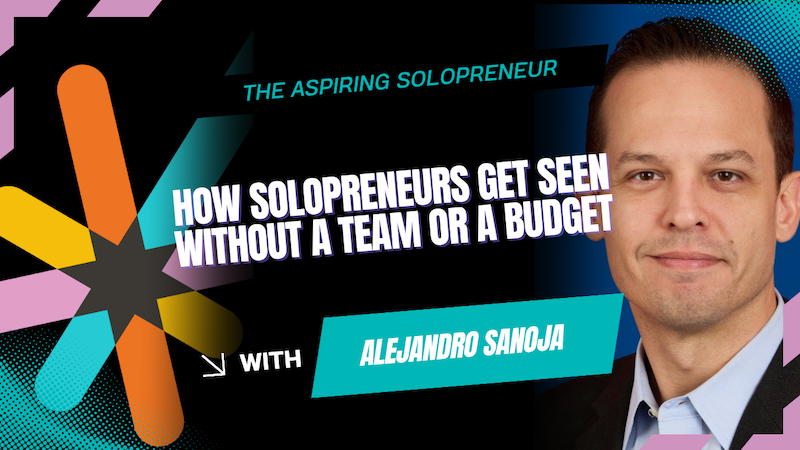
In this episode of The Aspiring Solopreneur, personal branding expert Alejandro Sanoja explains how solopreneurs can build authority and visibility from scratch, even with no audience, no team, and a budget of just $100. Hosts Carly Ries and Joe Rando explore storytelling, trust-building, boundary-setting, and why podcasting has become the highest-leverage marketing move for solo business owners in the AI era.
Who is Alejandro Sanoja?
Alejandro Sanoja is the founder and CEO of Latinpresarios, an adjunct professor at the University of Houston, a TEDx speaker, a published author, and an international speaker. He has been recognized as one of the top six personal branding experts to follow. He immigrated to the United States from Venezuela and built his career around professional communication, authentic leadership, and personal branding, specializing in helping introverts and immigrants build their visibility.
What is the best way to build a personal brand with no money?
According to Alejandro, the best low-budget strategy is a podcast tour: aim for at least 10 podcast appearances in 90 days. A realistic $100 breakdown includes roughly $50 for a guest list (e.g., Fiverr), about $20 for an AI assistant like ChatGPT or Claude, and about $20 for a video-clipping tool like Opus Clip. A smartphone can replace an expensive camera (Joe records using an iPhone connected wirelessly through Riverside). The strategy works because podcast content lives forever, can be repurposed into many pieces of content, and transfers the host's existing trust to the guest.
How do you talk about what you do without sounding salesy?
Alejandro's framework is to lead with a story rather than your accolades. Open with an "inciting incident" and a turning point that puts you in the same position as your audience, so listeners connect with the problem before you ever mention the solution. When the focus stays on helping the other person rather than promoting yourself, talking about your work no longer feels braggy.
What builds trust in a personal brand?
Trust comes from combining two elements: warmth (vulnerability and personal connection) and competence (expertise and frameworks). Sharing expertise alone rarely resonates because people don't connect with it emotionally. Sharing personal vulnerability without expertise lacks authority. The two together create trust, a "Goldilocks" balance most people develop gradually.
What's the difference between introverts and shy people?
Being an introvert means you recharge through alone time and don't naturally practice social skills as much, not that you're afraid of people. Shyness is a separate trait. Introverts can become excellent communicators and even better salespeople than extroverts because they tend to be stronger listeners and prepare more thoroughly. The key is being intentional about practicing the skill set.
How can solopreneurs avoid burnout while staying visible?
Alejandro recommends batching activities, knowing your true capacity, and running visibility as a steady "drip" rather than turning the faucet on full. He aims for one to four podcast appearances a month plus occasional live talks and webinars, and reserves specific days (like Fridays) for coffee chats and social activities. He also stresses self-compassion and tuning out external voices—comparisons to peers, siblings, or family expectations.
Why isn't SEO content enough anymore?
Alejandro notes that SEO content still matters but no longer drives traffic as quickly, because AI overviews now answer many search queries directly, so users get the answer without seeing your brand or face. Podcasts cut through because they deliver high listener attention (more than 80% of people who start a podcast episode finish it), reach decision-makers and executives, build personal trust, and create evergreen content and mentions that AI tools reference as trust signals.
What's the single most impactful thing a solopreneur can do in 30 days?
Go on a podcast tour. For roughly two hours of work per episode (prep plus recording), a solopreneur can build trust with the host (and potential referrals), transfer trust from a loyal audience, and generate evergreen content. A single video episode can be turned into 30+ clips, LinkedIn posts, and blogs using AI. Alejandro cites a client, a luxury interview coach, who gained 3–5 new clients and roughly $30K in pipeline in 90 days using this approach.
Key takeaways
- A podcast tour (10+ appearances in 90 days) is the highest-leverage visibility move for solopreneurs.
- You can start for around $100 using a smartphone, a guest list, and AI tools.
- Lead with story and an "inciting incident" so promotion feels helpful, not salesy.
- Trust = warmth + competence; you need both.
- Introverts can outperform extroverts by preparing and listening well.
- Run visibility as a sustainable "drip" to avoid burnout.
- SEO still matters but podcasts now build the personal trust and AI trust signals that search content alone can't.
Resources mentioned
- Free listener resource: https://latinpresarios.com/the-aspiring-solopreneur/
- Latinpresarios website: latinpresarios.com
- Connect with Alejandro Sanoja on LinkedIn
Connect & subscribe
Leave a 5-star review, share this episode with a friend, and subscribe to The Aspiring Solopreneur on your favorite podcast platform, including YouTube.
Episode Transcript
Carly Ries: Think you need a big team, a polished image, or marketing budget to stand out? Well, think again. In this episode of The Aspiring Solopreneur, we sit down with Alejandro Sanoja, introverted immigrant turned one of the top six personal branding experts to follow. From building a brand from scratch in a new country to his go to strategy for getting noticed, a podcast tour you can launch on a $100, by the way, Alejandro shares why introverts often make the best salespeople, how to talk about your work without feeling salesy, and the simple trust formula every solopreneur needs, warmth plus confidence. Whether you're camera shy, stretched thin, or tired of shouting into the void, this one's packed with do it this week advice that you don't wanna miss.
You're listening to The Aspiring Solopreneur, the podcast for those in pursuit of a life first business. I'm Carly Ries, and my cohost, Joe Rando, and I spend every episode with solopreneurs who are proving there's a better way to run a one person business and experts who are helping make it happen. We like to say life first, then business. So let's get right to it. So Joe, I've said in the past, that when we have tax professionals on, I like having repeat people talking about similar topics because there's always a different take.
And we've recently had a personal branding episode come out, but Alejandro also has a different take. I just love getting different expert opinions even if we have similar topics because everybody has a different take. So Alejandro, thank you so much for coming on the show today. We are so excited to have you.
Alejandro Sanoja: Thank you for having me. I am excited. I've been listening to several episodes of the podcast. I love the life first business mindset that you guys have. I love the solopreneur resources that you're providing because solopreneurs need all the help they can get.
So I am very excited for this conversation.
Joe Rando: I have a question though before we get in.
Alejandro Sanoja: Yes.
Joe Rando: Are we talking about personal branding or taxes?
Carly Ries: Personal branding.
Joe Rando: Okay. somebody might be listening going, oh, you know what? I don't care about taxes.
Carly Ries: Yeah. Sorry. what I was trying to say is we've had a lot of tax episodes, and people are like, well, there are a lot of these. And it's like, but, there's always a different take.
And we just recently released another personal branding episode. So I want people to know that this is different than that personal branding episode. And every personal branding episode before, because it's so important. And even if we release the same episode over and over and over again, it needs to get in your head. So, we are talking about personal branding. Thank you so much for the clarification.
But before we get into all of our juicy questions, I do have an icebreaker question for you. And it actually revolves around personal branding.
If you had to build a personal brand from absolute zero, no contacts, no credentials, no social media, but you had ninety days and a $100, what would you do first?
Alejandro Sanoja: I love this question. And my answer has changed in the past few years. Because it used to be create really good SEO content that would compound over time. Especially as a solopreneur, you need those kind of activities. But recently, that has changed, and my answer would be to go on a podcast tour.
And you can do that with less than a $100. I would say you probably need some some type of equipment, maybe a good camera. Then the other use of that money would be probably buying a list so that you can go on podcasts. But a podcast tool, without a doubt, is the best thing you can do because it helps you transfer trust. And this is gonna be meta because we're in a podcast.
But it helps you transfer all the trust that the host has built with the audience, if you do it right and if you serve the audience, to the guest. In a podcast tour, usually the way we frame it is at least 10 episodes in ninety days. A lot of prep work so that you know you're gonna deliver value. And you can do it essentially for free because what you need to do is to do the work so that you're informed about the good podcast in your industry. Do the work of preparing so that you serve the host and you serve the audience.
And then the value is gonna compound because the content lives forever in those podcasts. You can repurpose the content, especially if it's video. Nowadays with AI, it's super simple. I think we're still on budget because a 100, maybe 50 for the list on Fiverr, $20 or ChatGPT or Claude, and the other $20, I would say, would probably be an Opus clip or one of these AI tools that you just put the video and it clips it. Because then you have the content, you're telling the stories, and you're gonna get links and mentions that are incredibly valuable nowadays for AI.
So solopreneurs, you don't have a lot of time. You go on this thirty minute, one hour episodes, and you're basically creating so much value that's gonna compound over time. And we can talk more about that. There's a lot more to it, but I'll leave it there and see where you wanna take it.
Joe Rando: Hey. just one thing, you mentioned getting a camera, but you know what? I'm using my iPhone as my camera on this podcast.
Alejandro Sanoja: that's interesting. How do you connect it to your computer?
Joe Rando: I'm using Riverside.
Alejandro Sanoja: oh, of course.
Joe Rando: Connects wirelessly and I think you might be able to do it with Zoom, which a lot of video podcast users use. So I mean, I haven't done deep research because of the tool we're using. It basically makes it easy for me, but it's a four k camera, so it gives me as high resolution as I want.
Alejandro Sanoja: Absolutely.
Joe Rando: great camera, and I already had it in my pocket.
Carly Ries: Mind blown. Yeah. Oh my gosh. I can't believe that was just an ice breaker.
Alejandro Sanoja: So just buy Something to hold it.
Joe Rando: Yeah. I've got a $22 selfie stick that I had from, when I went on vacation ten years ago. it expands. it's a selfie stick that expands into a tripod, but that was not part of the business investment. I bought that for vacations before taking selfies was considered whatever.
Carly Ries: It would fit in the $100 instead of buying a camera, I can't believe that was just the icebreaker question because that was already so much value. So let's start from the beginning. Tell us about your journey. You've said you were an introverted immigrant, and now you've been named one of the top six personal branding experts to follow. So what was kind of the turning point where you stopped trying to fit in and started building a brand around who you actually are?
Alejandro Sanoja: Well, growing up, I thought I was gonna be a professional basketball player. And for a while, I was checking the boxes because my mom plays for the national team in Venezuela. That's where I grew up. I was playing state I was the only kid in my high school when I was in middle school, was playing with high schoolers already, and I was the only kid playing state level championships. And all of the guys I was playing with at that time ended up in the national team. I don't know if you can see from the camera. Let me put myself next to the door. I am not short, but I am not basketball player level tall. So I had to switch strategies. And throughout the time, I had not been a good student, but then life has a way to sometimes push you out of your comfort zone.
In my case, it was the same push that me and other 10,000,000 Venezuelans got because of everything that was going on in the country. I'll summarize it with three very negative records that we broke. The first one is that we had over 1,000,000% inflation in one year. So imagine we were struggling in The US in the past years with close to 10% inflation. That's two digits. Imagine what seven digits does to your life.
For people to get an idea that you go into the grocery store and as you walk to the aisle to get the product that you wanna get, the price is going up. You get the product, you walk back to pay for it, the price is still going up in that time. So it just destroys the economy of the country. The second record, we had more than 30% GDP drop in one year. Usually, when that happens.
Economies, they study these phenomenons. It's usually a natural disaster or a war that causes this. None of that happened in Venezuela. The economies cannot explain why. We know why. It was because of the dictatorship regime.
And the third negative record that we broke is the refugee crisis. More than 30% of the country, more than 10,000,000 people had left the country. I'm one of those. This is the biggest crisis this side of the world.
So that happened to me. I had family here in Houston. I landed at the University of Houston, which transformed my life. And my plan was I just need to get good grades. If I just get good grades, I'm gonna have a good career, and I quickly learned that that is just the baseline requirement.
You have to have a good skill for you to have a good career, but the key is how you communicate it, how you come across. I learned all these concepts of networking, your thirty second pitch, having stories. So I went all in during my MBA because if I failed, my mom was waiting for me back home in Venezuela with a chancla in her hand.
Joe Rando: a what?
Alejandro Sanoja: I don't know if you know what a chancla is. A chancla is a flip flop. But in the hands of a Latino woman, it becomes a mythical device, a mythical motivation device that moms can use to throw
Joe Rando: Oh, a paddle!
Alejandro Sanoja: They throw at their Kids and hit their head when they don't do what they're supposed to do. So I went all in. I immersed myself in the program. It was my new home. They totally transformed my life.
And after the program, I started a business helping other people doing what I had to go through because it was such a transformation for me. I had to do improv comedy classes. I had to go to Toastmaster. I had to get as much help as possible because I was not only dealing with a new language, with a total new culture, a new way of doing things. So I started doing it for myself, building my personal brand by building my communication skills.
And then that's when I realized that other introverts and immigrants who want to start a business need the same help. And that's why I do what I do right now.
Carly Ries: It's so funny because . I know introverted doesn't mean like, that's where you get your, energy from is, being alone. It doesn't mean you're not outgoing, but I would not take you for an introvert. And maybe it was practiced through all those years, but you don't strike me as one.
Alejandro Sanoja: People say that and that's true because I've worked on it. These things don't come naturally to me and I had to be in The US, but the key difference is that I have to go into my cave and recharge. For example, if I'm going to a conference, I have to, okay, turn it on. Let's go. Let's have the conversations.
Let's ask the questions, but then I have to go home and recharge. It doesn't energize me to be around people, but I've learned to do it.
Carly Ries: Got it. Okay.
Joe Rando: Can I ask a question? Do you enjoy it?
Alejandro Sanoja: I enjoy it now and enjoy it especially in this setting. I don't enjoy the networking events and the conferences where you have the same conversations over and over again that are just surface level conversations. But this, I could do for hours and hours. I could have a coffee chat with someone because then I get to ask you deep questions and really learn about the other person. So I don't enjoy the group setting type networking, getting to know each other, but when it's one on one and we have the opportunity to go deep, it fills my heart, it fills my soul, and I can do it all the time.
Carly Ries: Okay. I'm so glad we've kind of pivoted to sales and networking a little bit because so many solopreneurs struggle with talking about what they do in like network setting networking settings or or not, because they feel salesy or bragging or whatever. So do you have a framework for communicating your value in a way that feels natural rather than performative like if you're at a big conference?
Alejandro Sanoja: The key is to tell a story. And I know it's kind of like a buzzword now, storytelling, and everybody's kind of like mentioning it and using it, but I've gone deep into this by reading a lot of books on writing from people who write novels. I was in a program for about two years to really understand stories. And what you need to do to not be selfie is to have an inciting incident and the turning point progressive complication before you get to the cell. And what that means, the inciting incident and the turning point and the progressive complications, what that means is that you need to put yourself in hold at the beginning of the story so that then people connect with that problem and then the solution is not selfie.
So if I talk about personal branding and what I do and all my accolades at the beginning, that is what is salesy. That is what people don't wanna do because it feels too self promotional. But when you understand or at least when you adopt the perspective that what you're doing, you're doing it to actually help other people, then it's easy to talk about it. But you put yourself in the same spot with the inciting incident than your audience and all the problems that you're facing. And then when they relate to that it's easier to say, hey, by the way, the way I've solved this problem of being an solopreneur and an introvert is doing this.
This might work for you too. So I think that is the way that you get past, feeling selfie and feeling braggy. You take it out of yourself, the focus, because it's not about you, it's about the person that you have in front of you that you're trying to help. If you know that a little bit of motivation, a little bit of telling your transformation or the transformation that you do for clients is gonna help that person take the step, then it's super easy because you're not doing it for you, you're doing it for the other person.
Carly Ries: No that makes so much sense. So another another thing, I wanna pivot to a little bit just with the personal brand is that a lot of solopreneurs feel pressure to kind of project a polished, like perfect professional image of themselves. And let's pivot from in person to online. So you've spoken about dropping the mask. how do you decide what to share authentically versus what to keep private when your personal brand is your business because you're a solopreneur?
Alejandro Sanoja: It's a process. It does not come easy at the beginning, and you should share as much as you feel comfortable doing so. And there are many examples out there. One of the biggest personal brands right now, I think everybody knows who he is, Gary Vaynerchuk, he shares a lot about what he does.
He shares his everyday life. I do not feel comfortable doing that, for example. And he does. But if you think about it, even though he shares a lot of his life, he does not share his personal life. You've never seen a post of him and his kids or about his kind of like really really private life.
So you have to understand that there are many many ways to do it and you just gotta start doing it slowly and get comfortable. And then at some point what happens is that you understand that to connect with people, you need both. You need to be vulnerable, so there's the warmth component, and then you need to share about your expertise so that there's the competence component. There's a ton of research on how those two things together are the things that create trust. And this happens a lot to people that we just share the competence component.
Here are three things you should do. Here's my expertise. Here's a framework. But nobody cares. If nobody connects with a human that's on the other side and the problems that they face, it's not gonna land.
So there's kind of like a Goldilocks process that you have to go through of you're probably gonna start with the expertise, it's not gonna resonate that much, slowly you're gonna see other people sharing personal things, you're gonna feel empowered to do so, people connect with you, and that's how you incorporate warmth and competence into every message that you share, and then it starts to resonate.
Carly Ries: Yeah. It's just the building blocks.
Joe Rando: And you see those people all over, YouTube and Facebook. These ads pop up, and it's like, you got to do these three things, and I just click, next, because it's like you say, they're basically coming out with their expertise, but there's no relationship, there's no trust, are you a real person telling me a real thing. I totally agree that that's really important. But, yeah, a little bit of a dance, right, to figure out what do people care about too. I mean, I could share all kinds of stuff about my life, and people would be like, well, I'll use this podcast to go to sleep.
Carly Ries: Well, Alejandro, I keep looking at your shirt with the big UH on there. And you teach at the University of Houston, and you've spoken at places like the SEC. How did you build that kind of credibility on your own? I mean, you've talked to our Toastmasters and all of that? But what can solopreneurs learn from your path to stand out when they're a solopreneur and they don't have a big team or anything behind them?
Alejandro Sanoja: Biggest thing I did at the beginning was to show up for others. And believe, you have to believe in yourself and you have to believe that you have what it takes to be in situations to show your expertise, but at the same time to be there for others. So something that I did while I was in business school, they had this program called the Bauer MBA Ambassadors. It was students who were doing good in the program, who the program used to kind of go to the events with prospective students so that prospective students could ask questions to the Bauer MBA ambassadors. And I remember at some point we had like several ambassadors and we all had to kind of fill a quota and go to certain events, was part of like the agreement.
And at some point the team asked me to stop going to events so other people could go, so that they could fill their quota. Because in my head, in those two years it was, you gotta be focused, these are the things that you need to do, and if you do it then repeatedly, you are gonna build the expertise and the social capital. So what I did at the beginning was to volunteer for anything. They needed someone in a panel, I would volunteer for it. They needed someone to present because usually most people don't wanna present.
Most people don't wanna do a podcast. Most people don't wanna do a presentation because it's scary. Public speaking is the number one fear for a reason. And if you do it and you do it well, it sounds like a superpower. So I started by volunteering to any opportunity to be in front of people and work on this skill set And slowly, because I got better, then at the university, the site invited me, hey, let's invite Alejandro to the panels to be in front of first LIC students.
And then they needed somebody to teach a workshop on networking or international students, and they asked me to come and I would come. And then some of the professors wanted me to go do some guest lectures on presentation for some classes and I would do it. And then slowly, that built up to the point where when they needed someone to teach at the executive MBA some of these concepts, I came to mind, and that's kind of how that happened. And same with the SEC. That was an event that happened at Bauer that they were talking about solopreneurs and businesses and how to raise capital.
And again, I came to mind because I had been doing the work for so long. It's not sustainable, I would say, to any solopreneur out there. I was very young at the time. I didn't have kids, so I could put all my focus into it. I think now the way I'm doing it is I'm trying to make it a drip that doesn't stop.
I'm not just like opening it up all the way and putting on my energy. It's just a drip. I try to go one to two between one and four podcasts every month. I try to do live presentations, webinars, a little bit of everything just to keep the skill set alive. But you do need to create momentum at least at first.
And the most important thing is to believe that you have something valuable to say.
Carly Ries: Okay. So for the other self proclaimed introverts out there, they know they need to be on podcasts, they know they need to be speaking, they know they need to be visible, but they're also shy. And again, being an introvert and being shy are not the same thing. What is your pep talk for people that know they need to get out there, but they just have such a mental block with it?
Alejandro Sanoja: You have to address it from both sides. You have to address it from the skill side, and you have to work on your stories. I rehearse. I know these stories like the back of my hand, and I still rehearse them a little bit before every episode because I need to make the story meaningful to you and to your audience. I have my stories that I know are good.
I'm gonna tell them. But before this episode, I did the work. I listened to an episode the episode with Alisa Rogers about building a business without losing your peace. I loved the Jonathan Stark episode. He talked about Alan Wise.
I love Alan too and his books. I went through both of your profiles. I went through your website. I learned about the LifeStarr program that you have for solopreneurs. and you don't see it, but I have notes everywhere to remind me of the things that I need to touch on.
So you need to prepare a lot more than other people as an introvert. If you're an introvert, you're not good at it, you know you're gonna have to put in the work. At least at first, you're gonna have to work a lot more than an extrovert that is just comfortable going off the cuff and improvising it. So I would say the first thing that you need to do to get comfortable is to work on your stories, have at least two, three, four good stories that you know you can tell. Practice them.
Practice the beginning, especially of the stories and the transitions. And we'll share a resource, by the way, for anybody who's struggling, who thinks they wanna go on podcast and they're not comfortable with it so that they can build their stories. But you just have to practice and put in the work at the beginning. That's the number one thing. And then the second thing is to focus on the audience. I do this a lot when I have to go and do an improv comedy show. in improv comedy, you have no idea what's gonna happen. A lot of people confuse it with stand up. It's not stand up. It's closer to a Friday night, let's say, Saturday Night Live.
It's closer to that because it's improvised. You have no idea. it's theater doing in front of people. You have no idea what's gonna happen. And it's very scary because not only you have to perform, but you have to be funny without knowing what's gonna happen. And there's usually a little bit of nerves when I'm in that position saying when you're gonna do a presentation and you're thinking, what if there's somebody in the audience that knows more than me about this topic?
What if they ask me a question that I don't know the answer to? And then your brain goes into fear. And the solution is to always think about at least one person in the audience who maybe they're having a bad day in the case of improv for me. Maybe they're having a bad day. Something really bad happened in their life.
Maybe they lost their job. They got some bad news. They came to the show. But if I can make them laugh, get entertained, get engaged, and just forget about that for a second. if you focus on that, then you're not worried about you and if you're gonna do good or not.
Same in a professional setting. I once was invited to speak at the Texas Lyceum. I had everything prepared, and then I went to the pre conference. And in the room, there were some of the top lawyers, some of the top CEOs of the banks in Texas. There were some politicians, people who had way more experience than me.
And, you know, I was nervous. I remember thinking, well, if one person from the audience gets something valuable out of the stories that I'm going to tell, then I made it. I made someone's life a little bit better and that's all it takes. So taking the focus, doing the work so that you're confident in that you've done the work and you prepared, and then changing the focus of what's in it for me and what are people gonna think of me to how is it that people are gonna get value from this talk that I'm doing.
Joe Rando: Question on that. So you are talking about introverts and how they struggle with all of these kinds of things. But is it maybe possible or true or sometimes true that the introverts, because they are worried about this stuff and do the prep work, might end up actually doing a better job than an extrovert that just walks in the room feels like they're gonna basically be fine because they aren't afraid and yet maybe aren't hitting the topics as you know, as crisply as somebody that does the prep work that an introvert is inclined to do.
Alejandro Sanoja: Absolutely. And I think there's research, I'm forgetting the name, but there's actually a ton of research that proves that introverts make can make better salespeople than extroverts because we're better listeners. That's another hack, for example, I learned that if you go into a conference or networking events and you're really good at about asking questions, you don't have to talk that much. And it actually helps more because you make people share and feel good about themselves. So that is absolutely true.
Introverts, again, people confuse introvertness with being shy, and those are two different things. Introvert is just you're not that comfortable around people and because of that, you don't practice a skill set as much. You're more comfortable in your own head, playing video games, reading books. So the only key thing is that you need to be intentional about practicing the skill set. Because extroverts are talking all the time.
They're talking to people, they're walking, and doing it all. So they practice the skill set a lot more than us. That is the only thing. You need to be intentional about doing it, but it becomes a little bit easier.
Joe Rando: They gotta practice listening. Right? The extroverts.
Carly Ries: That's true. I am guilty on all fronts.
Alejandro Sanoja: I'm curious Carly. What then would you say for introverts, for example, it's harder to be around people, but we can do it well because we if we prepare, we're good at listening and and all of those things. From your side, what would you say is what extroverts struggle with, and how do you overcome that?
Carly Ries: so it's funny. I also did improv, and my thing that I had to overcome was I was always thinking about what I was going to say next more so than what my partner, whoever was on stage, was saying. And like you said, you need to listen. And even in conversation, my husband is an introvert. And he's always like, I am not shy. People assume that because you just don't stop talking.
So he never has the opportunity because I'm always thinking of what am I gonna say next to keep the conversation going. I'm not good with pauses, I want the conversation to flow. And if there's ever any silence or anything, I feel the need to fill it. And my husband's been a really good educator. like, or you can just let it sit and be okay with that silence and then see what comes from there. And he's been very patient with me over the years because I'm like, ohhhh. So yeah. I would say that's a hard thing to overcome because my default is what am I gonna say next, not what are they gonna say next that I need to pay attention to. Well, okay. So Alejandro, you sound like you have a lot going on. And it sounds like you've been setting boundaries a little bit more now instead of putting the faucet on all the way, it's just dripping. We talk a lot about setting boundaries and the power of no as a solopreneur.
But you've built Latin prosarios, you've given a TED talk, and you teach at a university, and you have a family, all while being the face of your own brand. So how do you think about which opportunities to pursue now and which to turn down as a solopreneur to protect your peace, like you were saying with the Alyssa Rogers episode?
Alejandro Sanoja: for me, it is to batch your activities so that you know how much time you have for each of the things that you have to do. Right? So you have to network, have to prep for classes, I have to work in the business and on the business. you have to be very clear about your capacity and your level of energy. And this is something that we are not taught. this is coming from, I'm type a. I'm super competitive. I always wanna win, and I always wanna look good. But you feel slowly, either if you're religious through you could do it through prayer, if you are not religious and for your spiritual, you could do it through meditation, if not, you could do it through therapy. There are many tools so that you can start listening to your internal voice and tune down those external voices.
The majority of the problems come because if you have siblings, you might be comparing yourself to your siblings and this happens naturally. You might be comparing yourself with coworkers, classmates. You might have in your head the voice of your parents, the voice of your family telling you to do one thing, telling you to do the other thing. And the voice that matters most is your voice. And most of the time, especially if you're an entrepreneur and you're someone who wants to be a high achiever is that we are not kind to ourselves most of the time.
If you talked to other people the way you talk to yourself, you will be in fights all the time. So that is the number one thing. You have to slowly really understand what is my capacity and how do I go at , instead of going at a 100, a 110, a 150 all the time, which is gonna lead to burnout, how can I go at 85, ninety some days, 75, 50, if that is all you have, So that you can keep it going? Because the most important thing, we all know this, is just one step after the other. So in this big picture, I'll give you a tactical example.
I have a lot of people that call me because I wanna have a coffee to get some help or advice on something they're going through. It might be a classmate that's struggling with their job search. It might be somebody who just started a YouTube channel and they want some feedback on their videos or their content strategy. It might be a student that just graduated from undergrad. They're thinking about doing grad school and they want some help.
If it's somebody from Bauer, a student, a friend, somebody that I know, the answer is always gonna be yes in my case. But it's usually on Fridays and it's when I have the time. So it might be, for example, Fridays are my day for the social activities, usually in times where there's no traffic. So if I have to go out, I make it easy for me. And then if for example, for the next two weeks I already have it booked, I have no problem.
If somebody calls me like, hey, can we have coffee? I have this thing. Absolutely. Can you do in three weeks? Because that is when I have the allotted time for that activity.
So the key to be able to do it is that you have to build the system in a way that you're actually enjoying it. You're looking forward to doing these things that you set up yourself to do. Because if not, if you're just pushing yourself because of this external voice of society or your parents that you have to do, it's gonna be very hard to keep going.
Carly Ries: So just to wrap things up, if a solopreneur listening to this, who's very talented at what they do, but they're still very invisible in their industry, what would you say is the single most impactful thing they can do in the next thirty days to change that?
Alejandro Sanoja: Single most impactful thing that they can do for what exactly? What result?
Carly Ries: If they're super talented, but they're still invisible in their industry, would it be podcasting from your first answer? Is there another thing they could do that'd be impactful to get exposure over the next thirty days?
Alejandro Sanoja: I am biased, of course, because it's what we do. But I would say that the best thing you can do right now if you're in that position is to go on a podcast tour. And I say this because if you're a Solopreneur, you don't have a lot of time, you're doing a lot of things, so you have to be very not only efficient but effective with what you do. You have to move the needle and you have to do it in a way that it compounds. For example, one of the things that we all do right away when either when either we jump to entrepreneurship or as we're doing it as a side hustle, if you're still in that phase and you haven't jumped all in, is that you start doing networking because it's what everybody says.
Hey, go to events, talk about your business, pitch yourself, and some business will come up. And it does. If you go to enough events and you're good with your pitch and you talk to people, it'll happen. But then what happens is you do that, you get some clients, and because you're solopreneur, you have to go and do the work to serve those clients, so then you don't have the time to go to events. You get a few clients, revenue's good, and then lo and behold, one of those clients leaves for some reason.
I love the Jonathan Stark example that he said that, hey, when leadership changes and you're in the middle of a project, be very careful because most of the time, the project gets killed. So that happens a lot to us entrepreneurs that we do the work, we drum up business, then we gotta serve the business, something falls, and then we gotta go. It usually takes a little bit of time to create the pipeline again, so you're in this kind of like feast and famine cycle. That is why you have to do things that compound. For a while, that was content.
If you're really good at writing SEO content with topics that nobody was talking about, for example, pricing, answering the difficult questions that nobody else wanted to talk about, listing the best people in the industry, and we used to do that. You could rank pretty quick on Google for really valuable keywords, and then you would have a ton of traffic coming to you, and that would grow over time. Because of AI, that has changed. That playbook is not still working. SEO is still important, but it's not working as quickly because not a lot of the traffic that used to come to your website to answer those questions is now being answered in the AI overviews. So people get the answer.
It might be from your content, but they don't see your brand. They don't see your face. They're not in contact with you. What the podcast episode does, if you go on a podcast tour, is that number one, the majority of people listening to business podcasts are executives. Executives that start a podcast, and this is true for all listeners, more than 80% of people that start a podcast episode finish it, which is huge, way more than the videos or anything else.
The other thing is that executives that listen or business owners or decision makers that listen to podcasts, they most of the time, they do it when they're in the gym, when they're driving, or when they're in a plane. So you have their total attention. On top of that, if you say you go on a podcast episode, thirty minutes of the episode, and let's say it takes you thirty to forty five minutes to prep, let's call it two hours total per episode. The value that you get from it, it's unmatched. There's nothing like that out there right now because you're building trust.
Hopefully, if you did your job correctly and you prepped, you're building trust with the host because they saw that you did the work, you came prepared, you have good stories. That alone is super valuable. Because imagine if you build trust with the hosts, the hosts are seeing a lot of professionals coming. Like, you guys have almost 300 episodes. That's 300 business owners, decision makers, executives that might need the service of some of the other guests.
So if you build trust with the host, you might get referred. That's number one value. Number two, the audience. There's this weird psychological effect that happens of consistent listeners to a podcast that they get to feel like best friends of the hosts because they listen to the episodes all the time. So they know about them.
They know how they think. They know about their life. So there is this weird situation where the listeners of your podcast feel that they know you, so they trust you completely. And that trust can transfer in the episode if the guest does a good job. So for example, I'm kind of, like, crashing this party because you guys are doing all the work of posting the episode, editing, putting it out there on all the platforms.
And if I do the job correctly, I get to kind of, like, crash the party, bring a little bit of food, and bring something for the party, and that alone creates value for me. And we're not even getting started. Those are just a few of the valuable things. Now think about that podcast is gonna be if you're doing a good job of doing everthing content, it's gonna be out there on all the different platforms that AI is gonna start referencing. You have mentions of your expertise in different places, and that gives trust signals to AI.
In one hour, you're doing all of this. And then if you wanted to take it up a notch, especially if it's a video podcast, now it's even easier to put it on AI tool, get 30 clips, then download the the transcription, ask AI to write LinkedIn posts and maybe even blogs with that content. And the beauty is that most of the time you don't even need to review it or approve it if you do it well with the prompting because it's words that you already said. You agree with it. You don't need to review it.
So that's kind of how we work with executives and we tell them, I don't need a lot of your time. Just go on the podcast and then I'll do the rest for you. So by going, for example, to just one episode, you could have content for a month. You could have 30 pieces of content or more just from one episode. again, I'm super biased because it's what we're doing right now, and we'll share the resource so that people can prepare the stories and be prepared.
But on all sides, being on podcast and having this long form conversations is one of the most valuable things a fellow can do. On top of that, they're practicing their stories. They can see themselves. They can see the video. If they have a speaking coach or somebody they're working with to get better, they can send the video.
Hey. What feedback would you give me from this interview? What do I need to improve on my communication skills? So it's just like the asymmetry of value to effort in going into a podcast and doing a good job. in this moment, it's unmatched.
Carly Ries: It's so so true. Well, Alejandro, you've been so helpful today. You've provided so much wisdom for our audience. And we end every episode with this question. We ask all of our guests this question.
What is your favorite quote about success? We wanna know.
Alejandro Sanoja: I love this question. And I'm gonna tell you what it used to be and what it is now. My favorite success quote, and if you ask anybody who knew me from my high school and undergrad days in Venezuela, they would totally know that this is the quote. And it used to be a Vince Lombardi quote, Winning isn't the only thing, it's everything.
Joe Rando: Winning isn't everything. Winning is the only thing.
Alejandro Sanoja: The only thing. Right? And I used to be like that and it was so bad because I wanted to win in board games, in basketball, in everything. And I am sure that for example with basketball, people pick me in their team not because they wanted to play with me, but they just don't wanna play against me. And I've changed because I listened to Jordan Peterson mention that winning in games is not winning the game, it's getting invited to play the game over and over and over again.
So that is my mindset now. Whether it is playing pickle basketball, we're playing board games with the family, we are in a conversation and there are ideas floating around, no longer I want to win in the sense of winning the game. I just want people to think that I'm a fun player to whatever game they're playing, even a professional game, for example. Like, if you always have to give feedback, if it always needs to be your idea, you're not letting other people get that boost of feeling good about their work.
So I would say, it used to be winning isn't everything, it's the only thing, but now it is. Winning is getting invited to play different games with people.
Carly Ries: Love it. Well, where can people find you if they want to learn more about you or Latin Prosarios or anything online?
Alejandro Sanoja: Well, we are latinprosarios.com, but for this audience and episode in particular, we're gonna build a landing page, and it's likely going to be latinprosarios.com/theaspiringsolopreneur, where we're gonna have the resource that we talked about for any solopreneur to build their three key stories that they need to tell on every podcast so that the podcast and the content can turn into a pipeline for them and and can compound. So we'll have that in that page. We'll link to some of the valuable insights that we had in the conversation, but people can find me on the website and especially on LinkedIn, Alejandro Sanoja. If they look for it, I'm gonna be there and I'm always open to having conversations and helping other solopreneurs because I know it's not an easy path to walk. it can be very lonely sometimes.
And I love what you're all doing to create a community for solopreneurs. Find me on LinkedIn. We'll have a conversation and we can take it from there.
Carly Ries: Awesome. Well, thank you so so much for coming on the show today. And listeners, thank you so much for tuning in. As always, leave that five star review. It helps us spread the word to other solopreneurs trying to live a life first business.
Share this episode with a friend, and subscribe to our show to our shows, excuse me, on your favorite podcast platform, including YouTube. And we'll see you next week on The Aspiring Solopreneur. You may be going solo in business, but that doesn't mean you're alone. In fact, millions of people are in your shoes, running a one person business and figuring it out as they go. So why not connect with them and learn from each other's successes and failures?
At LifeStarr, we're creating a one person business community where you can go to meet and get advice from other solopreneurs. Be sure to join in on the conversations at community.lifestarr.com.