









20 min read
The AI Trap Many Solopreneurs Walk Into Without Noticing
 Carly Ries
:
Aug 18, 2026, 5:16:22 PM
Carly Ries
:
Aug 18, 2026, 5:16:22 PM
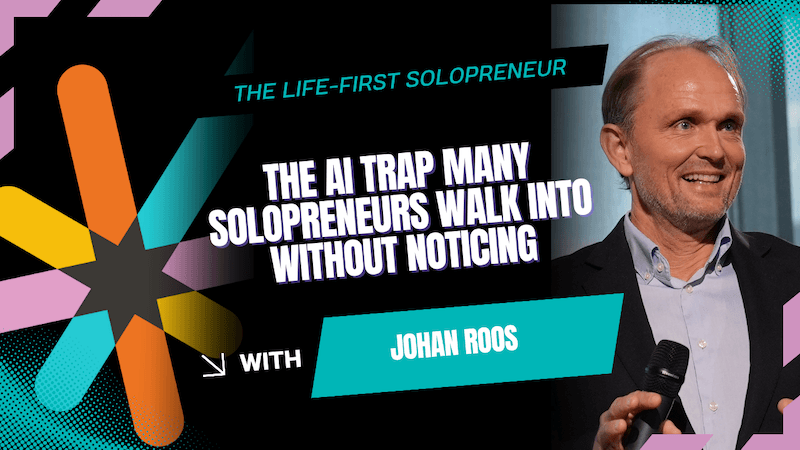
AI can either amplify your best human capabilities or quietly erode them, and the path you end up on comes down to the choices you make every single day. In this episode of The Life First Solopreneur, Johan Roos, creator of Lego Serious Play and author of Human Magic, joins Carly Ries and Joe Rando to explain how solopreneurs can stay on the right side of that line.
What is the erosion curve in AI use?
The erosion curve is the default path most people slip into when using AI. According to Johan, it happens when you rush to answers, stop holding questions long enough, accept the first output, and gradually become less curious, less critical, and more dependent. It is subtle and slippery, which is exactly what makes it dangerous.
What is the amplification curve?
The amplification curve is the conscious choice to use AI in a way that strengthens your core human skills. That means refining your prompts, challenging outputs, asking for alternatives, and increasing the precision of your questions with each round. Joe shares how he uses AI to review legal contracts, and Johan explains why iterating rather than running with the first answer keeps you on this path.
The five human capabilities AI cannot easily replicate
Johan identifies five skills worth protecting: curiosity, creativity, critical thinking, communication, and collaboration. He suggests early career professionals focus on critical thinking, while more seasoned solopreneurs guard their communication skills, since selling and connecting still depend on the human touch.
How solopreneurs can turn AI into a sparring partner
Without a team to debate, solopreneurs often lean on AI as a colleague. Johan recommends assigning roles to the tool, watching for sycophancy, staying alert to dependence, and measuring success by whether your questions are getting sharper. He also stresses the value of real peer groups as a trusted wisdom engine.
The wisdom compass
Johan shares four questions that guide practical wisdom: what matters, what is right, what resonates with the circumstances, and what will work. The middle questions involve moral judgment, and those are the ones you should never delegate to a machine.
Key takeaways for solopreneurs
- Choose amplification over erosion with every prompt
- Increase the precision of your questions over time
- Do not mistake volume of output for quality or depth
- Use AI as an expert, not as a substitute for expertise
- Hold on to your wisdom engine and your human magic
Learn more about Johan Roos at humanmagic.one, and connect with him on LinkedIn.
This is a sensitive area for some listeners. Johan touches on the risks of young people using AI for friendship and therapy. If you or someone you know is struggling, please reach out to a qualified professional or a trusted person for support.
EpisodeTranscript
Carly Ries: What if the smartest tool you have is quietly making you dumber? This week, we sit down with Johan Roos, creator of Lego Serious Play and the author of Human Magic, to unpack the two paths every solopreneur faces with AI. One amplifies your curiosity, creativity, and judgment, while the other slowly erodes them without you even noticing. Moral of the story, hold on to that human magic. Let's get into it.
You're listening to the Life First Solopreneur, the podcast for those in pursuit of a life first business. I'm Carly Ries, and my cohost Joe Rando and I spend every episode with solopreneurs who are proving there's a better way to run a one person business and experts who are helping make it happen. We like to say life first, then business. So let's get right to it. Johan, we were just speaking offline about how your travel schedule is busy right now.
You're speaking all over the world, including in The States pretty soon. And it does not surprise me at all that you are in high demand right now given the topic we are going to discuss today because I think it's something every person and but specifically today's Solopreneur needs to know about. But before we get into it, I have an icebreaker question for you just for us to get to know you a little better, our audience to get to know you a little better. Your work is driven by curiosity about how people learn and adapt. So I just wanna know what is something completely outside of business or AI that you've gotten curious about lately?
Johan Roos: There are two things, but I'll focus on the one that I think maybe some of your listeners will appreciate, and that is it was a long time, decades ago, since I was in a golf set. And I'm now sort of trying to pick it up again, and I'm just very curious how to strike with a driver without getting a slice.
Joe Rando: I know a guy that I need to introduce you to. He has international clients flying from all over the world to come to him, and I'll give you an intro. He's good friend.
Johan Roos: It's tough.
Joe Rando: Yeah. And I don't golf,
Carly Ries: My daughter is getting into golf, but we're trying to decide if she likes golf or she likes driving the golf cart and the snacks from the snack lady. I don't know which it is, but she's like, it's still part of the golf experience. So we'll see which, she's either gonna be on the PGA tour or not.
Joe Rando: I really like the windmill. That's my favorite.
Carly Ries: The windmill? What the windmill?
Joe Rando: Mini golf.
Carly Ries: Oh, I was like what? oh, Okay.
Johan Roos: That is cool. But the experience is quite far from the real thing. And I haven't done that for twenty years and I just totally forgot. It's not in my muscle memory. I just have to pick it up again, but it takes a little bit too much time for me.
Carly Ries: You'll get it. I have no doubt you'll get it. Well, listeners, spoiler alert, we're not talking about golf and mini golf for this entire episode. But if that's your hobby right now, please enjoy it. But I wanna get into the heart of today.
So you described two trajectories for professionals using AI, and again, specifically for Solopreneurs today. You have the erosion curve and the amplification curve. I guess my first question is, what am I talking about? What are these things? And then second, for a solopreneur who uses AI dozens of times, if not more than that, a day just to keep up, what are the early roaring signs that they've slipped into the erosion curve without realizing it?
Johan Roos: In this book, I do describe in a sense the overall message as you say. But I'll reframe it and say it's a choice. That's the message. You have a choice. We have a choice.
When we use these wonderful tools that are mind blowing and getting better every day, we have this choice to consciously or unconsciously also use them in a way that will amplify our basic human capabilities, curiosity, creativity, critical thinking, how we communicate, how we collaborate, and in a sense how we develop more wisdom. Or we can use them in a way where we get less curious. We don't hold the questions enough. We just rush to answers. We think we create them, but we don't realize it's just a medium of the training data that you use a recombination of stuff.
We forget to think critically. We don't ask because we love the output and we rush with it. We start to sound like an LLM when we communicate and write, our emails or LinkedIn posts. And we are super uncomfortable sort of handling AI agents as teammates, and we actually lose a little bit of our soul and our way to develop our practical wisdom. So that is sort of the choice.
And the choices we make every day, hundreds of times, every time we use these tools, every time we do stuff, we sort of actively make this choice or not. If it goes the default is that you use these amazing tools in a way that will gradually make you suddenly slip down the erosion curve. That is the danger of it. So I'm super positive. I'm all in favor of the AI tools.
Use as much as you can and so forth. But be careful. Be careful. So Carly asked about early warning signs. Should I stop there, or do you wanna talk about that?
Joe Rando: I think for me, I would love to have some kind of examples , let me ask a question. So I'm gonna give you a way that I use AI, and you can tell me whether I'm on the erosion curve, or whether I'm on the amplification curve.
Johan Roos: Can't wait.
Joe Rando: So here's something,
Johan Roos: Can't wait to assess you.
Joe Rando: Okay. It's good. So I do a fair amount with legal contracts. I'm one of those people. I don't sign a contract because somebody put it in front of me.
I know a lot of people just you know, they'll have some vendor or something, and they'll just take the thing and sign it and get move on. And I don't? Because a lot of times, what's in there is not very good for me . For the company. So I would always read them, and I hated it.
I don't love reading legal. I'm not a lawyer. I would probably miss things. So one of the things I do now is I put the contract into an AI, typically Claude these days, and from there, kind of tell it what I want and what I'm expecting and what I'm hoping for. And then I let it go through and assess all of the aspects of the contract and kinda come back with a list of issues, you know, serious issues, minor issues.
And then I work from those to go back and negotiate with the vendor. And I'm wondering, am I being lazy because I'm not reading the contract in detail anymore? Or am I amplifying my abilities by doing that so I can use my energy to negotiate the important things instead of trying to read through all the crap?
Johan Roos: Well, you're as lazy as I am, because I do the same. Okay. And I think this is a brilliant way of using the AI tools, because remember now, they're large language model. They're trained of text primarily, and then we have images and so forth. But look at the text now.
So they will look at all the text that has ever been produced if I simplify it. 75% on of everything on the Internet is in English. So we look at English text and everything that's used, And it will have this amazing combination and say, hey, here's what it typically looks like. So in a sense, based on the training data, here are some of the issues you should be aware of this. Super good way, Joe.
The danger, I would say, if any, Joe, is when you take the first round and just run with it. Right? The first answer that comes out or the first even recommendation, like you should do this and run with it. I heard you say you take this round and then you go back and you prompt again, you ask question, you challenge, and you say, please refine, give me three alternatives. Now that is the way to use it, of course.
And many, many people use it this way. I think this is fantastic because it helps our thinking. That's not what I'm talking about in the erosion curve. The erosion curve is when you don't hold the question for long.
You rush to an answer. You think that silence is a problem. You think that you don't understand that the LMM will never say, I don't know, but give you something. It's like a multiple choice thing. it will always be a choice.
Here, it's this, this, or this. You ask a second time, it will give you approximately another one. So that is in a sense the subtle rush to answers, the subtle rush to close an issue very, very quickly. Everybody's stressed these days. That is when the danger comes in.
And the challenge of, when you don't ask why? Why? Those are some of the warning signs in a sense for the erosion curve. Simple as that. And it's subtle. And it's slippery.
Carly Ries: Yeah. It makes sense. But for solopreneurs who don't have a team to debate with, they often use AI as, their calling. A lot of people are even naming it like, oh, my CMO is a squad and all of this.
Johan Roos: Mhmm.
Carly Ries: How can someone turn AI into a genuine sparring partner rather than , like you said? it's multiple choice. They're gonna give you an answer When there's no one else in the room to push back.
Johan Roos: So this is very very important. And to some extent, I'm also solopreneur in parts of what I'm doing. I used to be in big organizations and leading organizations and stuff. But now I'm working very much for myself and doing stuff. So I totally totally get it.
And I work a lot with founders as well. So I totally get it. So a little bit back, half half step back. I think an early warning sign is of course dependence. It's like a drug, If you can't live without it, you should be a little bit careful. There may be an an AA or whatever for LLMs, you know, an LLM or whatever. But the second a little bit slippery thing is believing this sycophancy that comes out of these, things. You know, the tech pros are not stupid. They understand human psychology and sociology.
You get somebody to say, what a brilliant idea, Joe. You're amazing. you're pulled into it. Of course, you know, and obviously it is. But for the rest of us, may be not, but it will still tell me I'm amazing and I get excited about that. So these are like, be a little bit aware and careful for that. When it comes to this idea of of having few colleagues or perhaps not a colleague or somebody who can you can go out and have a coffee with, You could say like, well, first of all, try to get a colleague, try to go to a cafe or whatever and check things out and have a conversation. But I think in a sense the fantastic possibility of these tools is that we can assign a role to that.
We can actually give the tools, the job to be our colleagues, you know. You can be even Socrates or you can be an ancient president or whatever or somebody who would argue with you or a colleague or somebody you wish you were a colleague. And you can actually do that. So role playing is amazing. This is used a lot in higher education now with these tools.
So I think that's very, very good. But for me, the real measurement here is about being able to increase the precision of your question. That may sound easy, but you know, if you use the tools and you find that you're more precise on the next question, that's very good. If you use the tools and you find that you accept an answer or that's good enough and so, and rush with it, that's a little bit of a warning sign. So try to increase the precision, be careful about that, and assign a role to help you, and be super critical on what you do.
That's very helpful.
Carly Ries: Well, and so also so we're talking so much about the human aspect and then the AI aspect. And your book identifies five capabilities, that algorithms can't easily replicate. And I'm gonna try to remember these, curiosity, creativity, critical thinking, communication, and collaboration. Those are five?
Joe Rando: Good job.
Carly Ries: thank you.
If a time strapped Solopreneur could only cultivate one of these, you think this year, which one should it be? Or do they need to cultivate all five?
Johan Roos: Give it a think in a sense. The first three, curiosity, creativity, and critical thinking is sort of in the mind, a lot in the mind. Right? And I will argue from another perspective, it's also in your hands. and then think of the other two, like communication and collaboration, something you do with others and try to do.
So you could think of them as like a phase one and phase two. I'll respond to your question by saying, if you're in an early career, more junior early career role, I think you should practice your critical thinking these days. And I'm speaking as like three decades in higher education, I've been a professor and leader of business schools and stuff. I'm worried about the quality of critical thinking these days. And it's sort of in the book you'll find that the chapter on critical thinking has, ancient roots.
This is back to reasoning and enlightenment and all that. But it has a simplistic tool in it from the early nineteen fifties by an English philosopher called Stephen Tolman called argument mapping. It's basically just asking you and helping you to map out your argument. You know, what is the argument you get and what is the argument you provide, and basically splitting it up into you have a ground for what you say. Like, so you've claimed something.
What's your ground? What's your because? How do you qualify it? How do you possibly review it, etcetera? This tool is a very useful tool to help you sharpen your critical thinking.
And I would say early careers, please do pay attention to that. If you're a little bit sort of what should we call a little bit me, a little bit more senior, more seasoned and so forth, I think what is very, very critical not to lose in this world when we spend hours and days in front of the flat screen like we do now, is communication. And if you're a solopreneur, we all have to sell our stuff, right? And you know, selling means communicating and eventually collaborating. But it means communicate, don't lose it.
So where I start a chapter on critical thinking with King Midas who believed in the Oracle, and didn't pay attention to which empire would fall when he started a war, his own it turned out. In the communication chapter, I praise Cicero, the famous Roman orator. You know, he was even a consul in '62, I believe, before Christ. This idea of being able to sway an audience with not just what you say, but how you say it, using what the Romans called the elegance of the body. I use even theater trick, tips and tricks in that chapter to tell people, don't forget this amazing important capability to use your entire corpus, you know, your body in your communication.
So you don't believe it's just text you write in an email or a sales proposal. So critical thinking, communication, absolutely vital.
Carly Ries: Okay. Yeah. That makes sense. I had a hunch I was gonna be those two, but I had to clarify talking to the expert.
But so I don't wanna liken AI necessarily to social media, but it can kind of get addicting. Like, once you get really into it, especially for solopreneurs who are using it as the partner to bounce ideas off of, it can be very consuming. And most of our listeners are Life-First solopreneurs. Meaning, they're building a business to support their life, not one that runs their entire life. And so they're looking for more freedom and less grind. is there a version of the amplification curve that buys back time rather than just producing more and more output? Because I feel like a lot of times, Solopreneurs, they'll get going and then they'll just keep going even though in theory AI is supposed to save you time. But if you keep putting that time towards AI, it's like a link.
Johan Roos: It's very interesting because I think we've all experienced it. And I understand and I assume that many of your listeners are very accomplished people, very driven people who want to do something and who creates value in various ways. And I think for for that part of the world, this is an extraordinary amplifier as a default. I feel I'm at least five times as productive as I was a couple of years ago.
And I have probably about 12 agents for me working as we speak, to do a lot of research and do stuff and so forth. So it's of course amazing. And you're pointing at a little bit of the flip side of this, namely that it will pull us more into it. Like we're more productive, so we'll do more and we don't get a life, you know, we have less and less things to do. So I do think in a sense that we have to be careful with these LLMs not to mistake quantity for quality or depth.
Because there is a temptation to generate a lot of stuff, reports, white papers, sales proposal or whatever, as a lot of text. These are large language, text based models primarily. There's of course imagery and leaders as well. They're not large thinking models. So just don't forget that.
And just because we produce a lot of text doesn't mean that the party on the other side read this text. In fact, the other party may just shove it into an LLM and and then and have it summarized in three sentences. So you get this loop on that LLM speaking to the LLM. So in a sense, just hold on to your depth. And holding on to your depth is very similar to holding on to your human magic in a sense. that's where I think it is. I created a tool thirty years ago called LEGO Series Play. It's using Lego material to do serious stuff in there. I was a strategy professor at Pine Home.
And the reason I did that with a good friend of mine called Bart Richter was that we felt that the conversations at that time were all about analysis and data and spreadsheets and all that. There was no depth to it. And these conversations, I worked a lot with leadership teams and boards and it became sort of a ritual of numbers and stuff. I Would say, where's your wisdom? You know, where's your judgment? Where's your common sense in here? Oh, we need to have the numbers.
And sort of it was pretty flat. So I developed this tool to make it deeper in a sense, to have people talk with their hands and express things in color, shape, size, and forms. It's a pretty cool tool.
It's a little bit the same now. The risk is that the conversations become flat despite zillions of words, zillions of documents. And this is something I really urge you to just be careful for. Remember that the LLM will recombine tokens, words, parts of words out there in a way that eventually will be the medium of the training Data.
It will look amazing to us, but it is the medium of the training data unless you've instructed to do something else. So building quality assurance to it. I work with quality assurance and business goals forever. Slow things down, ensure somebody reviews it, review and criticize it, do adversarial role playing with these things. Ask someone and get a life if you don't have it in the sense outside it Because it is addictive.
It's super addictive. Look at young people now. TikTok was one thing. Now look at what happens when young people use this. I was in Riyadh and I even had a young lady, a lady with a young child telling to me, a senior officer in one of the ministers saying, I'm worried about how our kids will communicate and collaborate these days.
And even they come and said, mom, Chat GPT says this, you said something else. this is super addictive, and it's gonna change how we communicate. Hold on to your human magic.
Carly Ries: Well, so okay. I wanna touch on that because you were like, how do people review it? Earlier, you guys were talking about uploading your legal documents and putting in, like, your side of things and all that. But a lot of people do turn to AI to get answers to things they don't know. I even type in, parenting advice stuff where I'm like, I don't know how to handle this situation.
I wonder how God would handle this situation. But since they're often looking for answers they don't know I mean, I guess, with, like, a legal document, of course, you'd have a lawyer still review But if it's for something else where there isn't that point person that could review it, how do you make sure things are right? And because like you said, people just are like, this is great, even though it's kinda the median. How do you do that?
Johan Roos: Be careful. Just if you're not the expert, you are risk being taken for a fool. This is why these tools are so good for experts who know their stuff. because you can assess that doesn't make sense, doesn't feel right.
It's not, I have a hunch that, gut feel, intuition, all of that stuff is our accumulated wisdom. Right? And if it doesn't feel right, don't do it. But if you use this in an area where you have no expertise and you use it as a coach, you know it's big, coaching, AI coaching is big now. Therapy was an early thing.
You know, my wife is a psychiatrist for children, and it's a bit scary that portion of the world, not that she would share anything with me, but the principle is scary that you would replace a human with an AI tool for sensitive, very personal matters, with, people are not well. I tell people just don't go there. Be really careful. But I'm worried about younger people who are using this as their first friend, you know, their first boyfriend or girlfriend or their therapist, as a teenager. That's super scary.
Lock themselves in the room is no longer just TikTok or Facebook or anything. It's an AI interacting with you. That's scary. What's also a little bit concerning is what I hear when young people enter the workforce and hopefully a lot of them get job less now than before, but that they use these tools to deliver. And then they deliver amazing and the boss says, woah, that's good.
Great. Go do another thing. And then they deliver it. And then eventually these young people will, did I really do that or was this the AI? So it's almost like you get an impostor syndrome.
Like, oh, I didn't really do that. I feel really bad. So it's like these are some scary psychological and sociologically and anthropological issues that you just have to be a little bit careful with. that's all.
Joe Rando: So just kind of digging into Carly's question a little more. I guess I'm gonna let you critique me again. When I use AI, I tend to treat it the same way. My wife is a children's book author. she's also a child therapist, but she writes children's books.
And she goes to these critique groups, and she comes back and she's like, I got all this advice, and you know, it's conflicting. I don't know what to do. And eventually we concluded, you have to just focus on the things that resonate with you. And I've been doing the same thing with AI. I'll go into AI and I'll say, hey, give me some ideas for whatever.
It'll come back with all this stuff and I'll look at it and maybe one thing will resonate. I'll go, oh. Mhmm. And then I'll dig into that and come back around and ignore all the other stuff. And if you do that iteratively, it seems like you get good results that are you and not the average of all of the words out there on the Internet.
And I'm just curious, is that what you would suggest, that approach? Or Is that No.
Johan Roos: It's nothing strange, Joe. It's like you do you. You do what makes sense to you, and I do what makes sense to me. Because we're all different. We have all different backgrounds.
So if presented with the same thing, we'll interpret it differently. That's, how the world is. And, I think there are four questions that you should hold on to. Two of them are particularly important. And this is what I have in the chapter about practical wisdom, which is a cross control concept about wisdom, actually. the first question is what matters? Second question is what is right? And remember, this is an ethical judgment. And the third question is what resonates with the circumstances around you right now?
What resonates given where you are and the time and the place and so forth? And the fourth question is, what do you think works? You know, what do you think works if you're looking for implementing doing something? So those four question is what I call the wisdom compass, right?
If you start to delegate those questions to an AI tool, you should start to be a little bit worried. Because it starts to then do more than, it's starting to do you. How can an AI tool respond to what is right? What is right is the answer to what you think is right because of your lived experience given circumstances and guardrails and culture, whatever you like to say. What matters and so on.
These are your hunches, your intuitions, your gut feel about what happens. This is your value creation. If you can get an answer to all of the other stuff, obviously whatever you output there is not where the value is created. All right. So you have to climb the ladder of value creation because the bottom rungs are being automated away by amazing AI tools.
But you have to hold on to things like what is right and what will work, . those are the final two. Then you have what matters and what resonate. You can get some help on that. But those other two are moral judgment.
And those you have to hang on to. So I say, Joe, fine as long as you don't give up this generator of wisdom. This is where fantastic peer groups are super good. And this is of course with solo entrepreneurs. I know a lot of solo entrepreneurs, founders who do stuff.
I'm part of an amazing network of 300 founders who have created more than 3,000 companies, in Europe. And for me, their meetings is a trust peer to peer wisdom engine because they will bring it up and there's a particular way of doing it and they come together and talk about it and they share and they're vulnerable and they get this stuff. These are wealthy people who do it. I don't know. You can imagine 10 companies here, and they divested and exited.
They don't do it for the money. This is amazing. So hold on to your wisdom engine, and that is these four questions.
Carly Ries: I can't think of a better place to stop and think hold on to your wisdom engine. but before we do actually stop I mean, Johan, we could seriously talk to you all day. I think all of this is so fascinating, and I love your perspective that you provide. In a world like AI, feel like everybody seems to have an opinion on it and you have such a good, perspective and I really appreciate everything that you shared. And before we share where people can find you, we have to ask you because we ask all of our guests this question.
What is your favorite quote about success?
Johan Roos: Success has many parents. That's the one. You know, failure, everybody wants to avoid failure, but if you do something and it's as successful, everybody's was suddenly a father or mother of that.
Carly Ries: I love that. That is a new one and it's unique and I so appreciate it. Well, where can people find you if they wanna learn more about you, your business, your book? Give us all the links.
Johan Roos: I'll simplify it. Of course, I'm on LinkedIn as well, but my name Johan, S as in Sierra, Roos because I have a double name. I'm not using all of it. So I'm on LinkedIn. But the best thing is to go to humanmagic.one.
Humanmagic.one. One word, humanmagic.one. If you do .org or com, you'll probably end up with the magicians, the society in the world, or whatever. That's not it. But it's humanmagic.one there's also a link to me. I have a johanrules.one
Joe Rando: Is that the number one or o n e?
Johan Roos: O n e. O n e.
Joe Rando: Okay. I've just never seen that. interesting.
Carly Ries: That's great. Well, like I said, thank you so so much for coming on the show today. We really appreciate it, and we are sure our listeners did as well.
Johan Roos: Fantastic. Carly, Joe, I enjoyed it. Thank you for all the great questions.
Joe Rando: Thank you.
Carly Ries: Thank you. And listeners, thank you so much for tuning in. As always, please leave that five star review. It helps us Build credibility and spread the word to other one person business owners.
Life-First one person business owners. Be sure to subscribe to our show on any podcast platform, including YouTube, and share this episode with a friend of our fellow Solopreneur. And we'll see you next week on the Life First Solopreneur. You may be going solo in business, but that doesn't mean you're alone. In fact, millions of people are in your shoes, running a one person business and figuring it out as they go.
So why not connect with them and learn from each other's successes and failures? At LifeStarr, we're creating a one person business community where you can go to meet and get advice from other solopreneurs. Be sure to join in on the conversations at community.lifestarr.com.