


19 min read
The Solopreneur's Guide to Hiring Your First VA Without the Panic
 Joe Rando
:
Sep 8, 2026, 8:23:13 AM
Joe Rando
:
Sep 8, 2026, 8:23:13 AM
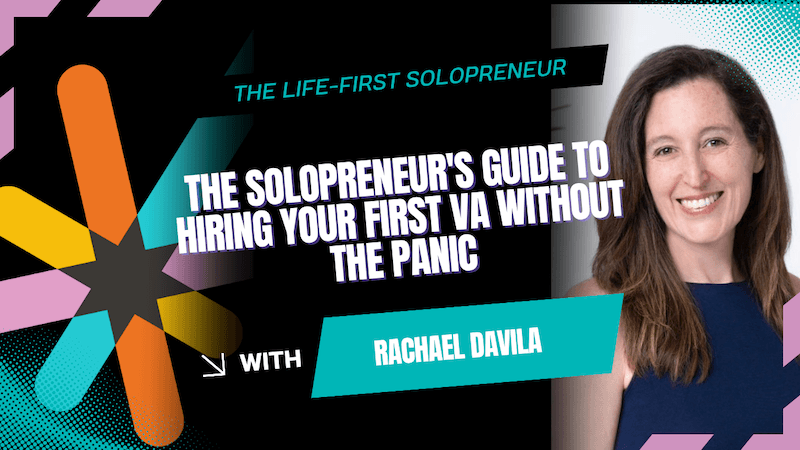
Being a solopreneur does not mean doing everything alone. In fact, trying to do it all is one of the fastest routes to burnout. In this episode of The Life-First Solopreneur, VA expert Rachael Davila explains exactly when and how to bring on virtual assistant support without the stress.
Who is Rachael Davila?
Rachael Davila is a virtual assistant mentor, author, and founder of Extra Hands! Virtual Assistance. She has worked as a VA since 2005 and hired her own first VA in 2021, giving her a rare view from both sides of the client relationship. She also hosts the podcast Hey! Do I Need a VA?
What is the difference between a doer and a collaborator VA?
A doer VA likes doing the work and thrives when you hand off clearly defined tasks with established processes. You say what you want, they do it. A collaborator VA is more solution-oriented and helps you figure out the how. You bring the vision or goal, and they help break it down into projects, milestones, and tasks. Collaborators tend to cost more because they take on more strategic thinking. Many businesses start with a collaborator to build systems, then bring on a doer to keep everything running.
When should a solopreneur hire a VA?
According to Rachael, if you are already asking "do I need a VA," you are on the journey. The best time to hire is before you are completely overwhelmed, because documenting processes and training take time you will not have in a crisis. If you are not ready to hire yet, start by tracking your time, noticing what does and does not need you, and documenting the tasks you would love to hand off.
How do you find and vet the right VA?
Do the work first. Know your handoff list, your budget, the qualities you want beyond the task list, and the gaps you are trying to fill within yourself. You can find the right fit at any budget once you know what you are listening for. Referral directories, vetted communities, and reputable registries are good places to start.
Is a cheaper VA actually cheaper?
Not always. As Rachael puts it, cheaper is not inexpensive. If a lower-cost VA takes three hours to do what an experienced VA can do in twenty minutes, you have not saved money. A client hour is not the same as a VA hour, because specialists work inside these tools every day.
Can AI replace a virtual assistant?
It depends on the work. If you can write a prompt to get the same result faster, you may not need a VA for that task. But for relationship-driven businesses, a human VA offers thought partnership, context, and judgment that AI cannot yet replicate. A great VA notices when your goals shift or when life is getting in the way and adjusts accordingly.
Rachael's life-first advice
Start small and build trust. Use the first 90 days for lower-risk projects so you can learn each other without putting your business on the line, then expand from there.
Learn more about Rachael at extrahandsva.com and listen to her podcast Hey! Do I Need a VA?
EpisodeTranscript
Carly Ries: Ever been handed a box of postcards and asked to exacto knife out the three d parts while binge watching a movie? Rachael Davila has. And on this episode, we pull back the curtain on the world of virtual assistants with a VA who has been in the games since the floppy disk era. You'll find out why hiring the cheapest help can actually cost you more, the real difference between a doer and a collaborator, when you should bring someone on and hint, it is earlier than you think, and whether you even need a human VA in the age of AI. If you've ever whispered, do I need a VA to yourself at 11PM while drowning in tasks?
This one is for you, so let's get into it. You're listening to the Life-First Solopreneur, the podcast for those in pursuit of a life first business. I'm Carly Ries, and my cohost Joe Rando and I spend every episode with Solopreneurs who are proving there's a better way to run a one person business and experts who are helping make it happen. We like to say life first then business, so let's get right to it. Rachel, you're I'm so happy that you're on this show today because some people get confused when they're like, what's your definition of solopreneur?
Does it mean you do absolutely everything by yourself? And we're like, absolutely not. Do not do everything in your business by yourself. That is a recipe for burnout and just not enjoying your business. And so we always say, bring on contractors, bring on VAs, and you are gonna help us navigate the whole VA world today.
But before we get into it, we have an icebreaker question for you. And that is, what's the most unusual thing a client has ever asked a VA to handle?
Rachael Davila: Well, I'm really glad you asked me that, Carly, because I didn't know until I got your questions what I would consider weird or unusual. But I had one client who ordered printed materials, but she asked me to exacto knife out the three d element of it. She sent me the whole box of printed postcards. And I remember putting a movie on and just exacto knifing around so that it would pop up.
Carly Ries: I remember I did a website for client. This is years ago. And to review the website, they asked me to print out each website page.
Joe Rando: Oh, that's Just...
Carly Ries: What are you talking about?
Rachael Davila: And maybe I'm showing my age here, but when I started in 2005, the Internet was not a new thing. I mean, we had AOL and and all the things, but, we didn't have Zoom. It was Skype and you didn't really use it for very much. And so I still had clients that were doing a lot of things on paper. I had one client who would ask me to hand write thank you notes to her clients because that was still an etiquette thing.
We weren't doing email marketing and stuff like that back then. I remember when Constant Contact came online and it was the user friendly email marketing program. Everything else needed coding at the time. So just seeing how, I have a friend who jokes all the time when she started, clients would send her the work on paper and she would mail them back a floppy disk or a disk. So it's funny.
Joe Rando: It was the old Internet.
Rachael Davila: Yes, To print it out so they could copy, line item and stuff. Yeah. It's crazy how much it's changed and you forget. Like, you think back and you go, why did I do it that way? And you're like, oh, because we didn't have Zoom. We didn't have GPS. I mean, so many things that just weren't. We can't live without now.
Carly Ries: To give context to the timeline, you've been a VA since 2005. But you didn't hire your own first VA until five years ago? What? 2021?
Rachael Davila: Yeah. 2021.
Carly Ries: What did sitting on the other side of the desk teach you that the sixteen years of doing the work never did?
Rachael Davila: So it's funny. Carly, I remember very distinctly a coach. We were going through my website, he's helping me rebrand and create the wording that's there. And he made this off handed comment about how scary it is to hire support. And I was like, I'm awesome. All VAs are like me and we're awesome. I didn't understand then that not all virtual assistants are the same. I call them collaborators and doers. Some people call them employee minded, business partner minded, entry level, executive level.
But when I hired my own VA, I had a really quick awakening of, oh, that's why they're scared. Because I hired a doer. My first VA was a high school senior who could do graphic design. And I jumped in both feet, didn't do any of the pre work because it was a friend's child who needed a side business. And as I learned how to work with them, I realized very quickly, oh, there is a lot more to working with virtual support than just handing off tasks.
I always stepped in and kinda guided the relationship because I'm very much a collaborator. Here's what we can do. Here's how I can help. I see what you're saying. Let's do this this and this.
Doers are very much, tell me what to do and I'll do it. So it leaves all of the ownership on the clients to know their systems, know their processes, know what they're looking for, and be able to communicate it clearly. And I was not set up for that for my own stuff. I could do it for clients but it was really hard on my side of do I even have a process? What does it even look like for me?
I just did it. I was the doer, so I was just doing it. I didn't know that I had a perfectionist tendency. Please don't leave one word at the end of a line until I saw a bunch of graphics with one word at the end of the line.
Joe Rando: You know, I hope in this podcast episode that we're gonna get to that, differences between the different kinds of VAs because that's really interesting. And, I'm not sure what you have lined up, Carly, but, I hope we get there.
Rachael Davila: Let's do it right now. Good bridge, though.
Carly Ries: Rachel, yeah, I mean, it's funny because I think of the e myth when they're like, I don't know if you've read Michael Gerber's the e myth, but there are different types of business owners. What do you see in the VA world? You're saying the doer. What are the other types?
Rachael Davila: So those are the primary distinctions, doers and collaborators. I've also seen kind of a middle ground where it's a doer who likes doing the work, but they've worked with clients long enough to kinda go, this work for this client, maybe we can bring it into your business. And so they lean into collaborators because they have the experience now of how things show up and how things have worked for past clients.
Joe Rando: Can we define collaborators? Because I'm not sure I know what it means exactly.
Rachael Davila: Okay. So doers like doing the work. Collaborators are more solution oriented sidekick navigators. The client brings what they want done, and the VA can step in and create the how. How are we gonna do that?
Joe Rando: As opposed to just, you know, fill out this form for me or design this page for me. It's, how should we design the page? Or how should we design the form? And they help you with that. Okay.
Carly Ries: Or is it even like a doer would be, I want you to do these LinkedIn posts, blah blah blah. And a collaborator would be, I need you to come up with this social media strategy. And then they figure out that side?
Rachael Davila: it's not like one size fits all. And I think different VAs bring their experience, their what they do in their own business to what they support clients with. And so it's really more, I think, leadership style of what the client needs. So if they're really clear on what their process and procedures are, and it's clearly outlined like, on Mondays, I do this post. On Wednesdays, I do this post.
And here's the stuff. I just need you to create the graphic and schedule it. Something like that that's really easy to hand off, a doer is gonna do really well. And that's not to say they can't do higher level activities, But they really need that clear outlined process procedure. You do this, you use this template, they set up automations, things like that to kind of follow the flow.
Collaborators on the other side are great for business owners who are visionary. They don't know how they're getting to the individual task. They're like, I have this great vision. I know what I want. I know what my goals are. I know where we're headed.
But they may not know all the milestones and projects and individual tasks to achieve that vision, and they need somebody who is like, okay. Let's break this down. I'm releasing , hey, do I need a VA challenge that helps business owners get from the idea of hiring support all the way to onboarding and what the first ninety days looks like.
Even within my own team and having done projects like this for other clients, I was still amazed at the idea of I'm doing a challenge and the cascade of projects that went underneath it. You know, one thing turned into a total tangent that was like, yeah, I still want that. And my VA guided me through all of that because they were building it from the back end. I need this. I need graphics. do you want a survey? Do you want an affiliate program? Like, they were asking questions that I hadn't even thought of because I hadn't done that for clients before and I didn't even know it was a thing I wanted. So collaborators look at the whole picture. What's your goal? Why are we doing this?
And making sure that all of those elements to capture the leads to communicate and follow and nurture all get implemented into the project. A doer will set it all up for you, but you have to be the one saying, I want this, this and this.
Joe Rando: So collaborators sound more expensive.
Rachael Davila: They are.
Carly Ries: So speaking of these types of VAs, if a listener is tuning in right now and they're like, well, I think I have an idea of the type of VA I'd want. but when should somebody bring on a VA? In my mind, they have an idea of when that is, but that might be too late. What are your thoughts on the signals for when somebody should hire a VA?
Rachael Davila: My whole platform is if you're asking the question, hey, do I need a VA? You're already on the journey. And you may not be ready right when you have the idea. But a lot of what I put in the book and I talk about on my podcast is the questions to ask yourself. Because if you don't have the budget to hire someone, how can you start to save up money so that you can bring someone on?
Do you even know what you're handing off? And that answer might be a no. And so then start tracking your time, see where it's going, what needs you, what doesn't need you and what would you love to hand off? A lot of times, you can start off with those awareness pieces. Getting clarity on do I have a process?
If I don't have a process, maybe I should start to create one for myself so that if I wanted to hand it off, I have all the pieces there. And so sometimes life is just lifing and you can't just go, okay, I'm gonna hire a collaborator to help me do all of this. It might be I'm gonna just start documenting my process so that I'm not looking all over for the email template that I use every time I follow-up with a client. And starting to pull things together into one place so that there there is a point in time where the risk outweighs the benefit. And I think for me, a virtual assistant is a business to business relationship.
The VAs that I work with and I collaborate with and the type of VA that I am is we are business owners doing administrative and operational support for other business owners. So it's b to b. If you're looking at it as a transaction, I'm gonna pay for x amount of hours. They're gonna do x amount of work. You have to make sure you have enough work.
You have to have the budget to keep going. You have to have all these things in place that I think can feed, is now the right time? Am I ready? Am I not ready? One of the things I learned as I hired my VA was I wasn't ready.
And it wasn't that I didn't have work for them to do or even the budget to pay them. It was I had to let go of my identity of being the doer of all things. I had to release my perfectionism because I would literally go behind my VA's back into Canva and make all the tweaks instead of telling them, I don't like that. Please tweak it. And I realized very early on if I kept making all of those tweaks, if I kept hoarding the tests, why was I hiring a VA in the first place?
And they wouldn't learn what my preferences are and how I worked. Because over twenty one years, I've worked with hundreds of clients who on paper did the same thing. I worked with dozens of coaches, but each one does things differently. They ask different things of me. Their version of good and another person's version of good, are completely different.
So, having to kinda look within as a business owner of what does it look like? How will I know if it is right? If I can. I was like, it's good enough. I can let it go.
Joe Rando: I have a question on that because I think it's something that I have said to people and I would like to check it with you because you're much more of an expert. And you made the point that of being ready. And a lot of that comes down to documenting processes, as you mentioned. And this idea of documenting processes can make your life easier even when you're doing it. But does it make sense to hire that helper of whatever form it is before you absolutely need it, because the amount involved in documenting and then training is the kind of thing that you're going to want to lead a little bit.
Because if you're completely overwhelmed and now you need help today, you're gonna be really in trouble bringing somebody on board at that point.
Rachael Davila: Yeah. I always wanna get to somebody before they're in that state of overwhelm, before they need someone. But you and I both know. It's like, okay. I have hit my limit. Now I need somebody and nobody is preemptively going, I'm gonna pay somebody to do this for me. It's when it becomes a hot pain point.
Joe Rando: I'm the exception because I hate bookkeeping so much. I totally let it. I was way ahead of the curve on that one.
Rachael Davila: But to your point, I think that if you are the type of person who is just overwhelmed by the idea of documenting a process, I think you can record a video about what you're doing as you're doing it so that you can hand the video to your VA and say, create an SOP on this. Or you bring somebody in to help you create those standard operating procedures. I mean, someone could say, I don't have a lead journey. Help me create one.
And then having that brainstorming thought partner to go, what does it look like? What has it looked like? We all have it. We just don't necessarily know in our head that it's part of our lead journey, whatever the process is. We just do it on autopilot.
But if you have to verbalize it to someone, oh, okay. When the lead comes in, I send them this email. Okay. Great. That email then becomes a template. A VA can help step in to help create those things if you're not the type of person organized in that way or your brain doesn't work that way to create it for yourself. So to kinda give people permission, you can hire a collaborator VA to help get all those things set up and then hire a doer VA to implement them and keep it all running. So you're not locked in to one type of VA or another. And if you start with one and it's not working, you can go to a different one.
No relationship is set in stone. And a lot of times I do encourage clients, especially visionaries who aren't detail oriented to start off with a collaborator to help them get all those things out of their head and and systematize so that they then can hire somebody to keep it going.
Carly Ries: How do you vet your VAs? You're talking about a friend of yours, high school kid, like, that didn't necessarily work out the way you'd hoped. So what is your process for finding the right one? Because ideally, you wouldn't be bouncing around. You'd find that golden ticket and have it last for a while.
Rachael Davila: Well, it's interesting because when I hired my first VA, my hand off list looked like I don't wanna do my social media. I need somebody else to create the graphics for me. So at that point in time, the VA I hired was the right fit for what I needed. Cause I didn't know anything else about myself and what support I needed. So I think if you hire somebody that feels like the right fit, and I am all about finding the right fit.
I think know your hand off list. Know your budget. Know what qualities you're looking for in the person beyond your task list. And know what gaps you're looking to fill within yourself. Are you a visionary and you need someone detail oriented?
Are you more disorganized than you would like to be and you need somebody to kind of organize you and keep things in motion? Do you need a thought partner? Somebody that like, I am a verbal processor. I need to talk it all out and I need my VA to step up and go, okay, here's what I heard you say and pull out those things. I didn't know that until I was in it, figuring it out.
So I think you can start where you are and then as you learn more about yourself and what you need out of a team member, then my first VA became our podcast manager because my dreams changed. My business direction changed. So they naturally progressed to a different role. So then I hired a different team member to do the things that they had been doing. They're really great at doing the social media graphics now for me.
But both of them are doers and when I hit that point where I needed a collaborator, somebody to kind of go, my gaps changed. The things that I needed from my business changed. And so I found a VA to fill the new gaps that emerged from up leveling and growing. So I don't think anyone is tied into one, you're not tied in and locked into a single support member. it also depends on your priority goals, your tasks that you want.
I mean, sometimes you need to start with a specialist to get your books in order before you can then focus on growth. You might need somebody to set up your calendar link before you start figuring out what your whole client journey looks like. So I think it depends on where you're at, what you need, and who's the best fit for that and for you at that time.
Carly Ries: Where can people find high quality VAs? Because sometimes people just go for the dollar number and they're like, oh, they're inexpensive. I'll go with that. And then are regretting it six months later. Where can people actually find high quality VAs if they really want one?
Rachael Davila: I often say cheaper is not inexpensive because if it takes a $15 an hour VA, three hours to do something that a $60 an hour VA can do in twenty minutes, are you saving money? Not always. I have a referral directory of VAs that I've met and vetted. So I know what they like to do. I know how they work. They're part of my community.
I do have resources of other organizations that people can go to other registries and directories. But I tell people, do the work first. Know what you're looking for so that when you are talking to a VA, you can listen for those things that you need. And you can find the right fit at any budget.
It just may not look like you think it does. Because I know a lot of people that are like, I have twenty hours worth of work. I need a twenty hour budget. And the work that most clients do that takes a lot of time is because they don't like doing it. It's not their skill set.
Someone else really can do it faster because we're in the programs all the time. If a client is only doing a newsletter once a month, it's gonna take them longer to do it than a VA who's in Mailchimp or ConvertKit or, Constant Contact all the time. The client hour isn't always the same as a VA hour.
Carly Ries: So Rachel, I'm gonna throw you a curveball because I did not put this on the prep sheet, but something tells me you might be answering this quite a bit now. So I think you might be prepared. Why hire a VA now instead of just use Claude?
Rachael Davila: AI. You said the AI question.
Carly Ries: I was just gonna ask it because I think VAs are so valuable, but I wanna hear from the pro why human VAs are still much more valuable than an AI VA.
Rachael Davila: My standard thought on that is it depends on what kind of VA you need. If you can write a prompt, or if you have to write a prompt for your VA to do a task that you could easily put into Claude and get a same result faster, then you don't need that VA. But there is still the human component to our businesses that AI is just not there yet. I'm not saying it won't ever be, and I use chat GPT for a lot of things. But you guys know, as Solopreneurs, we feel like we live and work in a vacuum.
Right? We leave our house to go to our office. We go back to our house. We never leave our physical location. So sometimes having that thought partnership, that experience of, well, yeah, you can do it that way. But have you thought of this, this, this, and this? AI, even at its best, is still gonna follow a set roll of prompts.
And sometimes you need that thought partner to go, but your goal is this. Is that still your goal or are we changing directions? That doesn't sound like you. That's not what you've been training your audience to receive from you.
There are things that we as humans will say that AI isn't there yet to say. And so I think for those who are building relationship driven businesses. If you're transactional, AI is probably gonna do great for you because it's quick and fast and you're not building a relationship. I'm very much relational. I know what's going on with my clients families, their lives.
And I can say, hey, life is lifing for you right now. Do we need to clear space in your calendar? Do we need to look ahead at projects? Do we need to do all these things? AI is not incorporating all that unless you put that into your prompt.
So I think my long winded short, it depends on the type of VA that you're working with and what you're having them do.
Carly Ries: I had a hunch you'd have an answer for that. And that was a good one. But Rachael, I mean, I this is so helpful. We talk to Solopreneurs all day every day, and I think some of them are nervous to hire VA just again to let go of the control, let go of the perfectionism. But I think everything you've talked about today is a good motivation to just do it.
If you think you need it, just do it. Before we wrap up, we have a question that we've just started asking recent guests, and now you. with the new Life-First lens that we're going with, we wanna know what is the lasting Life-First piece of advice you have for our listeners today?
Rachael Davila: Start small and build trust. I think that life is scary enough. Business ownership is scary enough. When you're looking to work with a team member, start small and build trust. Those first ninety days can be those easier to hand off projects that won't impact your business if you have to take it back on.
But you can learn each other along the way and build that trust to go, okay, they can handle this. They're doing a great job. It's looking like I want it to. Now I can give them something a little bit more risky or no, it's not working and I need to go back to the drawing board and find a new VA. So that's my piece of advice.
Start small and build trust.
Carly Ries: Love it. Great great wisdom. Well, where can people learn more about you? Get your book. Send us to all the links.
Rachael Davila: Okay. My website is www.extrahandsva.com. And the book and the podcast are there. And if you are asking yourself, hey, do I need a VA? You can start by listening to the podcast.
Season one talks about all those beginner things. The book is a how to guide and I take you through all the exercises that I didn't do and should have when I hired my own VA. And there it guides you. It asks you the questions to really get you thinking of what it looks like for you. And I think for everyone in your audience, you don't have to do it like everybody else.
You know, the relationship that you have with your business and then the relationship you have with your team member, it can look as unique as each of you are. I think even just knowing to have permission that it doesn't have to work the same way. I mean, Carly I bet your business runs differently than Joe's even though you guys are coworkers and cohosts and you know, you're all part of the same business. But you do things differently because of how your brain works, how you receive information, all of that. So doing it your way. I do have a challenge that is a thirty day challenge and it takes you from day one to day 30 asking all of those questions that are unique to you and your answers and your business.
Carly Ries: Joe, when she said, you guys are probably different. I immediately went to spreadsheets and Google Docs. I live in the doc world and Joe lives in the spreadsheet world
Joe Rando: Well, not Sheets.
Carly Ries: Yeah. Excel. So he's in the Excel world, and I'm in the Google Sheets world or Google Docs world, yet somehow we make it work. Well, Rachael, thank you so much for coming on the show today. Think this is so helpful for our audience. We really appreciate your time.
Rachael Davila: Thank you so much, Carly and Joe, for having me. This was really fun.
Carly Ries: And listeners, as always, thank you so much for tuning in. Please leave that five star review. It really helps us spread the word to other Life-First Solopreneurs. Share this episode with a friend that probably needs to hear all this advice that Rachael just shared with us. And subscribe to our show on your favorite podcast platform, including YouTube.
I'll see you next time on the Life-First Solopreneur. You may be going solo in business, but that doesn't mean you're alone. In fact, millions of people are in your shoes, running a one person business and figuring it out as they go. So why not connect with them and learn from each other's successes and failures? At LifeStarr, we're creating a one person business community where you can go to meet and get advice from other solopreneurs.
Be sure to join in on the conversations at community.lifestarr.com.