


22 min read
Why Most Solopreneurs Are Doing PR Completely Backwards
 Carly Ries
:
Sep 30, 2026, 7:59:30 AM
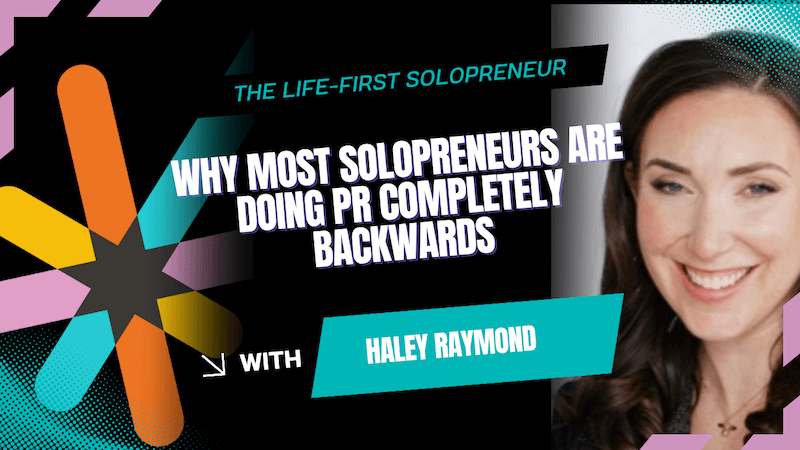
PR for a solopreneur is the practice of building trust and visibility with a specific audience across the channels that audience already uses. It includes media coverage, but it also includes social media, newsletters, podcast appearances, and strategic partnerships. Haley Raymond describes media coverage as one slice of a much larger umbrella, not the whole thing.
Is it true that PR is all about media contacts?
No. Haley says the "I only want someone with the best contacts" mindset is an old-school way of thinking. Relationships still help you get an email opened, but story and strategy now matter more. If someone promises you coverage in a specific outlet before they have even spoken with you about your business, treat that as a red flag.
What should solopreneurs figure out before choosing PR channels?
Two things: your goals and who you are speaking to. Haley says the audience question matters most for solopreneurs because your time is limited and you need the channels that give you the most efficient return. Media consumption tends to split along generational lines, so a business targeting Gen Z will show up in very different places than one targeting baby boomers.
Do solopreneurs have to be on social media?
Not heavily, and not on camera. Haley recommends some baseline presence because people will look you up after meeting you, and you want those first search results to be positive. But you do not need to become an influencer. Posting twice a week with consistency is a reasonable goal for someone who dislikes the platform.
Is legacy media still worth pursuing?
It depends on your audience. Haley defines legacy media as the outlets we think of before the internet, meaning newspapers, magazines, television and radio, plus modern news brands like The New York Times and CNN. For a local or brick-and-mortar business, local television and radio can still be genuinely powerful because you know exactly who you are reaching. For an online or niche business, a targeted podcast or a Substack with an engaged audience will often do more than a national mention.
What is the PESO model?
PESO is a framework created by Gini Dietrich that organizes your visibility into four categories. Paid covers advertising and paid speaking. Earned covers media coverage, podcast interviews and Substack features. Shared covers social media. Owned covers your website and newsletter. Haley says most solopreneurs can skip the paid category entirely and focus on owned channels they control, one or two shared channels done well, and earned opportunities that borrow other people's audiences.
Why did my big media feature not bring in any clients?
Usually because the coverage was treated as a finish line. Haley says the interview is the beginning of the work, not the end. Share it in your newsletter, post it on social, cut it into LinkedIn posts, and send it to prospects who are on the fence. Share it more than once, pulling out different ideas each time. Frame each share around what the audience can take away rather than a simple look at me announcement.
How do you measure PR results without relying on vanity metrics?
Look for movement at specific points in time. Check Google Analytics for traffic spikes after an appearance. Track newsletter signups, social growth and inbound inquiries. Create a unique link for each podcast or outlet so you know exactly where a lead originated. Haley notes that PR builds trust over time, so an upward trend across those numbers is often the earliest honest signal that it is working.
What is the biggest mistake solopreneurs make doing their own PR?
Shiny object syndrome. Haley describes the pattern of starting a TikTok because a relative suggested it, then adding Substack because someone said it was hot. Trying new things is fine, but she recommends auditing whether the time you spend on a channel is producing anything, then doubling down on what actually works for your business.
What are the first steps for a solopreneur with a tiny PR budget?
Start with podcasts your audience already listens to. Actually listen to them before you pitch, then send a short pitch rather than a full biography. Aim for a list of ten. Add local or trade media if your business has a geographic or industry hook. Start a simple monthly newsletter to stay top of mind with past clients, prospects and friends. Keep a minimal but consistent social presence on the one platform where your audience lives.
What is the life-first takeaway from this episode?
Haley's agency days produced a mantra she still uses. It's PR, not the ER. A typo, a late deliverable or an unhappy client is not a medical emergency. Perspective and a little grace go a long way when your business is also your livelihood.
Guest resources
Haley Raymond's website: haleyraymond.com
Haley on LinkedIn
EpisodeTranscript
Carly Ries: Our guest today is Haley Raymond, a PR pro who thinks about publicity the way a good travel agent thinks about a trip. Figure out where you actually wanna go first, then pick how you get there. We cover why landing a huge media feature can still leave you sitting in total silence What you're supposed to do the day after a big win, and the four letter framework that will stop you from launching a TikTok account just because your niece told you to. Plus the best mantra I have heard all year for anyone who has ever spiraled over a typo. It's PR, not the ER.
Let's get into it. You're listening to the Life First Solopreneur, the podcast for those in pursuit of a life first business. I'm Carly Ries, and my cohost Joe Rando and I spend every episode with solopreneurs who are proving there's a better way to run a one person business and experts who are helping make it happen. We like to say life first, then business. So let's get right to it.
Haley, I love talking to PR people because I'm a marketing person. And people often assume that if you know marketing, you know PR and vice versa, and that is simply not true. So every time I talk to a PR expert, I'm like, writing down notes and just soaking it all in. I do have a question for you that's our icebreaker question because I feel like sometimes people will get on their soapbox and be like, do this, do this. And especially on LinkedIn these days, there are all these shoulds. What's a piece of PR advice everyone repeats that just makes you absolutely cringe?
Haley Raymond: Yeah. I agree with you on the LinkedIn thing. so there are quite a few things that I'm like, oh my goodness. But, I think the one thing that bothers me the most is when people, specifically when someone's looking for a PR professional on LinkedIn, and they'll say things like, I only want someone with the best contacts. I only want someone who knows x y and z. And that is kind of an old school way of thinking. yes, relationships are important in PR, and I think it used to be really based on relationships. But now as media is evolving, your story and your strategy is so much more important in my opinion. So I would say as a tip for other solopreneurs that if there's ever someone who's promising you coverage in like Rolling Stone or Forbes, those are just kind of promising that without ever talking to you or meeting you, that's quite a red flag. So, yeah, it is more than just context, especially in today's evolving media landscape. yeah. So just a tip as well.
Carly Ries: It is funny how that evolved. So about fifteen years ago, I was working for an ad agency, and I was on the account service side working with the clients, and I would partner with the PR side. And an intern accidentally sent the head of PR's contact list out to the media list.
Haley Raymond: Oh my goodness.
Carly Ries: To this day, because she basically just shared all the years of relationship building that this woman had focused on. And now I'm just like, that used to be, I mean, it was like a bad intern mistake to do that.
Haley Raymond: It's a nightmare.
Carly Ries: yeah, I wonder if that would have the same impact now that, relationships, as important as they are, but now that there's so much more to it than that. Because this is kinda when companies were just getting on social media and it was like cool to be on Facebook. it's funny that you've seen that pivot too.
Haley Raymond: Yeah. Definitely.
I still would not recommend sending your contact list to anyone, but Yeah. It has changed a lot. It is still important. Relationships just like with any business, are important. get your foot in the door and, get your email opened, but it's not like a be all and end all, I would say.
Carly Ries: Yeah. Well, okay. But what isn't really different is that there are still so many channels, more channels now than back in the day. I feel like it is impossible to keep track of where you could be doing publicity for yourself. What's the first question you ask to cut through the noise when you're working with clients so they can really focus on the right channels and not be so overwhelmed?
Haley Raymond: Yeah. I would say if it can be one question with like two prongs, really what are your goals and who are you speaking to? I think who you're speaking to is probably the most important thing from a channel perspective, especially as a solopreneur because you only have so much time. So it's kind of like what are the channels that are gonna get you the most bang for your buck? what's the most efficient?
So usually how it typically goes is a lot of chance, for example, if your business is targeting gen z, you're likely gonna be on different channels than baby boomers. So it's a lot of media consumption and different channels really often breaks down by gender or generation. So that is just something that I always talk to clients. Because also if you don't really know who you're talking to, that affects a lot of things, kind of like what problem are you solving for your clients? What is your messaging? I think it's like, yes, your goal is important, but for most people your goal is to make money or to increase your visibility. So I think the next most important thing is who am I talking to and how can I target those people efficiently? And how can I make sure that my message is getting to them?
Carly Ries: And you say that PR is bigger than getting in the media. What does that mean? And where do you see a lot of solopreneurs getting this wrong?
Haley Raymond: Yeah. So I think a lot of people think that PR is like, I always think of Samantha Jones from Sex and the City, that she's just like, you know, drinking coffee all day and just networking and talking to journalists and it's all about getting in the media. But now it's more media coverage is just really one part of PR. Like, PR is a much bigger umbrella. So even, social media would technically fit under PR, newsletters, strategic partnerships, all of those things. also the other thing that's really important, I think, for people to know is that, as you said, Carly, there are so many different channels. So as the media evolves, you can't just be on, one media channel anymore. Like you can't just have a few media hits and you're good. Like, you have to be on social. You have to have a website. so, it's really now about creating an ecosystem because people right now get their news from like, I think millennials, they'll check like 11 sources a week as far as where they get their news. So being on just one channel is not enough. You need to be on and I'm not saying you need to be on every channel, but that's just another important thing to think about as far as like people are not just gonna see you in one place. You want to be in multiple different touch points.
Joe Rando: I'd like a clarification? So when you say be on, does that mean, social media that I have this big social media following, or do you mean maybe someone else who has a big social media following somehow interacts with you or, presents something that you've done or whatever? can you clarify on that?
Haley Raymond: That's a good question. So when I say beyond, what I usually, recommend to clients is, obviously, you're gonna have a website. You can have a newsletter. You can do, one or two social channels really well. But you're right that being on other people's channels and targeting other channels, like their audiences, is important as well.
So when I mean on, I mean like podcasts would be an example. you want to be on more than one podcast where you want to be pitching yourself to podcasts. So I would say it's both. I would say having your own channels, but then also using other people's channels to target their audiences.
Joe Rando: I only ask because there are many of us solopreneurs that don't like social media.
Haley Raymond: Yes. I know.
Joe Rando: Really find it's very time consuming. And if you're not the right type, it can be very unproductive. So I'm just wondering, do you have any thoughts around using PR maybe but focusing on places besides social media, or is it really a critical part of the ingredient in your opinion?
Haley Raymond: Yeah. That's a good question. And I've had clients before who are kind of the same, Joe. Like, they don't especially a lot of people are also afraid to, like, show their face on social media. Like, they're cool to, like, type something, but they don't wanna, like, be talking to camera.
So I think it's fine. I mean, I think if you're gen z, I think that's maybe a bigger issue. Like, I think because the young people are always on
Joe Rando: I'm not gen z. Okay. Well, But I think, yeah, like my parents, for example, that's not probably the first place they go. I do think there is value to being on some platform. the biggest one would be Facebook. because it's all people. if you were to go to a networking thing or someone's looking you up, they're gonna Google you.
Haley Raymond: So you want, those first few links to be, positive links about your business. But I would say that you don't have to be, an influencer. because also, I think, as you were asking, there are other things you can do. So one of my clients, they had co authors, had a sports psychology book and we partnered, we did content for mental health charities around sports psychology and mental health of athletes.
And we gave them content that they could use on their own channels. So that was an example of yes. we tapped into their audiences, but it didn't mean that we had to do this whole social media campaign. Like we did have our own social, but it also tapped into other audiences. So you can be kind of creative.
I do think social media is time consuming and it can take time. So I do think if it's also not working for you, you don't have to put in all your time. if networking, like, person to person, or in person is better, then, totally focus on that. It doesn't mean you have to be, an influencer. Right. Cool. Because there are a lot of people, including me, but, the other thing is you can use social media to network. You're not necessarily posting as much as just interacting with people and networking that way. So cool. Thank you.
Carly Ries: And then, Haley, is legacy media, is that like the traditional press release, getting in the news, getting featured in a magazine? Is that what legacy media is?
Haley Raymond: Yeah. So I would define legacy media as what we think of before Internet land. so legacy media would be your magazines, your newspaper, also like a news outlet. So New York Times, for example, is a legacy outlet that they have so many channels now. they're more than just a newspaper. So yeah, I would define legacy media as kind of what we think of the media. but whereas you guys, as a podcast, you're not really legacy media. Even though podcasting has been around for a long time, legacy media is kind of what we think of when we think of media as in, Forbes, New York Times, CNN, those kind of big titles.
Joe Rando: it's what I think of as media from when I grew up.
Haley Raymond: Yeah. Right? Pre circa '94. news, TV news, Newspapers, magazines
Carly Ries: Yeah. So solopreneurs, is it worthwhile for them to go after legacy media, or are they better served doing podcasts? like figuring out one channel or two channels on social media? do you see them spinning spinning their wheels? What am I trying to say, Joe? Kicking their tires. What is it?
Joe Rando: I have spinning their wheels.
Carly Ries: Spinning their wheels. my brain's not working right now. But is it worth it for solopreneurs?
Haley Raymond: I think it comes back to who you're targeting. So I still very much believe in legacy media and believe that there is still a place for it. I also think it's particularly, if you think of local media too, like if your business is very focused on your local community, like you have a store or you're a brick and mortar or you know, I'm trying to think of a solopreneur, you run your business and your business is local to you. I think legacy media, like local TV, local radio can still be very very powerful because you know that you're reaching people in those locations. I would say if you're kind of an online business or you kind of target a specific niche podcast or a fantastic podcast and also Stubstack, which I think is an underrated channel these days.
But, they have a very engaged audience. So I think if you're very niche, say you're all about running, you're probably more likely to go on a running podcast in a Substack about running than your local news. Or you're better to have an interview like this on a running podcast than a mention on CNN or so. That's gonna do more for you As far as moving the needle and making money. what I have found is the niche is, what do people say, niches in the riches
Carly Ries: Niches in the riches. Riches in the niches. Yeah.
Joe Rando: The riches are in the niches.
Haley Raymond: Yes. So that is really where people make the most. but then that being said too, say you are trade media, which is technically like a legacy media. That can also be very powerful.
It's really about where do you want to reach your people and then go from there. So instead of like, I am only gonna do podcasts or I'm only gonna do legacy media, we think of it as more like, where is my audience? And then go from there.
Joe Rando: Makes total sense. If you don't know where your people are, how are you gonna find them? Well, you know who they are, how are you gonna find where they are, I guess is what I'm trying to say.
Haley Raymond: Yeah. Agreed. So walk us through , how would you help someone decide where because solopreneurs have such limited time. do you have a framework of where people, once they figure out who their audience is and all that, where do they go from there? What's next?
Yeah. So usually when I work with clients, I always work with them on what their goals are and who they're targeting. and also their messaging. So messaging is important too. what do you actually want to say?
What do you want people to hear? Like, what do you want them to do? But as far as a framework, I'd say the most used framework from my opinion or from the PR world is the PESO model, which was developed by Ginny Dietrich. So it's not my idea. PESO stands for paid, which we'll come back to. The e is earned, s is shared, and then the o is owned. So it's a good way to look at your whole ecosystem. I would say most solopreneurs don't need to do the paid part. that would be like paid advertising, paid speaking gigs. Earned would be like I think it's like, you want to you wanna have a website so that would be owned, potentially a newsletter to reach people.
And then it all kind of intersects. So say I go on a podcast, I could go on this podcast. I could then share the link to this podcast in my newsletter. I can share it on social. I can, share it with potential clients.
So it all kind of intersects. But I would say from a starting point for most solopreneurs, what I would recommend is having some sort of presence on social. And as I said, you don't have to be a huge influencer. Having a website obviously, having a newsletter even if you don't have a huge mailing list, like just a monthly newsletter to keep you top of mind with prospective clients, previous clients, friends. And then doing things like this, so earned media.
So that would be your legacy media podcasts, substack. And then that kind of all works together as far as a framework. that's what I think sets most people up for success. If they have their own channels that they actually control, like your website or like you guys have a podcast, your newsletter, then you also have channels like social media. And then you also are tapping into other audiences and building trust through things like podcasts and, media interviews.
Carly Ries: Yeah. I like the acronym there. So some people I'm kinda going back to the legacy in their earned media. Some people, get a huge opportunity. And let's say they land in New York Times, or let's say they end up on the Mel Robbins podcast, or whatever.
Haley Raymond: Yeah. That'd be amazing.
Carly Ries: which is great. But then they hear crickets. Like, what are they doing wrong if they land this big spy and then it doesn't do anything for their business?
Haley Raymond: Yeah. That's a good question. I would say if you're on Mel Robbins, I would hope that you would see some lift , like, that would be fantastic. So I'm not saying don't go on those, if you've got a huge opportunity, say yes. But I would say that that is something I find with clients is they do a media interview or they do a podcast episode and then it's like, they think it's done.
But that's really the beginning. So you want to kinda shout it from the rooftop. share it in your newsletter, share it on social media. You can also cut it down into, LinkedIn posts. you can share it in more ways. It also can help with, if you're, trying to, close a client that you can share it with them.
It's like, hey, if you wanna learn more, I was on this podcast yesterday, things like that. So really shout it from the rooftops, especially if it's someone like a Mel Robbins. But really, a podcast is probably about thirty minutes to an hour interview of you just talking. It's a great way for people to learn more about you and hear about you. I would say yeah, share it everywhere. just make sure people know about it.
You can also share it multiple times. Pull out different things that were discussed. I would just say share it. I think people say oh, they share it one time and they're like, oh, I don't wanna look too promotional. But if people are following you, they want to hear from you.
So I think if you share it, share it in a way that you're adding value, You're not just like, look at me, I was on this podcast. It's this is what we talked about, you know, this is what people can take away from it. But yeah, I would say don't be afraid to promote yourself. don't be afraid to share something multiple times.
Carly Ries: I think some people when they think of PR, they're like, yeah, I'll share it. I'll get all this visibility. But visibility can seem so abstract. I think some of the things people like about marketing is you could look at a, let's say a blog post or even just you like a post and see the views. But also, if they have this visibility, they often fall back on vanity metrics.
And they're like, oh, I got This many views and this many likes. And it's like, okay, cool. But if it doesn't tie back to your goals or move the needle, then who cares? So how do you connect a PR strategy back to actual business goals rather than just blasting and getting visibility for visibility's sake?
Haley Raymond: Yeah. And that is something that I still am always trying to do better. I think there are a lot of vanity metrics as you said, because I do think good PR happens over time because you're trying to build trust. And that is not gonna just happen overnight. I know it can be frustrating for people when you don't see those, immediate conversions you know, like you would with, a digital campaign or something like that.
But there are ways to tie it back. I would say things like tracking Google to make sure it's working. So, tracking your Google Analytics. did you see a spike, when you were on a podcast or an immediate interview or tracking traffic on Google Analytics? Like, say you were mentioned, say you had a great feature in a magazine or something else . Is that driving traffic to your website?
Also things like, one of my clients, Amy Sudo, who I believe was on with you guys. So she did a lot of Substack Live interviews, And she actually tracked, who, after those, who signed up for her Substack, and she did notice, which ones were more successful than others. So there are ways to, if you kinda look at it as points in time, like, did you see a spike?
Have you seen, newsletter sign ups? Have you seen social media growth? things that are kind of like measuring metrics to, like, show that your visibility is growing. But then also that there is if you are selling something that people can, automatically sign up for, then that's also you can actually see, is money actually coming in? But also keeping in mind that PR does take some time, it does take a bit to see, a definite ROI, but there are ways that you can see, early signs that it's working and that it's building.
Because if you see, an upward trend in those numbers, then that's a good sign.
Joe Rando: We've seen a few people on this show that give a code, basically, that's their URL with a Slash and then something unique to this podcast. You know, they'll do some you know, Life First or something, and then they know exactly where that lead came from. So we've seen a few people do that. It's think it's a clever idea. Yeah. That's a great idea. Because then you also know, as you said, exactly where it came from. And that's also something you can do fairly simply. you don't have to have, a huge advertising team or something. So, yeah, no, I agree. That's a great idea.
Carly Ries: So there are maybe some listeners right now that are like, this is great and I totally see the value in PR. I'm gonna do it myself because I'm a solopreneur, and I try to do everything by myself until I realize that that's detrimental to my business. But until they get to that point, what mistake do you see solopreneurs make when they try to implement a PR strategy on their own as opposed to outsourcing that to a professional like you?
Haley Raymond: I think the main thing I see is that people try to do too much and they're not clear on their strategy. I don't mean that they're doing that in a wrong way. I think a lot of it's like shiny object syndrome. Like, you can say oh, my niece told me I need to be on TikTok, so I'm gonna start a TikTok. But then I've also heard that Substack's really good, so I'm gonna go on Substack. but I think if you could take a step back and, learn where your people are and you put that effort in, then you're gonna see a better return than just trying all these and it's not bad to try new things. It's more like do it in a strategic way instead of trying to just be on the coolest new channel or something like that. I see people sometimes spending too much time on, social media as you were saying, Joe, or also audit yourself, like, is it actually working? is the time you're putting into social, really are you seeing that back? So just kind of always be thinking strategically instead of just doing what people are telling you to do, really.
It's what is actually working for your business, and then double down on that.
Carly Ries: What would you say for somebody that is doing it on their own, and let's say they don't have any PR experience, and they have a tiny budget because they're just starting out. What are the first one, two, maybe three steps you would recommend they take immediately so they could get going? Besides identifying your audience and things like that.
Haley Raymond: Yeah. So if you know who you wanna talk to and know what you want to say, I do think targeting podcasts like this, finding podcasts, also listening to podcasts. A lot of people say I wanna be on podcasts, but they don't listen to them. So, listen to them and, learn, where your audience is and what they're listening to, and then pitch yourself.
That's one thing I like about PR and, media in general is it's very democratic. anyone can email you guys, whether you want everyone to email you or not, but really anyone could reach out to you and pitch themselves. And my one guidance on that would be to keep it short.
I think some people think they have to put, a huge biography, in their email. So, yeah. I think pitch, maybe start with 10 podcasts. What are 10 podcasts that you think is where your audience is listening to and pitch yourself to those. Because a podcast I think they're unique in that they're leading to other opportunities for people.
So you pitch a podcast. Like, I know you guys now, it's almost a networking opportunity too. I've seen with clients, it has brought them other opportunities or has introduced them to people, within their network who introduced them to someone else. So I think that's a really unique thing with podcasts right now is, it's also something you could share on social. It's something you could share in your newsletter. So in addition to podcasts, I would also if you are local, reach out to your local media about, something cool that you're doing.
And then also a newsletter, I think, is one thing that is very cheap and can be fairly simple to do, a monthly newsletter, just keeping you top of mind for people that already like you or that maybe prospective clients. It's really just a good touch point with people for your name to keep coming up. So those would be the main things. I would say podcasts and local media or kind of like trade media, wherever those niche audiences are, a newsletter.
And I do think some sort of social is important. Even if it's not your, favorite thing to do, even if you post, twice a week, at least try to, get some consistency there, because it's often one of the first places that people go to, check you out. So for you to not have anything , so say you're selling baby products or something, Instagram is, one of the biggest mom destinations. So if you don't have a presence on Instagram, you do want to have a presence there if you're targeting moms. So, I would say some sort of social media presence is important.
But as I said, you don't have to be, talking to the camera all the time or you don't have to be, a huge influencer, for it to still be worth it. Yep. Well, thank goodness for that. Really, this has been so helpful, and I think it'll really help our listeners. I want to end today with a new question that we're asking all of our guests since we are now the Life-First solopreneur. And that is, do you have a Life-First piece of advice for our audience to help them live a Life-First business or create a Life-First business? So yeah. And I'm still working on this myself. Life-First, I think it's gonna be, it can be tricky. I think when I was in the PR agency world, we used to say it's PR, not the ER.
And I say that to myself sometimes when I get stressed about something, or like say I made a typo, or something went a day later than I expected it to, or there's a client that's unhappy about something, if you say it's PR not the ER, it kind of just puts things in perspective. Like you're not saving lives. everyone's still breathing and healthy. So I think sometimes that could just be a good mantra for running a business as well. That sometimes you just have to put it in perspective and know that not everything is gonna go perfectly. And just giving yourself grace.
I think that's what I've been trying to work on. Like not to be so stressed about it all the time that work is only part of life. And that, yeah, you don't want your business to consume everything else in your life.
Carly Ries: What do you guys think, ER doctors say to de stress? Because ER is the ER.
Joe Rando: The same thing, Carly.
Haley Raymond: Yeah.
Carly Ries: Or like, it's not rocket science, but for rocket scientists, it is. I agree for normal people.
Haley Raymond: Yeah. Sure. There's always something
Carly Ries: But for people that aren't a rocket scientist or an ER doctor, I think that's very great advice. Where can people find you if they wanna learn more?
Haley Raymond: Yeah. So the fastest way to find me is on my website. So it's Haley Raymond, and it's h a l e y raymond dot com. And then I also am really most active on LinkedIn. you can find me on LinkedIn. So it's Haley, and there are a billion ways to spell Haley. So it's h a l e y. But, yeah, I'd say LinkedIn probably the place I hang out the most. So feel free to reach out to me.
Carly Ries: Awesome. And we'll include all that stuff in our show notes. But thank you so much for coming on the show today. This is really fun.
Haley Raymond: Thanks for having me. As I said, I'm a super fan, so I'm really excited to be here.
Carly Ries: You heard it folks. And if you are a super fan, please leave us a five star review. We would so appreciate it. Share this episode with a friend, especially one that needs some PR advice.
And don't forget to subscribe to our show on any of your favorite podcast platforms, including YouTube. We'll see you next time on the Life-First Solopreneur. You may be going solo in business, but that doesn't mean you're alone. In fact, millions of people are in your shoes, running a one person business and figuring it out as they go. So why not connect with them and learn from each other's successes and failures?
At LifeStarr, we're creating a one person business community where you can go to meet and get advice from other solopreneurs. Be sure to join in on the conversations at community.lifestarr.com.