


4 min read
The Solopreneur Who Raised His Hourly Rate 17x by Delegating Two Things
 Joe Rando
:
Nov 24, 2026, 7:50:03 AM
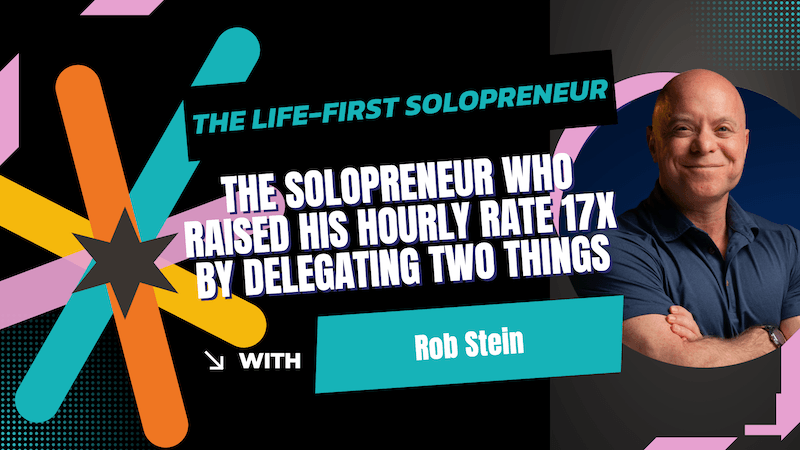
Most successful solopreneurs feel exhausted because of decision fatigue, not because they are working too many hours. According to Rob Stein, feeling overworked is a symptom, and decision fatigue is the root cause. Every email, notification, and small fire that lands on your desk pulls from a limited "decision reserve," and once it's drained, you have nothing left for the work that actually grows your business.
Rob knows this firsthand. A former middle school teacher who once earned $48,000 a year, he went on to build three businesses and earn more than half a million dollars a year. He had the house, the car, and a newborn daughter. He also hadn't taken a day off in two years. During a dinner at their favorite restaurant, his wife told him she always knew when he was thinking about work because he kept his head down, stared at his food, and ate really fast. That was the moment he realized business metrics don't define happiness. The structure of your business does.
What is decision fatigue, and how is it different from being overworked?
Decision fatigue is the mental drain that comes from making too many decisions that are not the highest and best use of your time. Studies estimate the average person makes around 35,000 decisions a day, from which side of the desk to put your coffee on to whether to take a major deal.
Rob points to email as the perfect example. A founder spends the first hour of the day in their inbox and feels wiped out. Email isn't hard, but it forces thousands of tiny decisions that don't need to come from the founder. Other common symptoms include being highly reactive, feeling constantly overwhelmed, and being physically present but mentally absent with family.
Why do solopreneurs misdiagnose decision fatigue?
Solopreneurs misdiagnose decision fatigue because the habits that created their success are the same habits now holding them back. In the early days, grit, long hours, and doing everything yourself are rewarded. So when things start to feel heavy, the brain reaches for more of the same.
As Rob puts it, "You succeed your way to decision fatigue. You don't fail your way there." Instead of fixing the root cause, many founders try a new supplement, a cold plunge, a gratitude journal, or a new organizational system. Those tools treat symptoms. The real question is which decisions should be reaching you in the first place.
What is a decision audit?
A decision audit is a one-week exercise where you document every decision that enters your mind. It's different from a task audit. Even if you've delegated a task, any decision about that task that gets brought back to you still counts, because it still drains your decision reserve. The result is a visual map of every decision flowing to you, and as Rob says, you can't fix something you can't see.
What are the four questions that remove you as the bottleneck?
After the decision audit, Rob runs every decision through four questions.
- Eliminate. Which decisions were necessary before but aren't anymore? One of Rob's clients realized her lowest-value clients, worth $600 to $800 each, took about 30% of her day for roughly 10% of her revenue. Her top clients paid $8,000 to $12,000. She let the low-value clients go, along with every decision attached to them.
- Automate. Which decisions still need to happen but can be handled by technology? Rob says that today, this covers the vast majority of them.
- Delegate. Which decisions need human judgment, just not yours? This can mean handing them to a person, or letting AI do 90% of the work while a human makes the final call.
- Protect. Which decisions must stay with you? For Rob, that's diagnosing a client's business on a consultation call. No one else in his business has that skill.
Rob's key principle is to delegate decisions, not just tasks.
How can solopreneurs use AI agents to manage email?
Rob uses AI agents built with Claude and ChatGPT to sort, draft, and respond to email across eight addresses and two businesses. He creates different skills and assigns them to different agents. Each morning, a digest in Slack shows his calendar and any conflicts. Routine emails are answered automatically. Anything tied to a keynote, consulting engagement, podcast, or client gets drafted and waits in his drafts folder for review. He checks email three times a day in Spark and spends about 15 minutes total.
Do productivity hacks and morning routines help with decision fatigue?
Productivity hacks rarely fix decision fatigue because most of them create more decisions. Which tool, which setting, who manages it? Rob, a former competitive bodybuilder, doesn't have a morning routine at all. He has coffee with his wife, makes breakfast for his family, and starts working. His view is that a morning routine will never outpace the architecture of your business.
What does rebuilding your decision architecture look like?
Rob uses a four-phase, 90-day process.
- Diagnose. Run the decision audit and understand the business model.
- Design. Map out a new, customized decision architecture.
- Implement. Install the new systems through eliminate, automate, delegate, and protect.
- Refine. Adjust what isn't working once the plan meets reality.
The payoff can be dramatic. By delegating just two parts of a project, Rob cut his personal involvement from 80 hours to 4. His per-deal take dropped from $15,000 to about $12,200, but his effective hourly rate jumped from $187 to over $3,000, and he used the time he got back to land more deals.
Key takeaways
- Feeling overworked is a symptom. Decision fatigue is the cause.
- The tools that got you from A to B won't get you from B to C.
- Delegate decisions, not just tasks.
- Run every decision through eliminate, automate, delegate, and protect.
- Business success alone won't make you happy. A well-structured business will.
Frequently asked questions
Can a solopreneur really delegate without a team?
Yes. Rob currently runs his businesses with AI as his only team. AI agents can handle email, scheduling, and drafting, while you stay in the loop on high-value decisions.
How long does a decision audit take?
Rob recommends tracking every decision for one week.
Does structuring your business for happiness limit your income?
No. Rob says he makes more money now than ever because his business is structured properly. Money becomes a byproduct.
Free resources from Rob Stein
Listeners can get Rob's Decision Architecture Blueprint, which includes the six-page Decision Freedom Playbook and a free one-hour diagnostic call with Rob, at solo.robstein.com
Listen to the full episode of The Life-First Solopreneur to hear Rob's complete story and framework.